
DEIR AL-BALAH, Gaza Strip: Saeed Abu Elaish’s wife, two of his daughters and two dozen others from his extended family were killed by Israeli airstrikes over the past 15 months.
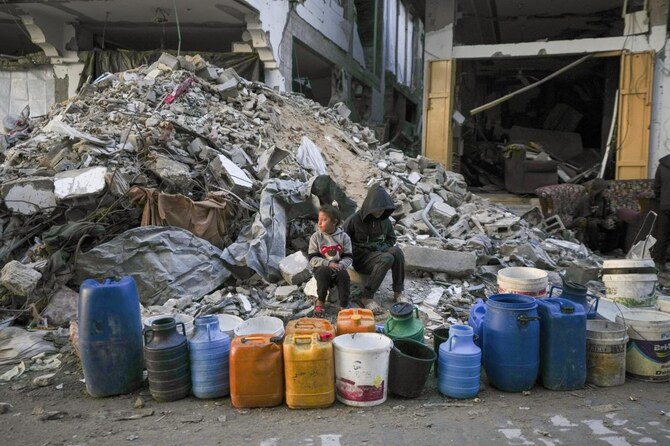
His house in northern Gaza was destroyed. He and surviving family now live in a tent set up in the rubble of his home.
But he says he will not be driven out, after President Donald Trump called for transferring all Palestinians from Gaza so the United States could take over the devastated territory and rebuild it for others. Rights groups said his comments were tantamount to a call for “ethnic cleansing” and forcible expulsion.
“We categorically reject and will resist any plans to deport and transfer us from our land,” he said from the Jabaliya refugee camp.
Trump’s call for depopulating Gaza has stunned Palestinians. Hundreds of thousands in the territory rushed to return to their homes – even if destroyed – as soon as they could following the ceasefire reached last month between Israel and Hamas.
Though some experts speculated that Trump’s proposal might be a negotiating tactic, Palestinians across the region saw in it an effort to erase them completely from their homeland, a continuation of the expulsion and displacement of hundreds of thousands of Palestinians from their homes in what is now Israel during the 1948 war surrounding its creation.
That event is known among Palestinians as the “Nakba,” Arabic for the “Catastrophe.” Trump’s statement — a wild swing away from years of US policy — meshed with calls from far-right politicians in Israel to push Palestinians out of Gaza, particularly into Egypt.
“We don’t want a repeat of our ancestors’ tragedy,” said Abu Elaish, a health care worker.
Like many, Abu Elaish could point to his own family’s experience. In May 1948, Israeli forces expelled his grandparents and other Palestinians and demolished their homes in the village of Hoj in what’s now southern Israel just outside the Gaza Strip, he said. The family resettled in Gaza’s Jabaliya camp, which over the decades grew into a densely built urban neighborhood. Israeli troops leveled most of the district during fierce fighting with Hamas militants over recent months.
Mustafa Al-Gazzar was 5 years old, he said, when his family and other residents were forced to flee as Israeli forces in 1948 attacked their town of Yabneh in what is now central Israel.
Now in his 80s, he sat outside his home in the southern Gaza city of Rafah, flattened by an airstrike, and said it was unthinkable to go after surviving 15 months of war.
“Are you crazy, you think I would leave?” he said. “You think you’ll expel me abroad and bring other people in my place? … I would rather live in my tent, under rubble. I won’t leave. Put that in your brain.”
“Instead of being sent abroad, I should return to my original land where I was born and will die,” he said, referring to Yabneh, located near what is now the central Israeli city of Yavneh. He said Trump should be seeking a two-state solution. “This is the ideal, clear solution, peace for the Israelis and peace for the Palestinians, living side by side,” he said.
In his comments Tuesday alongside visiting Israeli Prime Minister Benjamin Netanyahu, Trump said Palestinians from Gaza should be resettled in lands in Egypt, Jordan or elsewhere, promising them a “beautiful place.” Egypt and Jordan have both rejected Trump’s call to resettle Palestinians on their soil.
Trump said the US would take over Gaza and rebuild it into a “Riviera of the Middle East” for “the world’s people,” dismissing the idea that Palestinians would refuse to leave or want to return.
Amna Omar, a 71-year-old from the central Gaza town of Deir Al-Balah, called Trump a “madman.”
Omar was able to go to Egypt during the war after her husband was diagnosed with pancreatic cancer. In Cairo, doctors told them his cancer had gone untreated for too long and he died in October.
She said she intends to go back home as soon as she can, as did other Palestinians in Egypt.
“Gaza is our land, our home. We as Gazans have the right to the land and want to rebuild it,” she said. “I don’t want to die in Egypt like my husband. I want to die at home.”
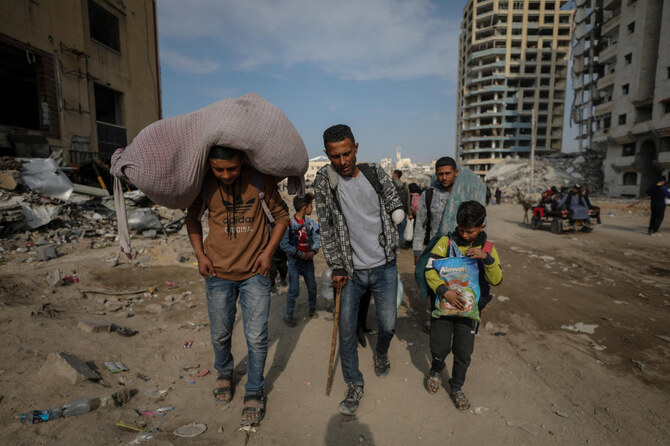
Palestinians have shown a powerful determination to return to their homes after nearly the entire population was displaced by the war. Joyous crowds streamed back to northern Gaza and Rafah, both of which were devastated by Israeli bombardment and ground offensives.
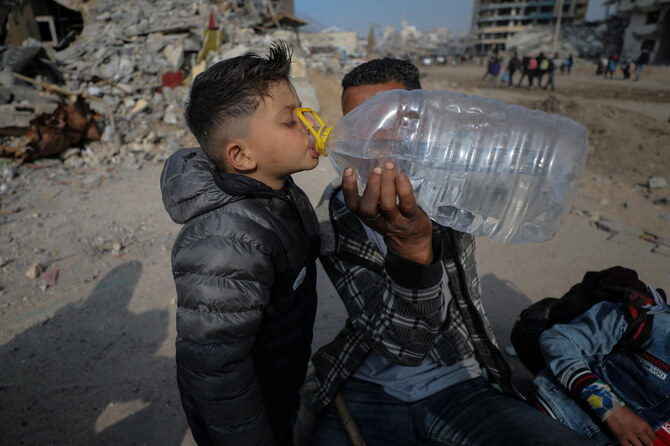
With their neighborhoods reduced to landscapes of rubble, many returnees are homeless, water is scarce and electricity is largely non-existent in most areas. Still, for most, the destruction has not diminished their will to stay.
“We remain here, even if it means living in the rubble of our homes — better that than living in humiliation elsewhere,” said Ibrahim Abu Rizk, who returned to Rafah to find his home in ruins. “For a year and a half, we have been slaughtered, bombed, and destroyed, only to then leave just like that?”
The ceasefire deal brokered by the US, Egypt and Qatar, calls for a return of Palestinians to their homes as well as a massive international reconstruction effort in its third phase – assuming Israel and Hamas can reach a deal on who will govern the territory.
International law forbids the forced removal of populations. The Israeli rights group B’tselem said Trump’s statement “constitutes a call for ethnic cleansing through uprooting and forcibly transferring some 2 million people. This is Trump and Netanyahu’s roadmap for a second Nakba of Palestinians in the Gaza Strip.”
Palestinian refugees have long demanded they be allowed to return to homes in what is now Israel, citing the right to return widely recognized for refugees under international law. Israel argues that right does not apply to the Palestinians and says a mass return would end the Jewish majority in the country.
Throughout the 15-month war in Gaza, many Palestinians expressed fear that Israel’s goal was to drive the population into neighboring Egypt. The government denied that aim, though some hard-right members of the coalition called for encouraging Palestinians to leave Gaza and for restoring Jewish settlements there. The Israeli-occupied West Bank — home to more than 500,000 settlers — has also seen more than a year of escalated violence.
The rejection of Trump’s call was echoed by Palestinians in the West Bank and in surrounding Arab countries like Jordan and Lebanon that are also home to large refugee populations.
“If he wants to displace the population of Gaza,” Mohammed Al-Amiri, a resident in the West Bank city of Ramallah, said of Trump, “then he should return them to their original homeland from which they were displaced in 1948, inside Israel, in the depopulated villages.”