

Saudi Arabia says no to displacement of Gazans, rejects relations with Israel without Palestinian state

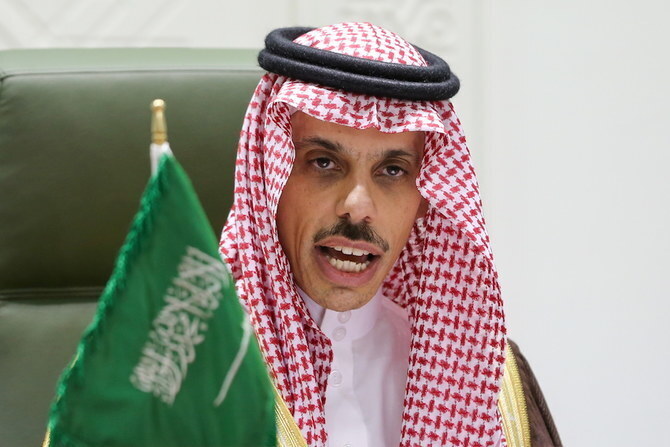
Saudi Foreign Minister Prince Faisal bin Farhan addresses the 162nd regular session of the Arab League in Cairo, Egypt, on September 10, 2024. (KSA MOFA/File)
Short Url
Updated 05 February 2025
Follow

Saudi Arabia says no to displacement of Gazans, rejects relations with Israel without Palestinian state

  • Statement comes after President Trump hinted at US ownership of Gaza after Palestinian displacement
  • Trump insists Egypt and Jordan will have to take the displaced Gazans, with both states rejecting the idea

RIYADH: Saudi Arabia on Wednesday said its long-held position that Palestinians must have their own independent state was firm and not open to negotiation, a stance Crown Prince Mohammed bin Salman has reiterated many times before.

The Saudi Foreign Ministry statement came shortly after President Donald Trump said he wants the US to own the Gaza Strip after all Palestinians are displaced from there and sent to other countries, where settlements will be constructed for them.

The Kingdom’s position has been a longstanding one with its leaders repeatedly calling for justice for Palestinians, who they say deserve a state of their own alongside Israel as a way to find a lasting solution to the decades long conflict.

Saudi leaders have repeatedly said any formal relations between the Kingdom and Israel hinge on the creation of a viable Palestinian state on the 1967 borders.

The ministry statement highlighted a speech by the crown prince at the Shoura Council on September 18, 2024, where he stressed that Saudi Arabia will continue its tireless work toward the establishment of an independent Palestinian state with East Jerusalem as its capital, adding the Kingdom will not normalize ties with Israel without it.

The crown prince expressed a similar sentiment during the extraordinary Arab-Islamic summit in Riyadh on Nov. 11, 2024, where he stressed the continuation of efforts to establish a Palestinian state and demanded an end to Israeli occupation of the Palestinian territories.

He also urged more countries to recognize the State of Palestine, stressing the importance of mobilizing the international community to support the rights of Palestinians, which were expressed in the resolutions of the UN General Assembly by considering Palestine eligible for full membership of the world body.

“The Kingdom of Saudi Arabia also stresses its previously announced categorical rejection of any violation of the legitimate rights of the Palestinian people, whether through Israeli settlement policies, annexation of Palestinian territories, or attempts to displace the Palestinian people from their land,” the statement added.

Trump, standing next to Prime Minister Benjamin Netanyahu at the White House on Tuesday, said the Palestinians would be better off living outside of Gaza which has been bombed to rubble during Israel’s brutal 15-month attack.

“I don’t think people should be going back,” Trump said. “You can’t live in Gaza right now. I think we need another location. I think it should be a location that’s going to make people happy.”

The president insists Egypt and Jordan would have to take the Gazans he plans to displace. Both countries have rejected the idea outright.

Trump also did not rule out the use of American troops to help reconstruct the enclave and ensure the ownership of the territory, which he said could become the “Riviera of the Middle East,” given its temperate climate and prime location on the Mediterranean coast.

The Kingdom said that it’s the international community’s duty to work to alleviate the severe human suffering of the Palestinian people, who will remain in their land.

“Lasting and just peace cannot be achieved without the Palestinian people obtaining their legitimate rights in accordance with international legitimacy resolutions, and this is what was previously explained to the previous and current American administrations,” the ministry statement said.

Lebanese man flees hometown, months after repairing home damaged in last war

Updated 3 sec ago
Follow

Lebanese man flees hometown, months after repairing home damaged in last war

  • Lebanese man rebuilt home four times but fled new war
  • Many in Lebanon ‌were still recovering from 2024 conflict
HAZMIEH: Just days ago, Hussain Khrais was proudly showing off his newly restored home in south Lebanon, fixed up after ​being badly damaged in 2024 clashes between Israel and Hezbollah. But a new war has since erupted and his home is in the line of fire again.
Khrais fled his hometown of Khiyam, about five km (three miles) from the border with Israel, as Israel pounded Lebanon with heavy airstrikes last week in retaliation for Iran-backed group Hezbollah’s rocket and drone fire into Israel.
“Is the house I worked so hard to build, or the business I started, still there? Or is it all gone?” Khrais told Reuters from a relative’s home near the capital Beirut where he and his family are now staying.
“The feeling is ‌very, very upsetting, ‌because we still don’t know if we’ll go back or not.”
’WHAT ​KIND ‌OF ⁠LIFE IS ​THAT?’
It ⁠wasn’t Khrais’ first time — or even his second. The 66-year-old has been displaced at least four times in the last four decades by Israeli incursions and airstrikes, each time returning to a town in ruins and rebuilding patiently.
Last year, he spent months and around $25,000 repairing the damage from the last war between Hezbollah and Israel, which ended 15 months ago. Hezbollah started firing at Israel after the United States and Israel launched airstrikes against Iran on February 28.
“It really bothers me to think this is the life I’ve lived,” Khrais told Reuters. “Once ⁠again, displacement, return, rebuilding, restoration — then again displacement, return, rebuilding. What kind of life ‌is that?“
With no support from the Lebanese state and ‌little coming from Hezbollah’s social welfare program, most Lebanese whose homes were ​damaged or destroyed in the 2024 war have ‌used their own private funds to rebuild.
Reconstruction has placed a huge burden on affected Lebanese families, still ‌struggling to access their savings in commercial banks after a financial collapse in 2019.
Two weeks ago, Khrais had told Reuters he was scared that a new war would start. “I’m at an age where I can’t start all over again. That’s it,” he said.
’WORTH THE WORLD’S TREASURES’
The new war has dealt Lebanese another blow. About 300,000 people have ‌been displaced over the last week by Israel’s strikes and by the Israeli military’s evacuation orders, which encompass around 8 percent of Lebanese territory.
Khrais is staying ⁠with around 20 other ⁠displaced relatives, some displaced from Khiyam and others from Beirut’s southern suburbs, which have been hit hard by Israeli strikes.
He is glued to the television, where news bulletins have reported on Israeli troops and tanks pushing deeper into his hometown.
“I’ve been in Beirut for four days now, and these four days feel like 400 years,” Khrais said.
He misses his house dearly.
“Maybe the thing I’m most attached to, is when I open the door to my children’s bedrooms and see the pictures of their children hanging on the walls,” he said.
“That sight is worth the world’s treasures — to see my grandchildren’s pictures in Khiyam.”
Khrais has no news on the state of his home. He said he remains hopeful but that if it has been destroyed, he’ll still do what he’s always done.
“The big shock would be if I ​came back and didn’t find it. But my ​feeling says no, God willing, it will remain. And like I said, even if we don’t find the house, we’ll go back and rebuild,” he said.