Trial of man in Salman Rushdie stabbing begins with jury selection

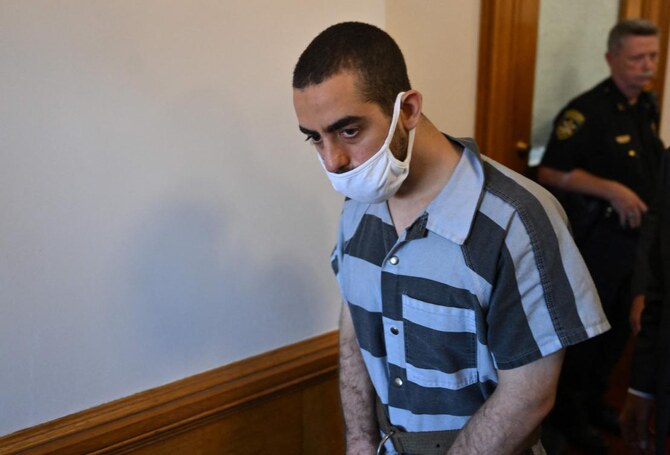
Hadi Matar, the man accused in the attempted murder of British author Salman Rushdie, leaves court after a procedural hearing at Chautauqua County Courthouse in Mayville, New York on Aug. 18, 2022. (AFP)
Short Url
Updated 04 February 2025
Follow

Trial of man in Salman Rushdie stabbing begins with jury selection

  • Matar has pleaded not guilty to charges of second-degree attempted murder and second-degree assault
  • Matar’s trial has been delayed twice, most recently after his defense lawyer unsuccessfully tried to move it to a different venue

NEW YORK: The trial of the man charged with attempting to murder the novelist Salman Rushdie at a New York lecture is due to begin on Tuesday with jury selection.
Hadi Matar, 26, can be seen in cellphone videos rushing the stage at the Chautauqua Institution in western New York in August, 2022, as Rushdie was being introduced to the audience. Rushdie, 77, was stabbed with a knife multiple times in an attack that led to the loss of his right eye and damaged his liver.
Matar has pleaded not guilty to charges of second-degree attempted murder and second-degree assault. Rushdie, who has faced death threats since the 1988 publication of his novel “The Satanic Verses,” is due to be among the first witnesses to testify at the trial.
Rushdie has published a memoir about the attack, and said in interviews he believed he was going to die on the Chautauqua Institution’s stage.
Rushdie, who was raised in a Muslim Kashmiri family, went into hiding under the protection of British police in 1989 after Ayatollah Ruhollah Khomeini, then Iran’s supreme leader, pronounced “The Satanic Verses” to be blasphemous. Khomeini’s fatwa, or religious edict, called upon Muslims to kill the novelist and anyone involved in the book’s publication, leading to a multi-million-dollar bounty.
The Iranian government said in 1998 it would no longer back the fatwa, and Rushdie ended his years as a recluse, becoming a fixture of literary parties in New York City, where he lives.
After the attack, Matar told the New York Post that he traveled from his home in New Jersey after seeing the Rushdie event advertised because he disliked the novelist, saying Rushdie had attacked Islam. Matar, a dual citizen of his native US and Lebanon, said in the interview that he was surprised that Rushdie survived, the Post reported.
Matar’s trial has been delayed twice, most recently after his defense lawyer unsuccessfully tried to move it to a different venue, saying Matar could not get a fair trial in Chautauqua. The trial is being held at the Chautauqua County Court in Mayfield, a town of about 1,500 people near the Canadian border. If convicted of attempted murder, Matar faces a maximum sentence of 25 years in prison.
Matar is also facing federal charges in which prosecutors in the US attorney’s office in western New York accused him of attempting to murder Rushdie as an act of terrorism and of providing material support to the armed group Hezbollah in Lebanon, which the US has designated as a terrorist organization.


Unprecedented gagging order over Afghan data breach should have been avoided, former secretary says

Updated 5 sec ago
Follow

Unprecedented gagging order over Afghan data breach should have been avoided, former secretary says

  • Ben Wallace tells MPs that he had ordered time-limited injunction to protect lives of Afghan veterans
  • Sensitive details of thousands was leaked via email mistake because ‘someone didn’t do their job’ 

LONDON: The former UK defense secretary has said he would not have proposed a secret gagging order to conceal the catastrophic data breach that threatened the lives of thousands of Afghans.

Ben Wallace told MPs on Tuesday that he had ordered a time-limited injunction to protect the news of the data leak, The Independent reported.

At the time, in mid-2023, the Ministry of Defence had scrambled the learn the source of the leak, which took place when an official accidentally emailed a sensitive spreadsheet containing Afghans’ contact details outside of the ministry.

It led to the publication of the identities of thousands of Afghans who had served alongside British forces during the war against the Taliban, placing them at risk of reprisal.

They were secretly relocated to the UK, and the leak was only revealed to the British public when a High Court judge lifted a superinjunction last year.

It followed a longtime lobbying effort by The Independent and other news organizations to have the details of the leak released.

Wallace told MPs: “We are not covering up our mistakes. The priority is to protect the people in Afghanistan and then open it up to the public. We need to say a certain amount are out of danger.”

On the indefinite injunction, he added: “I didn’t think it was the right thing to do; I didn’t think it was necessary.

“I said, ‘we’re not doing that.’ The only thing we’re going to do, is we need to basically hold off in public until we get to the bottom of the threat these people are under. I said we won’t cover up our mistakes; we’ll talk about them.”

The rules surrounding a superinjunction forbid even mentioning its existence.

Wallace said: “You can have an injunction, I think, without reporting the contents … a superinjunction; my understanding is you can’t even say there’s an injunction. I think I would never have been in that space. Public bodies are accountable. If necessary you could even ring up the journalist and say ‘please hold off, people are at risk.’ Most journalists don’t want to put people at risk.”

The superinjunction was applied by a judge shortly after Wallace had left government.

It came after the MoD applied to the High Court for a regular injunction.

Grant Shapps, the subsequent defense secretary, then maintained the gagging order until the 2024 general election, when the Labour opposition took government.

Wallace blamed the 2022 breach on negligence, adding: “Someone didn’t do their job.”

The former defense secretary had implemented new checking procedures in the ministry after another Afghan data breach, but that “that clearly didn’t happen on this occasion; someone clearly didn’t do their job,” he told MPs.

Wallace said that military and defense spending is not a priority for voters, “partly because they don’t know” the true nature of the threat facing Britain.