

UK to set up council for Islamophobia definition

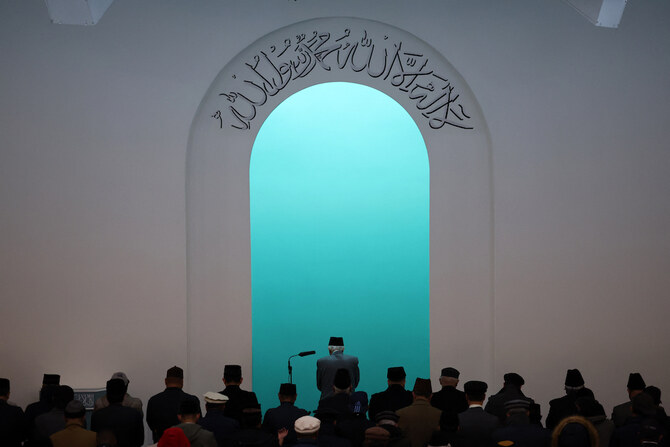
Members of the Ahmadiyya Muslim Community pray at the Baitul Futuh Mosque in southwest London on April 15, 2023. (AFP)
Short Url
Updated 04 February 2025
Follow

UK to set up council for Islamophobia definition

  • Deputy PM to establish body to advise government on areas relating to anti-Muslim hate
  • Conservative ex-minister tipped to head council after working on previous definition

LONDON: The UK is planning to establish a council to offer advice to the government and discuss matters relating to Islamophobia.

The council, to be set up by Deputy Prime Minister Angela Rayner, will have 16 members. Among its duties will be helping provide a new official definition of Islamophobia in the UK.

Former Conservative Minister Dominic Grieve is thought to have been recommended to lead the council, having previously chaired the Citizens’ UK Commission on Islam.

Qari Asim, a Leeds-based imam who previously worked as an advisor to the government, has also been shortlisted to join the council.

Grieve wrote a forward to a 2018 all-party parliamentary group report which established an Islamophobia definition subsequently adopted by the Labour Party.

The all-party Islamophobia report determined that “Islamophobia is rooted in racism and is a type of racism that targets expressions of Muslimness or perceived Muslimness.”

Grieve said he “greatly welcomed” the report in his forward, adding that it “makes an important contribution to the debate as to how Islamophobia can best be addressed. It is well researched and can give all of us food both for thought and positive action.”

He told the Daily Telegraph that he had not yet been approached to lead the new council, but added: “If I can be of assistance in doing something constructive requested by any government on a non-party political basis I am willing to consider it. It depends on what it is and whether I can add value and help the wider public service.”

On the report’s definition of Islamophobia, he said: “It was apparent at the time that defining Islamophobia is extremely difficult for perfectly valid reasons relating to freedom of expression.”

Grieve added: “Perfectly law-abiding Muslims going about their business and well integrated into society are suffering discrimination and abuse.”

The Daily Telegraph reported that Rayner is looking to establish a similar council on antisemitism, alongside plans to widen reporting of anti-Muslim and anti-Jewish non-crime hate incidents in the UK.

A spokesman for Rayner’s department told the newspaper: “All forms of religious and racial hatred have absolutely no place in our society. The Government engages regularly with faith communities to help foster strong working relationships and we are actively exploring a more integrated and cohesive approach to tackling racial and religious hatred, including Islamophobia and anti-Semitism. Further details of this work will be set out shortly.”


Treason trial of South Sudan’s suspended VP is further eroding peace deal, UN experts say

Updated 5 sec ago
Follow

Treason trial of South Sudan’s suspended VP is further eroding peace deal, UN experts say

  • The experts said forces from both sides are continuing to confront each other across much of the country
  • “Years of neglect have fragmented government and opposition forces alike,” the experts said

UNITED NATIONS: The treason trial of South Sudan’s suspended vice president is further eroding a 2018 peace agreement he signed with President Salva Kiir, UN experts warned in a new report.
As Riek Machar’s trial is taking place in the capital, Juba, the experts said forces from both sides are continuing to confront each other across much of the country and there is a threat of renewed major conflict.
UN peacekeeping chief Jean-Pierre Lacroix told the UN Security Council last month that the crisis in South Sudan is escalating, “a breaking point” has become visible, and time is running “dangerously short” to bring the peace process back on track.
There were high hopes when oil-rich South Sudan gained independence from Sudan in 2011 after a long conflict, but the country slid into a civil war in December 2013 largely based on ethnic divisions, when forces loyal to Kiir, an ethnic Dinka, battled those loyal to Machar, an ethnic Nuer.
More than 400,000 people were killed in the war, which ended with the 2018 peace agreement that brought Kiir and Machar together in a government of national unity. But implementation has been slow, and a long-delayed presidential election is now scheduled for December 2026.
The panel of UN experts stressed in a report this week that the political and security landscape in South Sudan looks very different today than it did in 2018 and that “the conflict that now threatens looks much different to those that came before.”
“Years of neglect have fragmented government and opposition forces alike,” the experts said, “resulting in a patchwork of uniformed soldiers, defectors and armed community defense groups that are increasingly preoccupied by local struggles and often unenthused by the prospect of a national confrontation. ”
With limited supplies and low morale, South Sudan’s military has relied increasingly on aerial bombings that are “relatively indiscriminate” to disrupt the opposition, the experts said.
In a major escalation of tensions in March, a Nuer militia seized an army garrison. Kiir’s government responded, charging Machar and seven other opposition figures with treason, murder, terrorism and other crimes.
The UN experts said Kiir and his allies insist that, despite having dismissed Machar, implementation of the peace agreement is unaffected, pointing to a faction of the opposition led by Stephen Par Kuol that is still engaged in the peace process.
Those who refused to join Kuol and sided with Machar’s former deputy, Natheniel Oyet, “have largely been removed from their positions, forcing many to flee the country,” the experts said in the report.
The African Union, regional countries and the Intergovernmental Authority on Development, or IGAD, have all called for Machar’s release and stressed their strong support for implementation of the 2018 agreement, the panel said.
According to the latest international assessment, 7.7 million people — 57 percent of the population — face “crisis” levels of food insecurity, with pockets of famine in some communities most affected by renewed fighting, the panel said.