Hundreds flee Santorini as quakes disrupt life

1 / 3
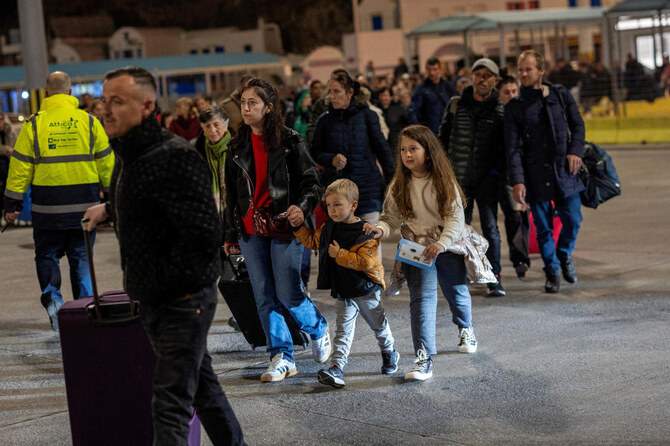
People board a ferry to Piraeus, following an increase in seismic activity on the island of Santorini, Greece, February 4, 2025. (Reuters)
2 / 3
Cars line up as people wait to board a ferry to Piraeus, following an increase in seismic activity on the island of Santorini, Greece, February 4, 2025. (Reuters)
3 / 3
People board a ferry to Piraeus, following an increase in seismic activity on the island of Santorini, Greece, February 4, 2025. (Reuters)
Short Url
Updated 04 February 2025
Follow

Hundreds flee Santorini as quakes disrupt life

SANTORINI: Hundreds of people packed a port in Santorini in the early morning hours of Tuesday to board a ferry and reach safety in Athens as a series of quakes kept shaking the famous Greek tourist island.
Hundreds of quakes have been registered every few minutes in the sea between the volcanic islands of Santorini and Amorgos in the Aegean Sea since Friday, prompting authorities to shut schools in Santorini and the small nearby islands of Ios, Amorgos and Anafi until Friday.
A tremor with a magnitude of 4.7 was recorded by the European Mediterranean Seismological Center (EMSC) at 0653GMT on the island most of whose popular white and blue villages cling to steep cliffs over the sea.
“Everything is closed. No one works now. The whole island has emptied,” said Dori, a 18-year-old local resident who declined to give his last name, before boarding the ferry to Athens.
“We will go to Athens until we see how things develop here.”
More people were expected to fly out on an additional flight on Tuesday.
With seismologists estimating that the intense seismic activity could take days or weeks to abate, people were advised to stay out of coastal areas due to the risk of landslides and avoid indoor gatherings.
Some hotels started emptying their pools as they were told that the water load made buildings more vulnerable.
Greece is one of the most earthquake-prone countries in Europe as it sits at the boundary of the African and Eurasian tectonic plates whose constant interaction prompts frequent quakes.
Santorini took its current shape following one of the largest volcanic eruptions in history, around 1600 BC. The last eruption in the area occurred in 1950.


Germany plays down threat of US invading Greenland after talks

Updated 13 January 2026
Follow

Germany plays down threat of US invading Greenland after talks

WASHINGTON: Germany’s top diplomat on Monday played down the risk of a US attack on Greenland, after President Donald Trump’s repeated threats to seize the island from NATO ally Denmark.
Asked after meeting Secretary of State Marco Rubio about a unilateral military move by Trump, German Foreign Minister Johann Wadephul said: “I have no indication that this is being seriously considered.”
“Rather, I believe there is a common interest in addressing the security issues that arise in the Arctic region, and that we should and will do so,” he told reporters.
“NATO is only now in the process of developing more concrete plans on this, and these will then be discussed jointly with our US partners.”
Wadephul’s visit comes ahead of talks this week in Washington between Rubio and the top diplomats of Denmark and Greenland, which is an autonomous territory of Denmark.
Trump in recent days has vowed that the United States will take Greenland “one way or the other” and said he can do it “the nice way or the more difficult way.”
Greenland’s government on Monday repeated that it would not accept a US takeover under “any circumstance.”
Greenland and NATO also said Monday that they were working on bolstering defense of the Arctic territory, a key concern cited by Trump.
Trump has repeatedly pointed to growing Arctic activity by Russia and China as a reason why the United States needs to take over Greenland.
But he has also spoken more broadly of his desire to expand the land mass controlled by the United States.