

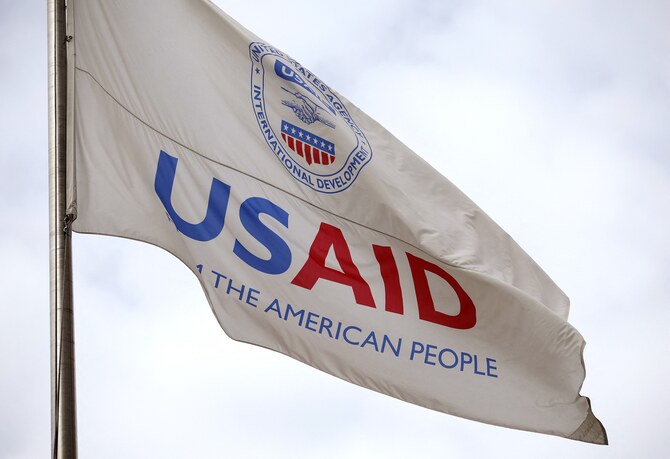

WASHINGTON: Dozens of senior officials put on leave. Thousands of contractors laid off. A freeze put on billions of dollars in humanitarian assistance to other countries.
Over the last two weeks, President Donald Trump’s administration has made significant changes to the US agency charged with delivering humanitarian assistance overseas that has left aid organizations agonizing over whether they can continue with programs such as nutritional assistance for malnourished infants and children.
Then-President John F. Kennedy established the US Agency for International Development, known as USAID, during the Cold War. In the decades since, Republicans and Democrats have fought over the agency and its funding.
Here’s a look at USAID, its history and the changes made since Trump took office.
What is USAID?
Kennedy created USAID at the height of the United States’ Cold War struggle with the Soviet Union. He wanted a more efficient way to counter Soviet influence abroad through foreign assistance and saw the State Department as frustratingly bureaucratic at doing that.
Congress passed the Foreign Assistance Act and Kennedy set up USAID as an independent agency in 1961.
USAID has outlived the Soviet Union, which fell in 1991. Today, supporters of USAID argue that US assistance in countries counters Russian and Chinese influence. China has its own “belt and road” foreign aid program worldwide operating in many countries that the US also wants as partners.
Critics say the programs are wasteful and promote a liberal agenda.
What’s going on with USAID?
On his first day in office Jan. 20, Trump implemented a 90-day freeze on foreign assistance. Four days later, Peter Marocco — a returning political appointee from Trump’s first term — drafted a tougher than expected interpretation of that order, a move that shut down thousands of programs around the world and forced furloughs and layoffs.
Secretary of State Marco Rubio has since moved to keep more kinds of strictly life-saving emergency programs going during the freeze. But confusion over what programs are exempted from the Trump administration’s stop-work orders — and fear of losing US aid permanently — is still freezing aid and development work globally.
Dozens of senior officials have been put on leave, thousands of contractors laid off, and employees were told Monday not to enter its Washington headquarters. And USAID’s website and its account on the X platform have been taken down.
It’s part of a Trump administration crackdown hitting the federal government and its programs. But USAID and foreign aid are among those hit the hardest.
Rubio said the administration’s aim was a program-by-program review of which projects make “America safer, stronger or more prosperous.”
The decision to shut down US-funded programs during the 90-day review meant the US was “getting a lot more cooperation” from recipients of humanitarian, development and security assistance, Rubio said.

US billionaire Elon Musk arrives for the inauguration ceremony before Donald Trump is sworn in as the 47th US President, Jan. 20 (AFP)
What do critics of USAID say?
Republicans typically push to give the State Department — which provides overall foreign policy guidance to USAID — more control of its policy and funds. Democrats typically promote USAID autonomy and authority.
Funding for United Nations agencies, including peacekeeping, human rights and refugee agencies, have been traditional targets for Republican administrations to cut. The first Trump administration moved to reduce foreign aid spending, suspending payments to various UN agencies, including the UN Population Fund and funding to the Palestinian Authority.
In Trump’s first term, the US withdrew from the UN Human Rights Council and its financial obligations to that body. The US is also barred from funding the UN agency for Palestinian refugees, or UNRWA, under a bill signed by then-President Joe Biden last March.
Why is Elon Musk going after USAID?
Musk’s Department of Government Efficiency, known as DOGE, has launched a sweeping effort empowered by Trump to fire government workers and cut trillions in government spending. USAID is one of his prime targets. Musk alleges USAID funding has been used to launch deadly programs and called it a “criminal organization.”
What is being affected by the USAID freeze?
Sub-Saharan Africa could suffer more than any other region during the aid pause. The US gave the region more than $6.5 billion in humanitarian assistance last year. HIV patients in Africa arriving at clinics funded by an acclaimed US program that helped rein in the global AIDS epidemic of the 1980s found locked doors.
There are also already ramifications in Latin America. In southern Mexico, a busy shelter for migrants has been left without a doctor. A program to provide mental health support for LGBTQ+ youth fleeing Venezuela was disbanded.
In Colombia, Costa Rica, Ecuador, and Guatemala, so-called “Safe Mobility Offices” where migrants can legally apply to enter the US have been shuttered.
The aid community is struggling to get the full picture— how many thousands of programs have shut down, and how many thousands of workers were furloughed and laid off under the freeze?
How much does the US spend on foreign aid?
In all, the US spent about roughly $40 billion in foreign aid in the 2023 fiscal year, according to a report published last month by the nonpartisan Congressional Research Service.
The US is the largest provider of humanitarian assistance globally, although some other countries spend a bigger share of their budget on it. Foreign assistance overall amounts to less than 1 percent of the US budget.
Could Trump dissolve USAID on his own?
Democrats say presidents lack the constitutional authority to eliminate USAID. But it’s not clear what would stop him from trying.
A mini-version of that legal battle played out in Trump’s first term when he tried to cut the budget for foreign operations by a third.
When Congress refused, the Trump administration used freezes and other tactics to cut the flow of funds already appropriated by Congress for foreign programs. The General Accounting Office later ruled that it violated a law known as the Impoundment Control Act.
It’s a law we may be hearing more of.
“Live by executive order, die by executive order,” Musk said on X Saturday in reference to USAID.


