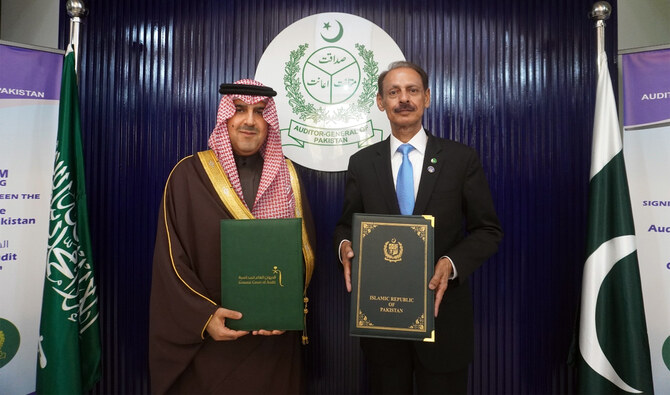
ISLAMABAD: Pakistan and Saudi Arabia have signed a Memorandum of Understanding (MoU) to increase collaboration in public sector auditing through enhanced cooperation between audit institutions of both countries as well as training programs and the exchange of trainers, a spokesperson for the Auditor-General of Pakistan’s (AGP) office said on Monday.
The development comes during a four-day visit to Pakistan by a delegation of Saudi Arabia’s General Court of Audit (GCA), led by GCA President Dr. Hussam bin Abdulmohsen Alangari, which arrived on Sunday.
The agreement was signed during AGP Muhammad Ajmal Gondal’s meeting with the Saudi delegates, aiming to strengthen audit cooperation, enhance knowledge-sharing, and improve governance, transparency and accountability in government spending.
Muhammad Raza Irfan, a public relations officer at the AGP’s office, told Arab News the agreement will not only strengthen professional relations between auditing institutions of both countries, but also further promote bilateral cooperation between Pakistan and Saudi Arabia.
“This collaboration marks a significant step toward fostering international cooperation in auditing,” AGP Gondal was quoted as saying in a statement issued from his office.
“The exchange of ideas and methodologies will undoubtedly strengthen our capacity to meet emerging challenges and set new benchmarks for public accountability.”
Discussions at Monday’s meeting focused on fostering closer ties between the Supreme Audit Institutions (SAIs) of Pakistan and Saudi Arabia, sharing innovative audit methodologies, and planning collaborative initiatives for the future, according to the AGP office.
The two sides agreed to share best practices in audit standards, performance audits, and citizen participatory audits, and expand expertise in thematic, environmental and impact audits.
“It also agreed to collaborate on training programs, exchange trainers, address emerging auditing challenges and plan cooperative audits, including a performance audit on the oil and gas sector in 2025,” the statement read.
Both sides reaffirmed their shared commitment to promoting transparency, accountability and excellence in public sector auditing.
Dr. Alangari praised Pakistan’s initiatives in modernizing audit practices and expressed his enthusiasm for future collaborations, according to the AGP office.
“The partnership between our two SAIs is a testament to the shared vision of accountability and transparency,” the GCA president was quoted as saying.
“We are eager to build upon this momentum and address challenges collectively, ensuring value addition to public sector auditing globally.”
The meeting underscored the importance of international collaboration to address emerging challenges and leverage innovative technologies in auditing.
“The Saudi side also announced the launch of the second phase of the Fund for Improved SAI Performance (FISP), which is scheduled for mid-February,” the statement said.
“The office of the AGP was also offered to apply for the second phase of FISP, which provides funds of up to $40,000.”
The GCA’s FISP initiative is aimed at providing funding to SAIs in developing countries to help them improve their performance and capacity in conducting audits and upholding accountability within their respective governments.
Pakistan and Saudi Arabia are close regional partners and economic allies, and both countries signed 34 agreements worth $2.8 billion in October last year. The Kingdom is home to over 2 million Pakistani expatriates, serving as the top destination for remittances for the cash-strapped South Asian country.


Pakistan, Saudi Arabia sign agreement to boost cooperation in public sector auditing
https://arab.news/ge9ny
Pakistan, Saudi Arabia sign agreement to boost cooperation in public sector auditing

- Development comes during a visit to Pakistan by a Saudi General Court of Audit delegation, led by Dr. Hussam bin Abdulmohsen Alangari
- Auditor General of Pakistan’s office says both sides agreed to collaborate on training programs, exchange of trainers to tackle audit challenges

Pakistan says responding to Afghan ‘offensive operations’ after border fire as tensions escalate
- Afghan Taliban spokesperson says “large-scale offensive operations” launched against Pakistani military bases
- Pakistan says Afghan forces opened “unprovoked” fire across multiple sectors along shared border
ISLAMABAD: Afghanistan’s Taliban authorities said on Thursday they had launched “large-scale offensive operations” against Pakistani military bases and installations, prompting Pakistan to say its forces were responding to what it described as unprovoked fire along the shared border.
The escalation follows Islamabad’s weekend airstrikes targeting what it said were Tehreek-e-Taliban Pakistan (TTP) and Daesh militant camps inside Afghanistan in response to a wave of recent bombings and attacks in Pakistan. Islamabad said the strikes killed over 100 militants, while Kabul said dozens of civilians were killed and condemned the attacks as a violation of its sovereignty.
In a post on social media platform X, Afghan government spokesperson Zabihullah Mujahid said Afghanistan had launched “large-scale offensive operations” in response to repeated violations by the Pakistani military.
Pakistan’s Ministry of Information said Afghan forces had initiated hostilities along multiple points of the frontier.
“Afghan Taliban regime unprovoked action along the Pakistan–Afghanistan border given an immediate, and effective response,” the ministry said in a statement.
The statement said Pakistani forces were targeting Taliban positions in the Chitral, Khyber, Mohmand, Kurram and Bajaur sectors, claiming heavy Afghan casualties and the destruction of multiple posts and equipment. It added that Pakistan would take all necessary measures to safeguard its territorial integrity and the security of its citizens.
Separately, security officials said Pakistani forces had carried out counterattacks in several border sectors.
“Pakistan’s security forces are giving a befitting reply to the unprovoked Afghan aggression with full force,” a security official said, declining to be named.
“The Pakistani security forces’ counter-attack destroyed Taliban’s hideouts and the Khawarij fled,” they added, referring to TTP militants.
The claims from both sides could not be independently verified.
Cross-border violence has intensified in recent weeks, with Pakistan blaming a surge in suicide bombings and militant attacks on militants it says are based in Afghanistan. Kabul denies providing safe havens to anti-Pakistan militant groups.
The clashes mark the third major escalation between the neighbors in less than a year. Similar Pakistani strikes last year triggered weeklong clashes before Qatar, Türkiye and other regional actors mediated a ceasefire in October.
The 2,600-kilometer (1,600-mile) frontier, a key trade and transit corridor linking Pakistan to landlocked Afghanistan and onward to Central Asia, has faced repeated closures amid tensions, disrupting commerce and humanitarian movement. Trade between the two nations has remained closed since October 2025.