

Consumer inflation in Pakistan eases to 9-year low in January

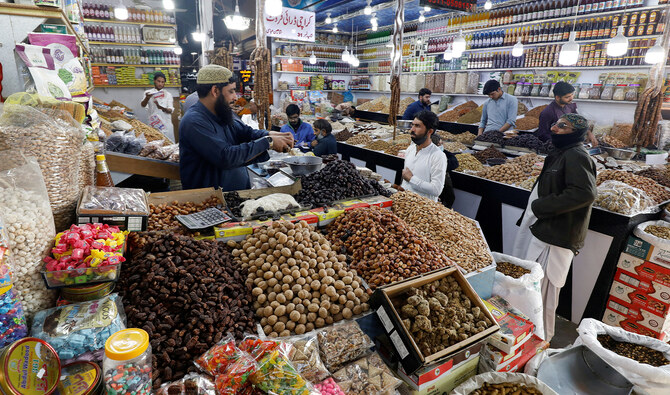
People buy dry fruits at a market in Karachi, Pakistan, on February 1, 2023. (REUTERS/File)
Short Url
Updated 03 February 2025
Follow

Consumer inflation in Pakistan eases to 9-year low in January

  • Inflation rate fell to 2.4% year-on-year in January, statistics bureau says 
  • Inflation rate is down from a multi-decade high of around 40% in May 2023 

KARACHI: Pakistan’s consumer inflation rate fell to its lowest in more than nine years, dropping to 2.4% year-on-year in January, the statistics bureau said on Monday.

Inflation has cooled significantly, easing from 28.3% in January 2024.

Consumer prices in January rose 0.2% from the month before, according to the Pakistan Bureau of Statistics.

The South Asian country, currently bolstered by a $7 billion facility from the International Monetary Fund (IMF) granted in September, is navigating an economic recovery. The IMF is set to review Pakistan’s progress by March, with the government and central bank expressing confidence about meeting its targets.

“Inflation is lower because of the statistical base effect, also supported by currency stability and lower food and energy prices,” said Adnan Sami Sheikh, assistant vice president of research at Pakistan Kuwait Investment Company.

Pakistan’s central bank cut its benchmark interest rate by 100 basis points to 12% last week, as inflation eases and growth looks set to pick up after 1,000 basis points of rate cuts over the last six months.

The State Bank of Pakistan has slashed rates from an all-time high of 22% last June, one of the most aggressive moves among central banks in emerging markets and exceeding its 625 bps of rate cuts in 2020 during the COVID-19 pandemic.

Pakistan’s consumer inflation rate fell to 4.1% in December, its lowest in more than six years, helped by favorable base effects. That was below the government’s forecast and down from a multi-decade high of around 40% in May 2023.

After the policy rate decision, central bank Governor Jameel Ahmad told a press conference that inflation would ease further in January but noted core inflation remained elevated.

He forecast full-year inflation in the year to June would average 5.5%-7.5%. 


Closing Bell: Saudi stocks slip as Tadawul falls 1% amid broad market weakness

Updated 30 December 2025
Follow

Closing Bell: Saudi stocks slip as Tadawul falls 1% amid broad market weakness

RIYADH: Saudi stocks fell sharply on Tuesday, with the Tadawul All Share Index closing down 108.14 points, or 1.03 percent, at 10,381.51.

The broader decline was reflected across major indices. The MSCI Tadawul 30 Index slipped 0.78 percent to 1,378.00, while Nomu, the parallel market index, fell 1 percent to 23,040.79.

Market breadth was strongly negative on the main board, with 237 stocks falling compared to just 24 gainers. Trading activity remained robust, with 164.7 million shares changing hands and a total traded value of SR3.19 billion ($850.6 million).

Among the gainers, SEDCO Capital REIT Fund led, rising 2.73 percent to SR6.77, followed by Chubb Arabia Cooperative Insurance Co., which gained 2.69 percent to SR20.20.

National Medical Care Co. added 1.72 percent to close at SR141.60, while Alyamamah Steel Industries Co. and Thimar Advertising, Public Relations and Marketing Co. advanced 1.57 percent and 1.13 percent, respectively.

Losses were led by Al Masar Al Shamil Education Co., which tumbled 8.36 percent to SR24.65. Raoom Trading Co.fell 6.75 percent to SR64.20, while Alkhaleej Training and Education Co. dropped 6.60 percent to SR18.12 and Naqi Water Co. declined 5.51 percent to SR54.00. Gulf General Cooperative Insurance Co. closed 5.44 percent lower at SR3.65.

On the announcement front, Chubb Arabia Cooperative Insurance Co. signed a multiyear insurance agreement with Saudi Electricity Co. to provide various coverages, expected to positively impact its financial results over the 2025–2026 period. The deal will run for three years and two months and is within the company’s normal course of business.

Meanwhile, Bupa Arabia for Cooperative Insurance Co. announced a one-year health insurance contract with Saudi National Bank, valued at SR330.2 million, covering the bank’s employees and their families from January 2026. Despite the sizable contract, Bupa Arabia shares fell 0.8 percent to close at SR137, weighed down by the broader market weakness.

In contrast, United Cooperative Assurance Co. revealed an extension of its engineering insurance agreement with Saudi Binladin Group for the Grand Mosque expansion in Makkah. The contract value exceeds 20 percent of the company’s gross written premiums based on its latest audited financials and is expected to support results through 2026. However, the stock came under selling pressure, ending the session down 4.51 percent at SR3.39.