

Lawyers in Pakistan’s capital strike to protest ‘unfair’ transfer of judges

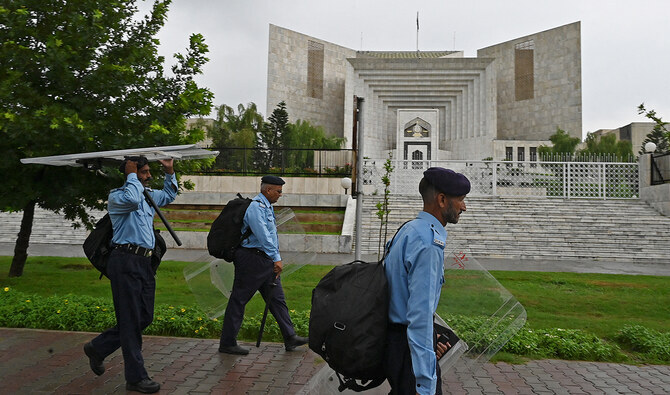
Riot policemen carry their gear as they walk past the Supreme Court building in Islamabad on July 25, 2022. (AFP/File)
Short Url
Updated 03 February 2025
Follow

Lawyers in Pakistan’s capital strike to protest ‘unfair’ transfer of judges

  • Lawyers in Pakistan’s capital strike to protest ‘unfair’ transfer of judges
  • Lawyers reject president’s move, say transfer “unfair” and affects seniority of other Islamabad High Court judges 

ISLAMABAD: Lawyers associated with the capital’s bar associations and councils have gone on strike today, Monday, to protest against the president’s move to transfer three judges from different high courts to the Islamabad High Court (IHC). 

President Asif Ali Zardari on Saturday approved the transfers of Justice Sardar Muhammad Sarfraz Dogar from the Lahore High Court, the Sindh High Court’s Justice Khadim Hussain Soomro and Balochistan High Court’s Justice Muhammad Asif to the IHC, invoking anger from the capital city’s district and high court bar associations. 

Zardari went ahead with the transfers despite opposition from five of 10 IHC judges. In a letter addressed to the chief justices of the Supreme Court and high courts on Friday, the judges said the decision was unfair to the existing senior judges of the IHC.

They also cited speculation and news reports that the government wanted to appoint Justice Dogar as the IHC’s chief justice, saying that it would be a “fraud on the constitution.”

“This decision is unfair to the judges serving in the IHC as it clearly affects their seniority,” Asad Manzoor Butt, president of the Lahore High Court Bar Association, told Arab News. 

Butt supported the Islamabad High Court Bar Association’s call for notification of the judges’ transfer to be canceled. 

“We will travel to Islamabad to consult with the Bar leadership and extend our support to them,” he said. 

Pakistan’s constitution empowers the president to transfer a judge from one high court to another after the concerned judge consents to the decision. The president can approve the transfer after consulting the chief justice of Pakistan and the chief justice of both high courts.

The Islamabad Bar Council (IBC) said on Sunday that the capital city’s lawyer bodies will pursue all legal and constitutional avenues to challenge the move and safeguard the “judicial independence of Islamabad.”

It said an All-Pakistan Lawyers’ Convention will be held under the IBC on Monday to formulate a future strategy to challenge the transfers. 


Rating firm S&P says it won’t rush Iran war downgrades, sees risks for countries like Pakistan

Updated 12 March 2026
Follow

Rating firm S&P says it won’t rush Iran war downgrades, sees risks for countries like Pakistan

  • Agency says it is monitoring indebted energy importers as higher oil prices strain finances
  • Gulf economies seen better placed to weather shock, though Bahrain flagged as vulnerable

LONDON: S&P Global ‌said it would not make any knee-jerk sovereign rating cuts following the outbreak of war in the ​Middle East, but warned on Thursday that soaring oil and gas prices were putting a number of already cash-strapped countries at risk.

The firm’s top analysts said in a webinar that the conflict, which has involved US and Israeli strikes ‌against Iran and Iranian ‌strikes against Israel, ​US ‌bases ⁠and Gulf ​states, ⁠was now moving from a low- to moderate-risk scenario.

Most Gulf countries had enough fiscal buffers, however, to weather the crisis for a while, with more lowly rated Bahrain the only clear exception.

Qatar’s banking sector could ⁠also struggle if there were significant ‌deposit outflows in ‌reaction to the conflict, although there ​was no evidence ‌of such strains at the moment, they ‌said.

“We don’t want to jump the gun and just say things are bad,” S&P’s head global sovereign analyst, Roberto Sifon-Arevalo, said.

The longer the crisis ‌was prolonged, though, “the more difficult it is going to be,” he ⁠added.

Sifon-Arevalo ⁠said Asia was the second-most exposed region, due to many of its countries being significant Gulf oil and gas importers.

India, Thailand and Indonesia have relatively lower reserves of oil, while the region also had already heavily indebted countries such as Pakistan, Bangladesh and Sri Lanka whose finances would be further hurt by rising energy prices.

“We ​are closely monitoring ​these (countries) to see how the credit stories evolve,” Sifon-Arevalo said.