JERUSALEM: Israeli Prime Minister Benjamin Netanyahu will begin talks on a second phase to the Gaza ceasefire in Washington on Monday, his office said hours after the completion of the fourth hostage-prisoner exchange of the truce.
Netanyahu spoke with the US President’s Middle East envoy Steve Witkoff, on Saturday and agreed that negotiations would “begin when they meet in Washington.”
A date for formal talks involving mediators and delegations from Hamas and Israel has not been set, with the 42-day first phase due to end next month.
Netanyahu’s office said Witkoff would talk to key mediators before discussing with the Israeli premier “steps to advance the negotiations, including dates for delegations to leave for talks.”
The second phase is expected to cover the release of the remaining captives and to include discussions on a more permanent end to the war, something several members of Netanyahu’s government oppose.
FASTFACT
The second phase is expected to cover the release of the remaining captives and to include discussions on a more permanent end to the war, something several members of the Israeli government oppose.
As part of the first phase, Hamas on Saturday freed three Israeli hostages in exchange for more than 180 Palestinian prisoners released from Israeli custody.
Hostages Ofer Kalderon and Yarden Bibas were paraded on stage by militants before being handed over to the Red Cross in the southern Gaza city of Khan Younis.
US-Israeli Keith Siegel was freed in a similar ceremony at Gaza City’s port in the north.
The Israeli military later confirmed that all three were back in Israel.
Israeli campaign group the Hostages and Missing Families Forum hailed their release as “a ray of light in the darkness.”
“I hope that this is a sign of the rebirth of the people of Israel, not just of Ofer, not just of the hostages,” Kalderon’s uncle Shemi said, overcome with emotion.
Later in the day, a bus carrying released Palestinian prisoners was greeted by a cheering crowd in the West Bank city of Ramallah, while three other buses were met by hundreds of well-wishers in Khan Younis.
“I need a great deal of composure to control myself, to steady my nerves, to absorb this overwhelming moment,” said one released prisoner, Ata Abdelghani, as he prepared to meet his now 10-year-old twin sons for the first time.
After holding the hostages for more than 15 months, militants in Gaza began releasing them on Jan. 19 under the terms of the ceasefire deal with Israel.
Hamas and Islamic Jihad have so far handed over 18 hostages to the International Committee of the Red Cross, the Israelis among them, in exchange for hundreds of Palestinian prisoners, many of them women and children.
A total of 183 prisoners were freed Saturday, all of them Palestinian except for one Egyptian.
The ceasefire’s six-week first phase hinges on the release of a total of 33 hostages in exchange for around 1,900 people, mostly Palestinians, held in Israeli jails.
Hundreds had gathered in the Tel Aviv plaza dubbed “Hostage Square” to watch live television coverage of the latest releases.
Sighs of relief ran through the crowd as the three were freed, though the mood was mostly somber. Ahead of the releases in Khan Younis and Gaza City, scores of masked Hamas fighters stood guard in an apparent effort to prevent large crowds from forming.
It was a sharp contrast to the chaotic scenes that accompanied Thursday’s handover, which prompted Israel to delay its release of Palestinian prisoners in protest briefly.
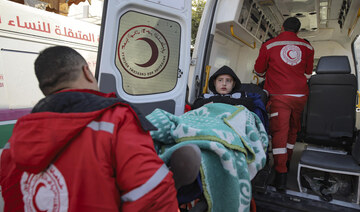
After Saturday’s hostage release, Gaza’s key Rafah border crossing with Egypt was reopened, with the Health Ministry in the Hamas-run territory saying 50 Palestinian patients in need of specialist treatment had passed through.
Egyptian state-linked channel Al-Qahera News showed footage of the first evacuees, who included 30 children with cancer.
Gaza hospitals director Muhammad Zaqout said he hoped the numbers would increase.
“We now have 6,000 cases ready to be transferred, and more than 12,000 cases that are in dire need of treatment,” he said.
Rafah was a vital entry point for aid before the Israeli military seized the Palestinian side of the crossing in May.
US President Donald Trump, who has claimed credit for the ceasefire deal, is expected to host Netanyahu at the White House on Tuesday.