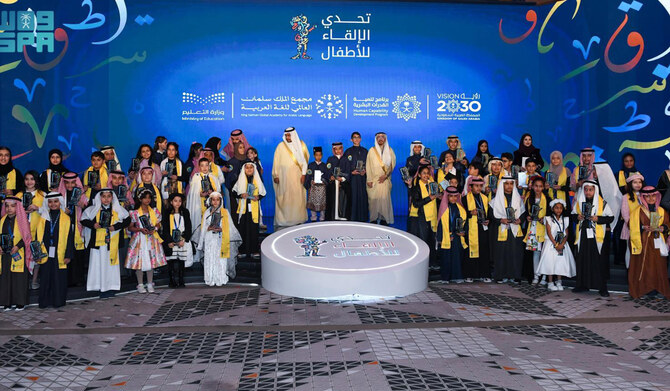

RIYADH: The King Salman Global Academy for Arabic Language, and the Ministry of Education honored the winners of the Children’s Reading Challenge in Riyadh on Sunday.
The academy awarded SR250,000 ($67,000) to 60 winners from a total of nearly 8,000 participants across 30 countries.
Abdullah Al-Washmi, the academy’s secretary-general, thanked the Ministry of Education for promoting the competition in Saudi schools.

SR250,000 ($67,000) was awarded to 60 winners from nearly 8,000 participants in 30 countries. (Supplied)
He also praised the judges, schools, and institutions for their contributions toward the academy achieving its goals — enhancing classical Arabic speaking skills, strengthening its presence in education and culture, and providing a platform for talented children.
Al-Washmi highlighted the competition’s international reach, saying: “This confirms the global status of the Arabic language and the academy’s role in promoting its spread and supporting linguistic creativity among future generations.”
The event featured a theatrical performance by children which showcased their speech and skills of expression in an engaging cultural display.

Maha Al-Otaibi, head of the linguistic culture sector at the academy. (Supplied)
The academy offered a training course on speaking skills on the sidelines, covering voice control techniques, audience interaction, expressive performance, and confidence in speech.
Maha Al-Otaibi, head of the linguistic culture sector at the academy, said that the participation of about 8,000 children from 30 countries reflected the growing global interest in the Arabic language.
Al-Otaibi said: “The competition contributes to strengthening cultural identity and consolidating Arab children’s connection to their mother tongue.
“It enhances their love for the art of the Arabic language and encourages families and teachers to support it, especially amid the challenges posed by the influence of other languages," she told Arab News.
She spoke of the programs accompanying the ceremony, such as the interactive Arabic language exhibition and the training course which helps children acquire essential skills to strengthen their Arabic proficiency and bring them closer to classical Arabic.
“Such programs contribute to promoting the spread of the Arabic language globally, building a generation aware of its culture and language, and capable of representing it with pride and distinction,” Al-Otaibi said.