



GAZA/CAIRO: Palestinian militant group Hamas handed over three Israeli hostages on Saturday, and dozens of Palestinian prisoners and detainees were released in exchange, in the latest stage of a truce aimed at ending the 15-month war in Gaza.
Ofer Kalderon, a French-Israeli dual national, and Yarden Bibas were handed over to Red Cross officials in the southern Gaza city of Khan Younis before being transferred to Israel. Israeli-American Keith Siegel was separately handed over at the Gaza City seaport.
Hours later, 183 Palestinian prisoners and detainees were released in the exchange. Among them, 150 arrived in Gaza while 32 got off a bus in Ramallah in the occupied West Bank, where they were greeted by large crowds. One freed prisoner will be exiled to Egypt, according to the Hamas prisoners’ media office.
“I feel joy despite the journey of pain and hardship that we lived,” said Ali Al-Barghouti, who was serving two life sentences in an Israeli jail.
“The life sentence was broken and the occupation will one day be broken,” added Barghouti, as the crowd around him in Ramallah chanted “Allah Akbar (God is the most great).”

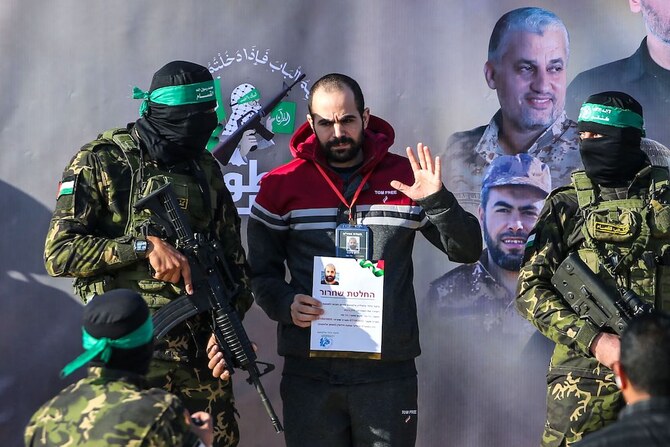
Ofer Kalderon, center, is released by Hamas militants in this still image taken from a video in Khan Younis, southern Gaza Strip on Feb. 1, 2025. (Reuters/Reuters TV)
At the newly reopened Rafah crossing on the southern border, [alestinian patients to be allowed to leave Gaza for medical treatment in Egypt.
Mohammad Zaqout, a senior official in Gaza’s health ministry, however, criticized the limited number of patients allowed to travel for treatment, saying that around 18,000 people needed better health care.
In Israel, crowds gathered at the location in Tel Aviv known as Hostage Square to watch the release in the morning of the Israeli hostages on giant outdoor screens, mixing cheers and applause with tears as the three men appeared.
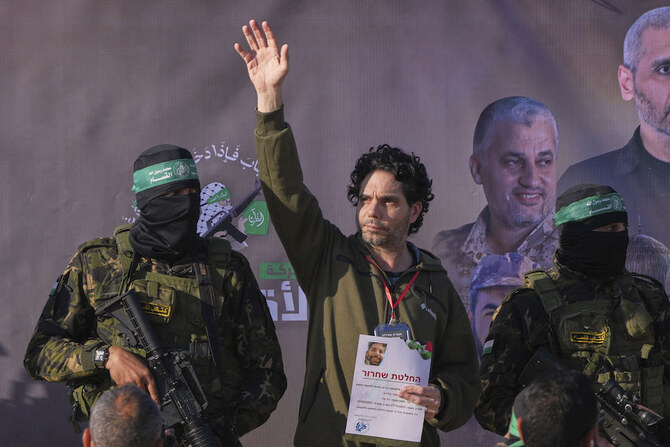
Kalderon, whose two children Erez and Sahar were released in the first hostage exchange in November 2023, and Bibas both briefly mounted a stage in Khan Younis, in front of a poster of Hamas figures including Mohammad Deif, the former military commander whose death was confirmed by Hamas this week, before being handed over to the Red Cross officials.
“Ofer Kalderon is free! We share the immense relief and joy of his loved ones after 483 days of unimaginable hell,” French President Emmanuel Macron said in a statement.
Saturday’s handover saw none of the chaotic scenes that overshadowed an earlier transfer on Thursday, when Hamas guards struggled to shield hostages from a surging crowd in Gaza.
But it was once again an occasion for a show of force by uniformed Hamas fighters who paraded in the area where the handovers took place in a sign of their re-established dominance in Gaza despite the heavy losses suffered in the war.

Israeli hostage Yarden Bibas waves on a stage before being handed over to members of the Red Cross in Khan Younis in the southern Gaza Strip on Feb. 1, 2025. (AFPTV/ AFP)
Negotiations on release of remaining hostages
The total number of hostages freed so far is 18, including five Thais who were part of an unscheduled release on Thursday.
After Saturday’s exchange, Israel will have released 583 Palestinian prisoners and detainees, including militants serving life sentences for deadly attacks as well as some detained during the war but not charged.
As the fighting has abated, diplomatic efforts to build a wider settlement have stepped up.
Prime Minister Benjamin Netanyahu is expected to meet US President Donald Trump on Tuesday with the ceasefire in Gaza, and a possible normalization of relations with Saudi Arabia as part of a postwar deal likely to be a focus.
During the first phase of the ceasefire, 33 children, women and older male hostages as well as sick and injured, were due to be released, with more than 60 men of military age left for a second phase which must still be worked out.
Negotiations are due to start by Tuesday on agreements for the release of the remaining hostages and the withdrawal of Israeli troops from Gaza in a second phase of the deal, which is intended to lead to a final end of the war in Gaza.
The initial six-week truce, agreed with Egyptian and Qatari mediators and backed by the United States, has mostly remained intact despite incidents that have led both sides to accuse the other of violating the deal.
Netanyahu’s government, which has hard-liners who opposed the ceasefire deal, and Hamas say they are committed to reaching an agreement in the second phase.
But prospects for a durable settlement remain unclear. The war started with a Hamas-led attack on Israel that killed 1,200 people, and saw more than 250 taken as hostages. The Israeli military campaign has killed more than 47,000 Palestinians. Gaza is in ruins and a deep legacy of bitterness and mistrust remains.
Israeli leaders continue to insist that Hamas cannot remain in Gaza, but the movement has taken every opportunity to demonstrate the control it continues to exert despite the loss of much of its former leadership and thousands of fighters during the war.


