

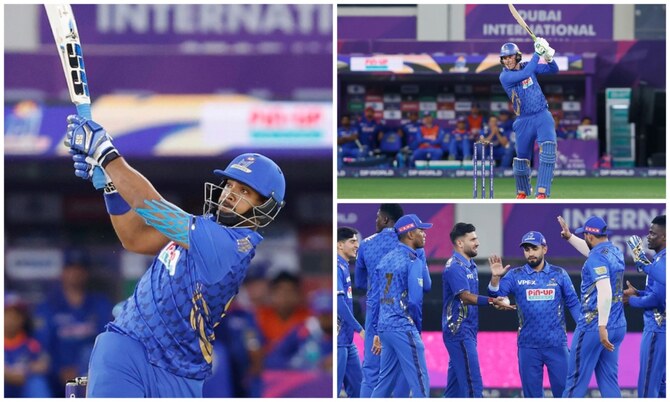
Pooran’s brilliance guides MI Emirates to victory over Gulf Giants in ILT20

MI Emirates secured a five-wicket victory over the Gulf Giants in the DP World ILT20 at the Dubai International Stadium on Friday, with skipper Nicholas Pooran (L) leading from the front. (ILT20/MI Emirates)
Short Url
Updated 01 February 2025
Follow

Pooran’s brilliance guides MI Emirates to victory over Gulf Giants in ILT20

  • Captain’s innings seals impressive triumph

DUBAI: MI Emirates secured a five-wicket victory over the Gulf Giants in the DP World ILT20 at the Dubai International Stadium on Friday, with skipper Nicholas Pooran leading from the front with a match-winning unbeaten 58 off 37 balls, earning him the Player of the Match award as his side claimed their first win of the season.

Batting first, the Gulf Giants made a strong start, with openers Gerhard Erasmus and James Vince regularly finding the boundary.

However, their momentum was dented in the third over when Akeal Hosein dismissed Erasmus for 12. Vince, undeterred, found an able partner in Jordan Cox, and together they pushed the score to 52 for one at the end of the powerplay.

Cox and Vince put together a solid 51-run stand before Alzarri Joseph dismissed Cox in the 10th over. Tom Curran chipped in with 13, while Vince continued to anchor the innings, reaching his half-century in style.

With the Giants poised for a strong finish, Vince was joined by Shimron Hetmyer, and the duo accelerated in the 16th over, hitting 19 runs. However, MI Emirates fought back, removing Hetmyer (15) and Vince (86 off 50 balls) in quick succession. Late contributions from Tim David and Chris Jordan (both 10 not out) took the Gulf Giants to 173 for six in 20 overs.

Chasing 174, MI Emirates got off to a flying start as openers Andre Fletcher and Muhammad Waseem took the attack to the bowlers. Waseem smashed a rapid 26 off 10 balls before departing, while Tom Banton added 11 before falling to Aayan Khan.

Despite a run-out setback that saw Kusal Perera dismissed for just one, Fletcher continued to hold the innings together, scoring 31 before being castled by Blessing Muzarabani, who impressed with figures of one for 17 in four overs. At 102 for four, MI Emirates faced an uphill task, needing 72 runs off the last five overs.

Pooran, however, took control of the chase alongside Bevon Jacobs, forging a crucial 53-run stand off 33 balls. Jacobs’ departure for 18 brought Romario Shepherd to the crease, but Pooran remained composed under pressure.

Reaching his half-century in the 18th over, Pooran shifted gears as Shepherd’s late blows further eased the equation. With six runs needed off the final over, the MI Emirates skipper finished the job in style, smashing a six over cow corner to seal the victory.

Reflecting on his match-winning knock, Pooran said: “I knew I had to get the job done and be there until the end. I am more experienced now and know what’s required. The key is to trust yourself to absorb the pressure.”

Vince, captain of Gulf Giants, admitted that missed opportunities cost his side. “We didn’t feel it was that straightforward out there. There was some turn for the slower bowlers, but we dropped a catch and it ultimately cost us tonight,” he said.


Arab Cup 2025 attendance surpasses recent AFCON and AFC Asian Cup

Updated 5 sec ago
Follow

Arab Cup 2025 attendance surpasses recent AFCON and AFC Asian Cup

  • The tournament, held under FIFA jurisdiction for the second time, achieved a record average attendance of 38,644 fans per match
  • Total attendance more than doubled since 2021, with Algeria vs. UAE quarter-final pushing it past one million spectators

RIYADH: For a tournament often dismissed by critics as little more than a friendly or “B-team” competition, the 2025 Arab Cup delivered a compelling response.

A total of 1,236,600 people attended the 32 matches across the tournament, an average of 38,644 spectators per game, as the Arab Cup returned to Qatar for a second consecutive time after its successful staging in 2021. That earlier tournament, initially launched as a Confederations Cup-like test event ahead of the World Cup, drew 571,605 spectators in total.

Despite those figures, the Arab Cup has faced persistent criticism. Questions have been raised around the quality of play and refereeing standards, with some supporters – both within and beyond the Arab world – branding the tournament “meaningless.”

Yet when placed alongside recent continental competitions, the attendance figures tell a different story.

The 2023 African Cup of Nations in Ivory Coast attracted 1,109,593 fans across 52 matches, an average of 21,338 per game. Meanwhile, the 2023 AFC Asian Cup, also hosted in Qatar, recorded 1,507,790 spectators over 51 matches — roughly 29,565 per game, the highest average in the competition’s history.

Direct comparisons, however, require context. Continental — as opposed to regional — competitions draw support from across vast geographies, while the Arab Cup benefits from strong expatriate communities based in the host nation. Expecting the same travel patterns from fans in East Asia or West Asia would be, to say the least, unrealistic.

Even so, the attendance of more than 38,000 fans per game is significant. The Arab Cup was not always popular, with the attendance in 2021 struggling to rise above an average of 17,000 per game. Only four games at the 2025 edition fell below the 20,000 mark.

Historical context further underlines this shift. The 2011 AFC Asian Cup in Qatar, along with multiple editions of the West Asian Football Federation Championship held across the region, struggled to surpass a figure of 13,000 fans per game.

While Morocco will bask in the glory of the 2025 Arab Cup, the tournament itself has shown a broader shift in football engagement across the Arab World — one no longer driven solely by interest in European leagues, but by growing confidence in domestic teams, national projects and regional competitions.

From Saudi Arabia’s ambitions in club football to Morocco’s recent international success and Qatar’s continued role as a host, momentum continues to build across the Middle East and North Africa, with the Arab Cup one of the latest competitions offering tangible evidence of that change.