Curious case of American woman in Karachi in pursuit of love, abandoned by online paramour

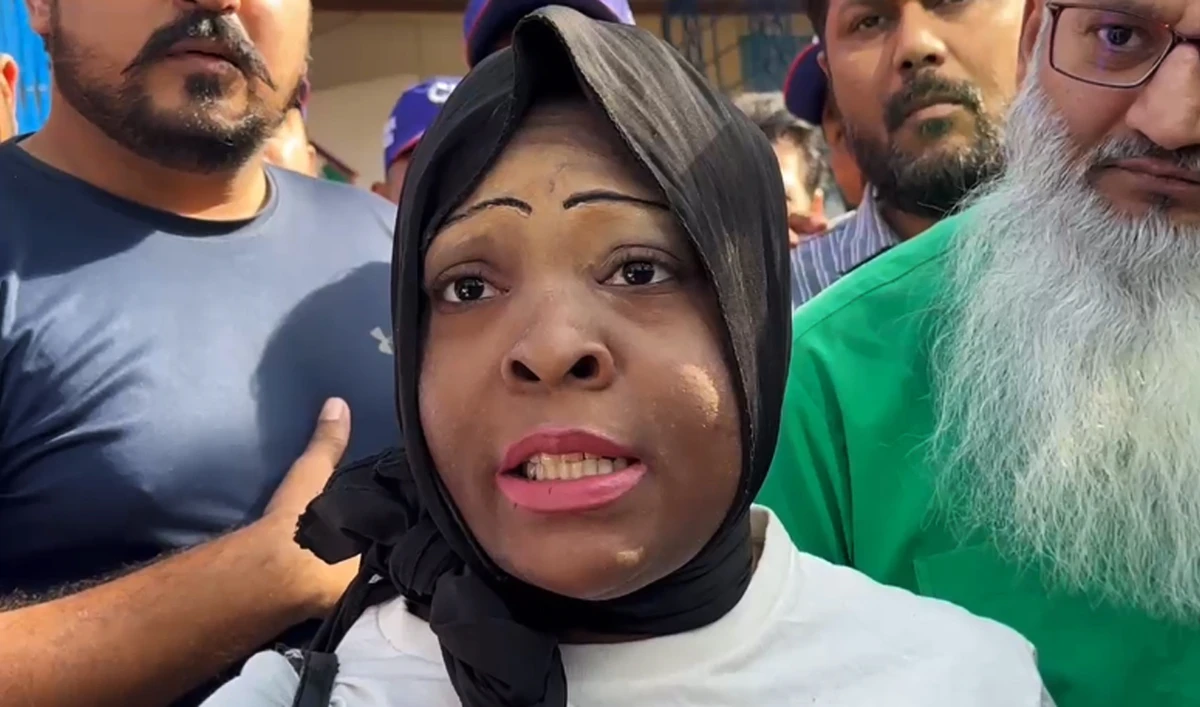
The screengrab taken from a video shows, Onijah Andrew Robinson speaks to the media in Karachi, Pakistan, on January 21, 2025. (AN)
Short Url
Updated 31 January 2025
Follow

Curious case of American woman in Karachi in pursuit of love, abandoned by online paramour

  • Onijah Andrew Robinson, 33, arrived in Karachi in October to meet 19-year-old Nidal Ahmed Memon
  • Memon abandoned her saying his family was not agreeing to their marriage, his whereabouts are unknown

KARACHI: An American woman who has been in the media storm after traveling to Karachi in pursuit of a Pakistani man she befriended online who ultimately refused to marry her said this week she doesn’t feel betrayed but wants to stay in Pakistan for now and be paid a weekly allowance. 

Onijah Andrew Robinson, 33, arrived in Karachi in October to meet 19-year-old Nidal Ahmed Memon, who later abandoned her saying his family was not agreeing to their marriage. His whereabouts are currently unknown. 

Robinson’s story came to light after local activist and YouTuber Zaffar Abbas publicized it on social media, with Sindh Governor Kamran Khan Tessori intervening to extend her expired visa and arrange a flight home.

Robinson, however, refused to board the flight this week, according to Station House Officer Kaleem Khan Moosa. She instead took a taxi to Memon’s apartment building in whose parking area she stayed for nearly 30 hours on Thursday before leaving for a Chhipa charity shelter, where she is expected to remain until her return to the US.

“That’s funny because I keep that private … I can never feel betrayed,” she told Arab News when asked about her relationship with Memon and his disappearance. 

“My demand today is to put [advertisement] in a newspaper that you will give us money tomorrow or by the end of this week. We need $50,000.”

It was unclear who she was demanding the money from, the Pakistan government or Memon. 

Authorities in Karachi said the woman had not filed a formal complaint against Memon.

“We learned that an American woman is present in the building in connection with a local man,” Senior Superintendent Police Arif Aziz. “The young man has disappeared after leaving his home, but since there is no complaint in this case and it is a personal matter, our responsibility is limited to providing security to the woman only.”

A spokesperson for the US consulate in Karachi said the mission was aware of the situation but could not comment due to privacy laws. The spokesperson for Pakistan’s foreign office, Shafqat Ali Khan, said it was a matter for local authorities in Sindh province to deal with.

Meanwhile, a number of Pakistani men have come forward with marriage proposals for Robinson. 

“If she wants to settle here, then I’ve bought a new house in Gulshan-e-Maymar [neighborhood]. I will accommodate her there and also give her $5,000,” said Muhammad Ismail.

“She has been betrayed and cheated. A promise has been broken, but we welcome the guest.”

Sharif Sheerani, 62, said he was ready to marry Robinson and move with her to the US if she paid him $50,000.

“My demand is $50,000,” he said. “I will go with her but she won’t agree because she is also broke, what will she give me? She’s asking for money herself.”
EU, Pakistan sign €60 million loan agreement for clean drinking water in Karachi

Updated 59 min 3 sec ago
Follow

EU, Pakistan sign €60 million loan agreement for clean drinking water in Karachi

  • Project will finance rehabilitation, construction of water treatment facilities in Karachi city, says European Investment Bank
  • As per a report in 2023, 90 percent of water samples collected from various places in city was deemed unfit for drinking

ISLAMABAD: The European Investment Bank (EIB) and Pakistan’s government on Wednesday signed a €60 million loan agreement, the first between the two sides in a decade, to support the delivery of clean drinking water in Karachi, the EU said in a statement. 

The Karachi Water Infrastructure Framework, approved in August this year by the EIB, will finance the rehabilitation and construction of water treatment facilities in Pakistan’s most populous city of Karachi to increase safe water supply and improve water security. 

The agreement was signed between the two sides at the sidelines of the 15th Pak-EU Joint Commission in Brussels, state broadcaster Radio Pakistan reported. 

“Today, the @EIB signed its first loan agreement with Pakistan in a decade: a €60 million loan supporting the delivery of clean drinking water for #Karachi,” the EU said on social media platform X. 

Radio Pakistan said the agreement reflects Pakistan’s commitment to modernize essential urban services and promote climate-resilient infrastructure.

“The declaration demonstrates the continued momentum in Pakistan-EU cooperation and highlights shared priorities in sustainable development, public service delivery, and climate and environmental resilience,” it said. 

Karachi has a chronic clean drinking water problem. As per a Karachi Water and Sewerage Corporation (KWSC) study conducted in 2023, 90 percent of water from samples collected from various places in the city was deemed unsafe for drinking purposes, contaminated with E. coli, coliform bacteria, and other harmful pathogens. 

The problem has forced most residents of the city to get their water through drilled motor-operated wells (known as ‘bores’), even as groundwater in the coastal city tends to be salty and unfit for human consumption.

Other options for residents include either buying unfiltered water from private water tanker operators, who fill up at a network of legal and illegal water hydrants across the city, or buying it from reverse osmosis plants that they visit to fill up bottles or have delivered to their homes.

The EU provides Pakistan about €100 million annually in grants for development and cooperation. This includes efforts to achieve green inclusive growth, increase education and employment skills, promote good governance, human rights, rule of law and ensure sustainable management of natural resources.