

Rwanda-backed M23 advances toward second DR Congo regional capital

Corneille Nangaa, leader of the rebel group Alliance Fleuve Congo (AFC) including M23, speaks during an interview with Associated Press in Goma, DR Congo, on Jan. 30, 2025. (AP Photo)
Short Url
Updated 31 January 2025
Follow

Rwanda-backed M23 advances toward second DR Congo regional capital

  • Group’s capture of most of Goma earlier in the week was a dramatic escalation in a region
  • The crisis has rattled the continent and international observers

GOMA, DR Congo: The Rwandan-backed armed group M23 moved south as it closed in on a key military airport in DR Congo on Friday, a day after pledging to take the capital Kinshasa and as international criticism mounted.

The group’s capture of most of Goma, the capital of North Kivu province, earlier in the week was a dramatic escalation in a region that has seen decades of conflict involving multiple armed groups.

Rwanda says its primary interest is to eradicate fighters linked to the 1994 genocide but is accused of seeking to profit from the region’s reserves of minerals used in global electronics.

The crisis has rattled the continent and international observers, with a southern African regional bloc holding an emergency summit in Zimbabwe’s capital Harare on Friday.

M23 fighters are now moving south.

Local sources said on Thursday that fighting was concentrated some 30 kilometers (19 miles) from the city of Kavumu.
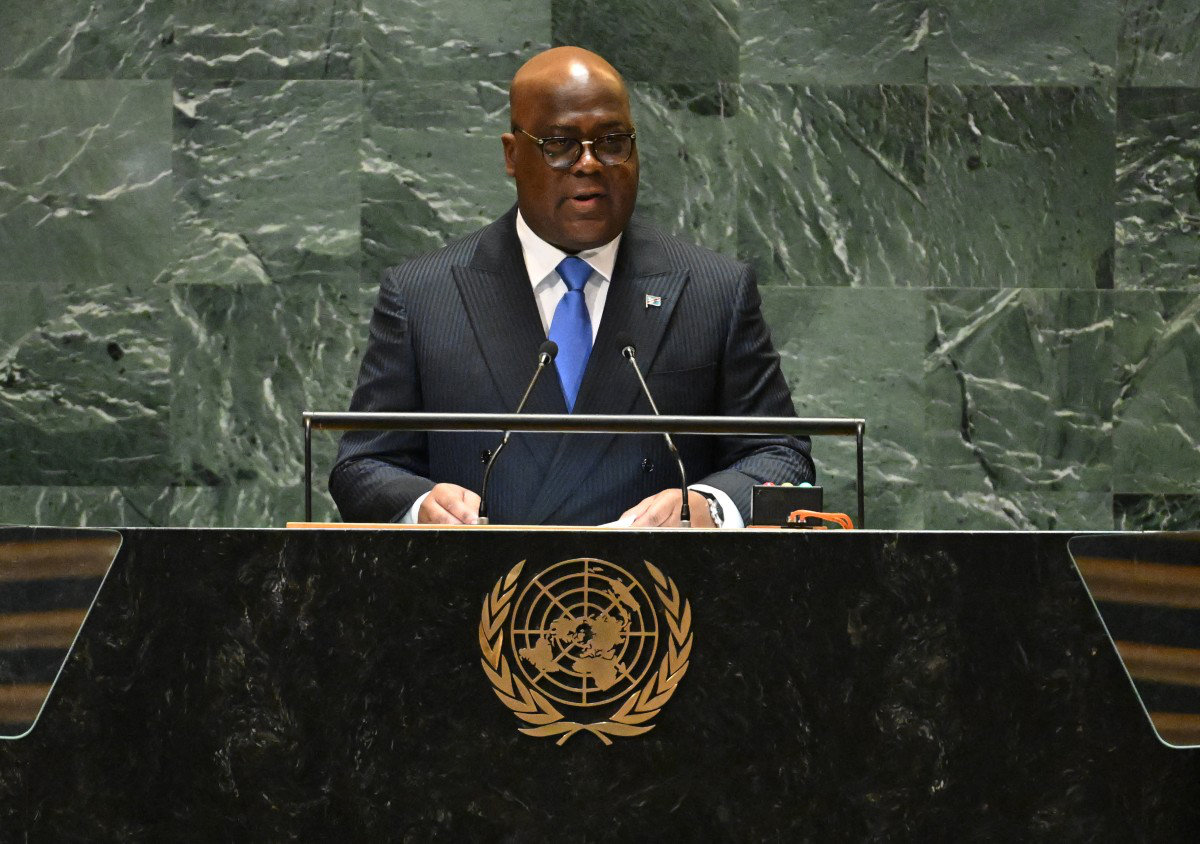


DR Congo President Felix Tshisekedi speaks during the 79th Session of the UN General Assembly in New York City on September 25, 2024. (AFP)

The city has a strategic military airfield and is where the Congolese army has laid down its defensive line just 40 km north of South Kivu’s provincial capital Bukavu.

The United Nations warned it was concerned by “credible reports that the M23 is moving rapidly toward the city of Bukavu.”

The second biggest city in eastern Democratic Republic of Congo after Goma, Bukavu has a population believed to be around two million.

The Congolese army has yet to comment on the latest M23 advances but President Felix Tshisekedi said earlier this week that a “vigorous” military response was under way.

Information about the fast-moving offensive has remained unclear, but so far M23 fighters have met limited resistance from the ill-equipped and poorly paid Congolese forces.

In Goma, residents have emerged to count the dead and search for food, as hospitals struggled to cope with the wounded.

“We do not want to live under the thumb of these people,” one person, who asked not to be named, said.

The United Nations, United States, European Union, China, Britain, France and mediator Angola have all called on Rwanda to withdraw its forces.

Britain said Thursday it was considering reviewing aid to Rwanda.

Rwanda has hit back at the criticism, with government spokesperson Yolande Makolo saying the UK did not deliver “a direct warning” about aid.

“The international community has its fair share of the blame in the current situation,” she posted on X.

Rwandan President Paul Kagame also strongly rejected accusations that Kigali is supporting the armed group, saying: “M23 are not Rwandans — they are Congolese.”

On Friday, the 16-nation Southern African Development Community will hold an extraordinary meeting to discuss the “worrying situation.”

Kagame and Angolan President Joao Lourenco, the African Union-appointed mediator between Kigali and Kinshasa on the conflict, will not attend.

The meeting follows soaring tensions between Kagame and South African President Cyril Ramaphosa after the deaths of 13 South African soldiers in DRC’s east.

“We are ready to defend ourselves if we are attacked by a coalition including South African forces,” Rwandan Foreign Minister Olivier Nduhungirehe told South African public broadcaster SABC late Thursday.

The M23 and Rwandan troops entered Goma on Sunday. During days of intense clashes that killed more than 100 people, the group seized control over much of the city as many Congolese soldiers surrendered or fled.
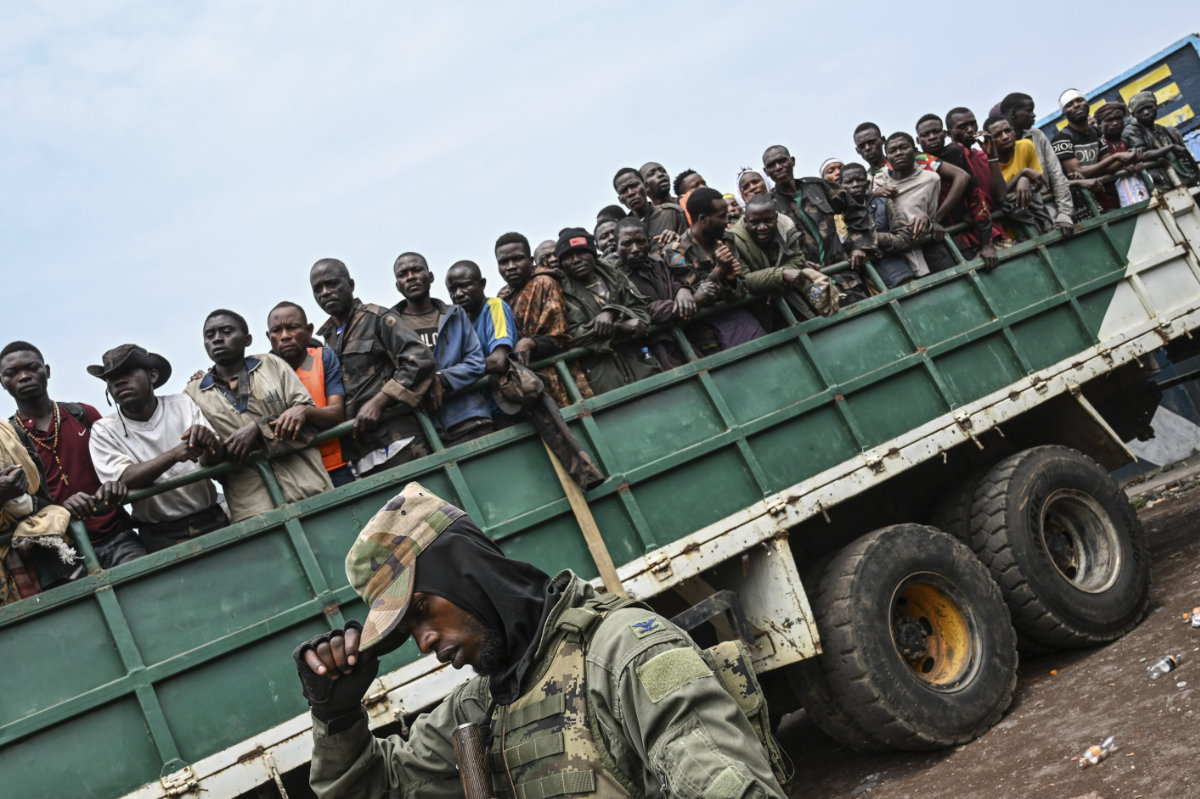


M23 rebels escort government soldiers and police who surrendered to an undisclosed location in Goma, DR Congo, on Jan. 30, 2025. (AP)

“We are in Goma and we will not leave,” Corneille Nangaa, head of a coalition of groups including the M23, said on Thursday.

“We will continue the march of liberation all the way to Kinshasa,” he added.

The offensive has heightened an already dire humanitarian crisis in the region, causing food and water shortages and forcing half a million people from their homes this month, the UN said.

Africa’s health agency warned that the “unnecessary war” in eastern DRC — a hotspot for infectious diseases including mpox — raised the risk of pandemic.

The DRC has accused Rwanda of waging an offensive to profit from the region’s mineral wealth.

A report by UN experts in July supported the claims, finding that Rwanda has thousands of troops in eastern DRC — and holds “de facto control” over the M23.

Rwanda has denied the accusations.


Refugee firefighters in Mauritania battle bushfires to give back to the community that took them in

Updated 2 sec ago
Follow

Refugee firefighters in Mauritania battle bushfires to give back to the community that took them in

MBERA: The men move in rhythm, swaying in line and beating the ground with spindly tree branches as the sun sets over the barren and hostile Mauritanian desert. The crack of the wood against dry grass lands in unison, a technique perfected by more than a decade of fighting bushfires.
There is no fire today but the men — volunteer firefighters backed by the UN refugee agency — keep on training.
In this region of West Africa, bushfires are deadly. They can break out in the blink of an eye and last for days. The impoverished, vast territory is shared by Mauritanians and more than 250,000 refugees from neighboring Mali, who rely on the scarce vegetation to feed their livestock.
For the refugee firefighters, battling the blazes is a way of giving back to the community that took them in when they fled violence and instability at home in Mali.
Newcomers with an old tradition
Hantam Ag Ahmedou was 11 years old when his family left Mali in 2012 to settle in the Mbera refugee camp in Mauritania, 48 kilometers (30 miles) from the Malian border. Like most refugees and locals, his family are herders and once in Mbera, they saw how quickly bushfires spread and how devastating they can be.
“We said to ourselves: There is this amazing generosity of the host community. These people share with us everything they have,” he told The Associated Press. “We needed to do something to lessen the burden.”
His father started organizing volunteer firefighters, at the time around 200 refugees. The Mauritanians had been fighting bushfires for decades, Ag Ahmedou said, but the Malian refugees brought know-how that gave them an advantage.
“You cannot stop bushfires with water,” Ag Ahmedou said. “That’s impossible, fires sometimes break out a hundred kilometers from the nearest water source.”
Instead they use tree branches, he said, to smother the fire.
“That’s the only way to do it,” he said.
The volunteer ‘brigade’
Since 2018, the firefighters have been under the patronage of the UNHCR. The European Union finances their training and equipment, as well as the clearing of firebreak strips to stop the fires from spreading. The volunteers today count over 360 refugees who work with the region’s authorities and firefighters.
When a bushfire breaks out and the alert comes in, the firefighters jump into their pickup trucks and drive out. Once at the site of a fire, a 20-member team spreads out and starts pounding the ground at the edge of the blaze with acacia branches — a rare tree that has a high resistance to heat.
Usually, three other teams stand by in case the first team needs replacing.
Ag Ahmedou started going out with the firefighters when he was 13, carrying water and food supplies for the men. He helped put out his first fire when he was 18, and has since beaten hundreds of blazes.
He knows how dangerous the task is but he doesn’t let the fear control him.
“Someone has to do it,” he said. “If the fire is not stopped, it can penetrate the refugee camp and the villages, kill animals, kill humans, and devastate the economy of the whole region.”
A climate-vulnerable nation
About 90 percent of Mauritania is covered by the Sahara Desert. Climate change has accelerated desertification and increased the pressure on natural resources, especially water, experts say. The United Nations says tensions between locals and refugees over grazing areas is a key threat to peace.
Tayyar Sukru Cansizoglu, the UNHCR chief in Mauritania, said that with the effects of climate change, even Mauritanians in the area cannot find enough grazing land for their own cows and goats — so a “single bushfire” becomes life-threatening for everyone.
When the first refugees arrived in 2012, authorities cleared a large chunk of land for the Mbera camp, which today has more than 150,000 Malian refugees. Another 150,000 live in villages scattered across the vast territory, sometimes outnumbering the locals 10 to one.
Chejna Abdallah, the mayor of the border town of Fassala, said because of “high pressure on natural resources, especially access to water,” tensions are rising between the locals and the Malians.
Giving back
Abderrahmane Maiga, a 52-year-old member of the “Mbera Fire Brigade,” as the firefighters call themselves, presses soil around a young seedling and carefully pours water at its base.
To make up for the vegetation losses, the firefighters have started setting up tree and plant nurseries across the desert — including acacias. This year, they also planted the first lemon and mango trees.
“It’s only right that we stand up to help people,” Maiga said.
He recalls one of the worst fires he faced in 2014, which dozens of men — both refugees and host community members — spent 48 hours battling. By the time it was over, some of the volunteers had collapsed from exhaustion.
Ag Ahmedou said he was aware of the tensions, especially as violence in Mali intensifies and going back is not an option for most of the refugees.
He said this was the life he was born into — a life in the desert, a life of food scarcity and “degraded land” — and that there is nowhere else for him to go. Fighting for survival is the only option.
“We cannot go to Europe and abandon our home,” he said. “So we have to resist. We have to fight.”