

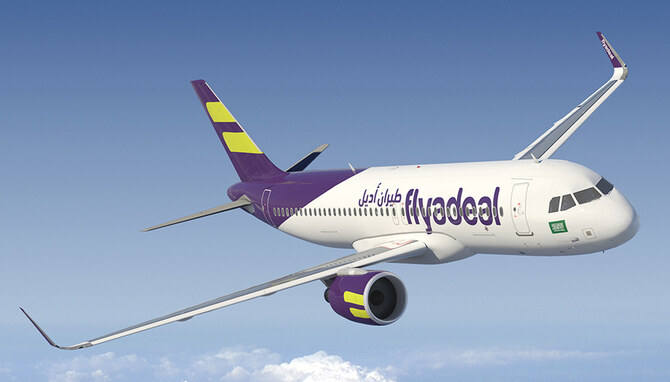
Saudi Arabia’s flyadeal joins IATA, boosting Kingdom’s aviation growth

The airline’s fleet includes 36 Airbus A320 aircraft, and it plans to significantly expand its network over the next 12 months as part of a major international growth initiative. File
Short Url
Updated 30 January 2025
Follow

Saudi Arabia’s flyadeal joins IATA, boosting Kingdom’s aviation growth

JEDDAH: Saudi Arabia’s low-cost carrier, flyadeal, has joined the International Air Transport Association, marking a significant step in its regional and global expansion while supporting the Kingdom’s growing aviation sector.

On Jan. 29, flyadeal’s management welcomed an IATA delegation, led by Kamil Al-Awadhi, the regional vice president for Africa and the Middle East, to celebrate the milestone at the airline’s headquarters in Jeddah.

In November, flyadeal earned IATA’s Operational Safety Audit certification, the highest safety accreditation in the airline industry.

This thorough evaluation examines an airline’s operational safety, ensuring it adheres to the most rigorous standards, covering areas like aircraft engineering, maintenance, flight operations, cabin services, ground handling, cargo, and security.

Saudi Arabia is investing heavily in its aviation sector as part of the Vision 2030 initiative, which seeks to diversify the economy beyond fossil fuels, boost the private sector, and enhance global connectivity.

The country aims to accommodate 330 million passengers by 2030, serve over 250 destinations, and transport 4.5 million tonnes of air cargo.

Steven Greenway, CEO of flyadeal, expressed his pride in joining IATA, an association that has long represented the airline industry with a unified voice.

“Since our founding in 2017, our growth has been rapid, with operational safety as a top priority. Becoming an IATA member was a natural next step for us,” he said.

Greenway also highlighted flyadeal’s new position alongside Saudia, the full-service airline that has been a longstanding IATA member.

“As Saudia and IATA celebrate their 80th anniversaries this year, we are proud to be part of this milestone,” he added.

Al-Awadhi also celebrated the addition of flyadeal to IATA, noting that their membership reflects the airline’s significant role in Saudi Arabia’s aviation expansion.

“Saudi Arabia has made remarkable strides in developing a world-class aviation sector,” he said. “flyadeal’s inclusion further demonstrates the Kingdom’s commitment to enhancing connectivity and fostering sustainable industry growth.”

He also praised the government’s ambitious vision for aviation and reaffirmed IATA’s commitment to supporting Saudi Arabia’s strategy to grow a thriving aviation industry that benefits travelers, businesses, and the economy.

flyadeal, which plans to carry more than 75,000 pilgrims on dedicated international charters during this year’s Hajj season, operates from key hubs in Riyadh, Jeddah, and Dammam.

It offers nearly 30 year-round and seasonal destinations within Saudi Arabia, as well as select cities in the Middle East, Europe, and North Africa.

The airline’s fleet includes 36 Airbus A320 aircraft, and it plans to significantly expand its network over the next 12 months as part of a major international growth initiative.


Restaurants helps POS spending stay above $3bn: SAMA

Updated 59 min 21 sec ago
Follow

Restaurants helps POS spending stay above $3bn: SAMA

RIYADH: Spending in restaurants and cafes helped Saudi Arabia’s weekly point-of-sale transactions stay above the $3 billion mark during the week ending Dec. 13, coming in at SR13.31 billion ($3.54 billion).

According to the latest data from the Saudi Central Bank, expenditure in the sector reached SR1.73 billion, marking a 3.7 percent week-on-week increase, with the number of transactions surging by 3.2 percent to 58.49 million.

Despite this surge, the overall POS value dropped 7.9 percent, with transactions representing a 0.03 percent weekly decrease to 236.12 million.

The seven-day period saw broad declines across several sectors. Spending on freight transport, postal, and courier services recorded the sharpest drop, falling 43.3 percent to SR34.57 million. Education followed with a 42.9 percent decrease to SR124.91 million, while expenditure on laundry services declined by 15.6 percent to SR51.58 million.

Expenditure on apparel and clothing fell by 8.7 percent, and spending on telecommunications dropped by 15.5 percent. In contrast, jewelry was the only category to register growth, edging up 1.2 percent to SR329.70 million.

Spending on car rentals declined by 7.2 percent, and airline expenditure fell by 4.1 percent to SR44.39 million.

Expenditure on food and beverages saw a 14.3 percent decrease to SR2.01 billion, claiming the largest share of the POS, followed by restaurants and cafes, which retained the second position.

The Kingdom’s key urban centers mirrored the national decline. Riyadh, which accounted for the largest share of total POS spending, saw a 5.2 percent dip to SR4.63 billion, down from SR4.89 billion the previous week. 

The number of transactions in the capital settled at 74.57 million, up 0.5 percent week-on-week.

In Jeddah, transaction values decreased by 7.1 percent to SR1.77 billion, while Dammam reported an 8.7 percent dip to SR651.55 million.

POS data, tracked weekly by SAMA, provides an indicator of consumer spending trends and the ongoing growth of digital payments in Saudi Arabia. 

The data also highlights the expanding reach of POS infrastructure, extending beyond major retail hubs to smaller cities and service sectors, supporting broader digital inclusion initiatives. 

The growth of digital payment technologies aligns with the Kingdom’s Vision 2030 objectives, promoting electronic transactions and contributing to the nation’s broader digital economy.