

Pakistan voices security concerns over presence of US weapons in Afghanistan

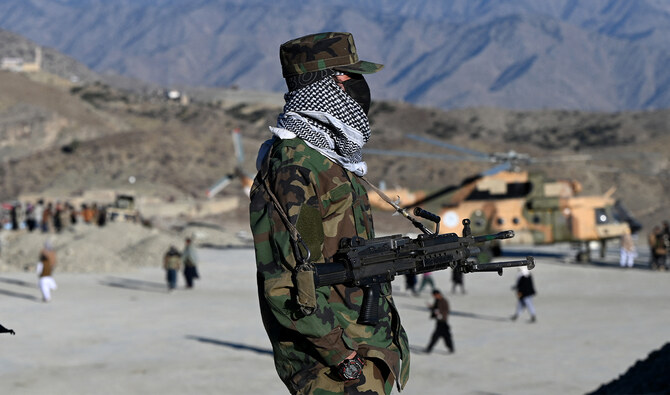
A Taliban security personnel stands guard in Sarana of Paktia province, south of Kabul, on December 12, 2024. (AFP/File)
Short Url
Updated 30 January 2025
Follow

Pakistan voices security concerns over presence of US weapons in Afghanistan

  • The weapons and equipment were reportedly left in the aftermath of a chaotic withdrawal of US and allied forces from Afghanistan in August 2021
  • Islamabad says it has repeatedly asked authorities in Kabul to take necessary measures to ensure these weapons do not fall into the wrong hands

ISLAMABAD: Pakistan on Wednesday voiced “profound concern” over the presence of advance United States (US) weapons in Afghanistan, which Washington has sought to be returned by Kabul’s Afghan Taliban rulers.

The weapons and equipment, coopted by the Afghan Taliban, were reportedly left behind in the aftermath of a chaotic withdrawal of US and allied forces from Afghanistan in August 2021. The previous administration of Joe Biden maintained that US forces had not left behind any equipment during the withdrawal that could be used by militants to target Pakistan.

However, President Donald Trump on Jan. 20 accused the Biden administration of giving “our military equipment, a big chunk of it, to the enemy,” conditioning Afghan aid to the return of these weapons. Afghanistan’s Taliban authorities on Wednesday called for the humanitarian aid not to be politicized.

“The presence of US advance weapons in Afghanistan, left behind in the aftermath of the withdrawal of its troops in August 2021, has been an issue of profound concern for the safety and security of Pakistan and its citizens,” the Pakistani foreign office said in a statement.

“These weapons have been used by terrorist organizations, including the TTP [Tehreek-e-Taliban Pakistan], to carry out terrorist attacks in Pakistan.”

The statement came months after Pakistani security sources said custom authorities had seized a large cache of US-made weapons and ammunition worth approximately Rs35 million ($125,000) at a border crossing between Pakistan and Afghanistan. The weapons seized at the Torkham border crossing in Pakistan’s northwestern Khyber Pakhtunkhwa (KP) province included M4 rifles and magazines, security sources said in Oct. last year.

Pakistan has struggled to contain surging militancy in KP since a fragile truce between the Pakistani Taliban, or the TTP, and the state broke down in November 2022.

The TTP and other militant groups have frequently targeted security forces convoys and check-posts, besides targeted killings and kidnappings of law enforcers and government officials in recent months.

In 2024 alone, the Pakistani military reported that 383 soldiers and 925 militants were killed in various clashes.

“We have been repeatedly calling upon the de facto authorities in Kabul to take all necessary measures to ensure that these weapons do not fall into the wrong hands,” the foreign office added.

The development comes at a time of strained ties between Pakistan and Afghanistan, and Islamabad has frequently blamed the surge in militancy on Afghanistan, accusing it of sheltering and supporting militant groups that launch cross-border attacks. Afghan officials deny involvement and insist that Pakistan’s security issues are an internal matter of Islamabad.


Bangladesh requests Pakistan to play T20 World Cup match against India on Feb. 15

Updated 8 sec ago
Follow

Bangladesh requests Pakistan to play T20 World Cup match against India on Feb. 15

  • Islamabad announced boycotting the Feb. 15 match in Colombo to protest the ICC’s exclusion of Bangladesh from the T20 World Cup
  • ’We are deeply moved by Pakistan’s efforts to go above and beyond in supporting Bangladesh during this period,’ the BCB chief says

ISLAMABAD: The Bangladesh Cricket Board (BCB) on Monday formally requested Pakistan to play its scheduled T20 World Cup match against arch-rival India on Feb. 15, following Islamabad’s decision to boycott the high-profile fixture.

Islamabad announced boycotting the Feb. 15 Pakistan-India match in Colombo to protest the International Cricket Council’s (ICC) exclusion of Bangladesh from the T20 World Cup, following Dhaka’s decision to not play matches in India owing to security fears.

On Sunday, ICC Deputy Chairman Imran Khwaja arrived in Lahore for talks with PCB officials and BCB President Aminul Islam as the sport’s governing body strived to save the high-stakes T20 World Cup encounter.

In a statement, the BCB thanked the PCB, ICC and all others for their positive roles in trying to “overcome recent challenges,” particularly thanking PCB Chairman Mohsin Naqvi and Pakistani cricket fans for demonstrating “exemplary sportsmanship and solidarity.”

“We are deeply moved by Pakistan’s efforts to go above and beyond in supporting Bangladesh during this period. Long may our brotherhood flourish,” BCB President Islam said in a statement.

“Following my short visit to Pakistan yesterday and given the forthcoming outcomes of our discussions, I request Pakistan to play the ICC T20 World Cup game on 15 February against India for the benefit of the entire cricket ecosystem.”

The dispute stemmed from the ICC’s decision to replace Bangladesh with Scotland last month after Bangladesh refused to play tournament matches in India. Dhaka’s decision followed the removal of Mustafizur Rahman from the Indian Premier League (IPL). He was bought for $1 million by the IPL’s Kolkata Knight Riders, but on Jan. 3 the Board of Control for Cricket in India (BCCI) ordered Kolkata to release Mustafizur without a public explanation but amid regional tensions.

Pakistani cricket authorities subsequently announced boycotting the match against India at R. Premadasa Stadium in Colombo on Feb. 15. An India-Pakistan fixture is the sport’s most lucrative asset, generating a massive share of global broadcasting and sponsorship revenue.

The PCB has remained defiant amid reports of potential sanctions. On Saturday, it rejected claims by Indian media that it had initiated a dialogue with the ICC to find a way out of the standoff.

The standoff highlights the growing friction within the sport’s governance, with Pakistan accusing India’s cricket board of influencing the ICC’s decisions. India generates the largest share of cricket’s commercial revenue and hence enjoys considerable influence over the sport. Critics argue that this financial contribution translates into decisive leverage within the ICC.

A large part of that revenue comes from the Indian Premier League (IPL), the sport’s most lucrative T20 cricket competition, which is run by the Board of Control for Cricket in India (BCCI). Between 2024 and 2027, the IPL is projected to earn $1.15 billion, nearly 39 percent of the ICC’s total annual revenue, according to international media reports.