

Bangladesh committed to meet demand for skilled workers in Saudi Arabia, top official says

1 / 3
Asif Nazrul, advisor to the Bangladesh Ministry of Law, Justice, Parliamentary Affairs, and Ministry of Expatriates' Welfare and Overseas Employment interacting with Saudi companies officials in Riyadh. (Supplied)
2 / 3
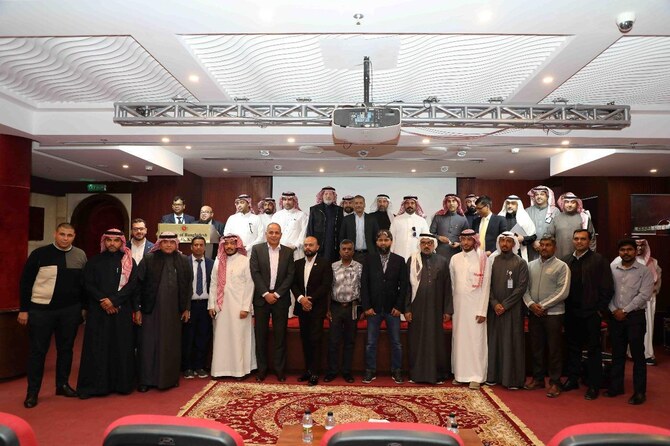
Delegates and officials posing for a Group photo at the Bangladesh Embassy event. (Supplied)
3 / 3
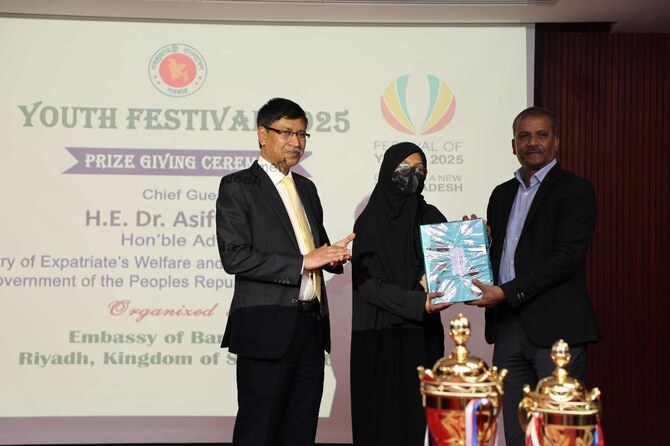
Asif Nazrul, advisor to the Bangladesh Ministry of Law, Justice, Parliamentary Affairs, and Ministry of Expatriates' Welfare and Overseas Employment and Bangladesh's new ambassador Delwar Hossain handing over prize to a winner of youth festival. (Supplied)
Short Url
Updated 29 January 2025
Follow

Bangladesh committed to meet demand for skilled workers in Saudi Arabia, top official says

  • Bangladesh government exploring options to facilitate expatriate participation, voting in national election

RIYADH: Bangladesh is committed to meeting demand for skilled workers in Saudi Arabia, said Asif Nazrul, adviser to the Bangladeshi Ministry of Law, Justice and Parliamentary Affairs, as well as the Ministry of Expatriates’ Welfare and Overseas Employment.

Speaking at a discussion organized at the Bangladesh Embassy in Riyadh with owners and senior officials of Saudi companies, Nazrul said that there were significant opportunities for Bangladesh to send skilled and semi-skilled workers, including doctors, engineers, nurses and technicians.

Nazrul, who is in Riyadh at the invitation of the Saudi Ministry of Human Resources and Social Development to attend the Global Labor Market Conference (Wednesday-Thursday), emphasized the need for qualitative changes in Bangladesh’s labor market in Saudi Arabia.

He highlighted the many employment prospects emerging from Saudi Arabia’s Vision 2030 initiatives, including mega projects such as NEOM, Red Sea, Qiddiya, Green Riyadh, Amala, Diriyah and Roshan, alongside major global events such as the AFC Asian Cup (2027), Winter Asian Olympics (2029), World Expo (2030) and FIFA World Cup (2034).

He sought the cooperation of Saudi recruitment companies, who acknowledged the presence of skilled professionals in Bangladesh but pointed out challenges such as inadequate information, marketing, networking, visa delays, language barriers and a lack of pre-boarding orientation.

Nazrul assured them of resolving these issues and emphasized strengthening ties through labor fairs, seminars and regular communication with company officials.

He also inaugurated the embassy’s e-demand attestation system, enabling Saudi companies to easily register online and attest worker demand letters without visiting the embassy, a key initiative for promoting transparency and efficiency.

Nazrul also distributed prizes to winners of competitions organized as part of the embassy’s “Festival of Youth 2025” on Wednesday.

Bangladesh’s new ambassador to Saudi Arabia, Delwar Hossain, welcomed the Saudi delegates at the interactive session.

Later, Nazrul interacted with Bangladeshi expatriates, listening to their concerns, including high airfare costs and excessive fees charged by recruiting agencies, and assured them of solutions and encouraged them to maintain close contact with the embassy through social media and its website. 

Appreciating their role in sending remittances, he assured the government’s continued welfare initiatives for expatriates and urged compliance with Saudi laws and culture to avoid legal complications.

On the issue of voting in national elections, he said that the government was exploring viable options to facilitate expatriate participation.


Carved by time: Saudi Arabia’s hidden geotourism gem of Razan

Updated 54 min 4 sec ago
Follow

Carved by time: Saudi Arabia’s hidden geotourism gem of Razan

  • Long before modern engineering, the geology of Razan functioned as effective natural infrastructure, sustaining life in an arid environment
  • This utility made Razan a strategic landmark, playing a vital role in the ancient Yemeni Hajj Road

AL-LITH: Sixty kilometers north of Al-Lith governorate in the Kingdom's west, rising above the shifting sands and valleys of the Makkah region, lies a place where the earth itself tells a story. This is Razan, a geological wonder where history is not written in ink, but etched into the stone by the patient hands of wind, water, and time.

Perched atop a high rocky mass and flanked by valleys to the northwest and southeast, Razan stands in natural isolation. This geographic solitude has acted as a guardian, preserving a landscape that feels almost otherworldly — a pristine stage set by nature over millennia.

The place is defined by its striking rock formations: dense clusters of stone, stepped ridges that resemble ancient staircases, and natural ceilings sculpted by the relentless flow of seasonal torrents.

The visual impact is one of dramatic contrast — the heaviness of solid rock balanced against open, airy spaces carved by erosion. Fine channels and intricate flow patterns mark the stone, serving as fossilized evidence of the water that once rushed through these corridors, shaping the land into a rugged work of art.
 

In the quiet majesty of Razan, the past is preserved. (SPA)

Nature’s infrastructure 

But Razan is more than just a scenic marvel; for centuries, it served as a lifeline. The same forces that sculpted the cliffs also hollowed out natural rock basins. These geological depressions acted as seasonal reservoirs, catching rainwater and supplementing nearby wells. Long before modern engineering, the geology of Razan functioned as effective natural infrastructure, sustaining life in an arid environment.

This utility made Razan a strategic landmark, playing a vital role in the ancient Yemeni Hajj Road. The sturdy, elevated terrain provided a natural pathway for pilgrims, offering stability and protection on their spiritual journey toward Makkah.

Today, Razan stands at the intersection of heritage and opportunity. No longer just a passage for pilgrims, it is emerging as a valuable asset for geotourism. Its unique topography offers a visual feast for travelers and a treasure trove for scientists studying geological history.

As Saudi Arabia moves toward the goals of Vision 2030, sites like Razan are finding new purpose. By transforming this geological narrative into a tourism destination, the region aims to preserve its natural heritage while breathing new life into the local economy.