

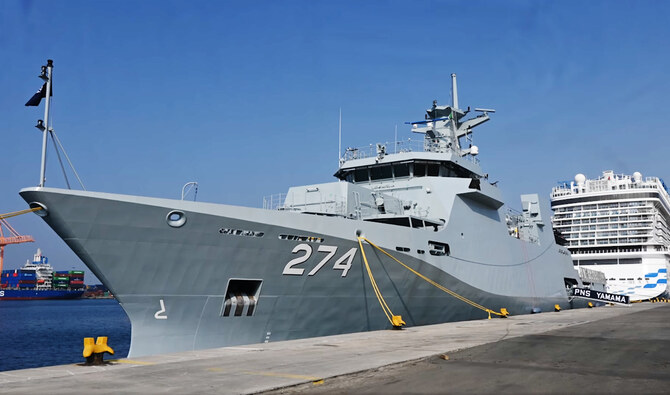
Pakistan Navy’s ‘Yamama’ holds bilateral exercise with Saudi ship in Jeddah

The handout image released by the Pakistan Navy on January 28, 2025, shows PNS ‘Yamama’ docked at the Jeddah Port, Saudi Arabia. (DG-PR Pakistan Navy)
Short Url
Updated 28 January 2025
Follow

Pakistan Navy’s ‘Yamama’ holds bilateral exercise with Saudi ship in Jeddah

  • Navy says exercise aimed to strengthen naval cooperation and enhance interoperability between the two allies
  • Ship’s crew held table-top discussions on maritime issues with Saudi naval leadership, says Pakistan Navy

ISLAMABAD: Pakistan Navy said its newly commissioned Yamama ship visited Jeddah on Tuesday where it met the Royal Saudi Naval Forces (RSNF) leadership and held a passage exercise (PASSEX) with the Kingdom’s ‘Makkah’ ship, saying the activities were designed to strengthen cooperation and foster interoperability. 

Yamama is Pakistan Navy’s fourth Offshore Patrol Vessel (OPV) that it says is equipped with advanced technologies and designed to operate in contested maritime environments. Upon its arrival at Jeddah port, the ship was received by senior RSNF officials and representatives from the Pakistan Embassy, the navy said. 

During its stay, the ship’s crew engaged in professional activities, including cross-ship visits, table-top discussions on maritime issues and meetings with the RSNF leadership. 

“Following the port visit, PNS YAMAMA conducted a PASSEX with HMS Makkah,” Pakistan Navy said. “The exercise was designed to strengthen naval cooperation and enhance interoperability between the two navies. Both forces reaffirmed their commitment to ensuring maritime security and promoting regional stability.”

The statement said Yamama’s visit to Saudi Arabia and the passage exercise further reinforced “strong brotherly relations” and defense collaboration between the two countries. 

Pakistan and Saudi Arabia enjoy strong defense ties and bilateral security cooperation. The two nations regularly engage in joint air, ground and sea military exercises while several cadets from the Kingdom, along with counterparts from other Middle Eastern nations, annually visit Pakistan to undergo specialized military training.

Apart from defense and security ties, Pakistan enjoys strong economic and trade relations with Saudi Arabia. The Kingdom is home to over two million Pakistani expatriates, serving as the top source of remittances for the cash-strapped South Asian country.


World Bank president in Pakistan to discuss development projects, policy issues

Updated 01 February 2026
Follow

World Bank president in Pakistan to discuss development projects, policy issues

  • Pakistan, World Bank are currently gearing up to implement a 10-year partnership framework to grant $20 billion loans to the cash-strapped nation
  • World Bank President Ajay Banga will hold meetings with Pakistan Prime Minister Shehbaz Sharif and other senior officials during the high-level visit

ISLAMABAD: World Bank President Ajay Banga has arrived in Pakistan to hold talks with senior government officials on development projects and key policy issues, Pakistani state media reported on Sunday, as Islamabad seeks multilateral support to stabilize economy and accelerate growth.

The visit comes at a time when Pakistan and the World Bank are gearing up to implement a 10-year Country Partnership Framework (CPF) to grant $20 billion in loans to the cash-strapped nation.

The World Bank’s lending for Pakistan, due to start this year, will focus on education quality, child stunting, climate resilience, energy efficiency, inclusive development and private investment.

"World Bank President Ajay Banga arrives in Pakistan for a high-level visit," the state-run Pakistan TV Digital reported on Sunday. "During his stay, he will meet Prime Minister Shehbaz Sharif and other senior officials to discuss economic reforms, development projects, and key policy issues."

Pakistan, which nearly defaulted on its foreign debt obligations in 2023, is currently making efforts to stabilize its economy under a $7 billion International Monetary Fund (IMF) program.

Besides efforts to boost trade and foreign investment, Islamabad has been seeking support from multilateral financial institutions to ensure economic recovery.

“This partnership fosters a unified and focused vision for your county around six outcomes with clear, tangible and ambitious 10-year targets,” Martin Raiser, the World Bank vice president for South Asia, had said at the launch of the CPF in Jan. last year.

“We hope that the CPF will serve as an anchor for this engagement to keep us on the right track. Partnerships will equally be critical. More resources will be needed to have the impact at the scale that we wish to achieve and this will require close collaboration with all the development partners.”

In Dec., the World Bank said it had approved $700 million in ​financing for Pakistan under a multi-year initiative aimed at supporting the country's macroeconomic stability and service delivery.

It ‍followed a $47.9 ‍million World Bank grant ‍in August last year to improve primary education in Pakistan's most populous Punjab province.