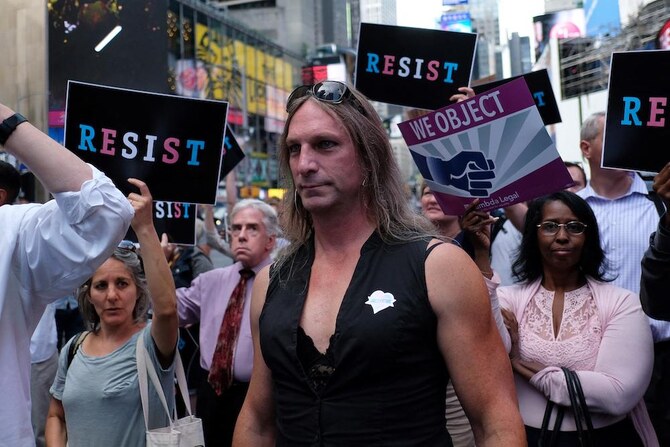
ABOARD AIR FORCE ONE: US President Donald Trump said Monday he had signed an executive order ridding the military of what he called “transgender ideology,” in a potentially major setback for LGBTQ rights.
In a series of orders related to the military that Trump told reporters he had signed on Air Force One, he also called for the building of a US version of Israel’s Iron Dome missile defense system.
The Republican signed further orders reinstating service members dismissed for refusing to take the COVID-19 vaccine, and extending a wider government crackdown on diversity programs to the armed forces.
“To ensure that we have the most lethal fighting force in the world, we will get transgender ideology the hell out of our military,” Trump told a Republican congressional retreat earlier in Miami.
Trump has previously promised to bring back a ban on transgender troops, but it was not immediately clear what specific steps were contained in the new order, which has not yet been published.
A White House official with him said the order involved “eliminating gender radicalism in the military.”
Trump’s orders came at the start of his second week back in the White House and on the day a welcome ceremony was held at the Pentagon for his new defense secretary, military veteran and Fox News personality Pete Hegseth.
“Thank you for your leadership Mr. President. We will execute!” Hegseth — who was confirmed last week despite concerns over his inexperience, and alleged record of heavy drinking and domestic violence — said on X.
Transgender Americans have faced a roller coaster of changing policies on military service in recent years, with Democratic administrations seeking to permit them to serve openly while Trump has repeatedly sought to keep them out of the ranks.
The US military lifted a ban on transgender troops serving in the armed forces in 2016, during Democrat Barack Obama’s second term as president.
Under that policy, trans troops already serving were permitted to do so openly, and transgender recruits were set to start being accepted by July 1, 2017.
But the first Trump administration postponed that date to 2018 before deciding to reverse the policy entirely, sparking criticism from rights groups.
Trump claimed that transgender service members were disruptive, expensive and eroded military readiness and camaraderie among troops.
Trump’s Democratic successor Joe Biden moved to reverse the restrictions just days after he took office in 2021, saying all Americans qualified to serve should be able to do so.
While the number of transgender troops in the American military is fairly small — with estimates of some 15,000 out of more than two million uniformed service members — their dismissal would reduce US forces at a time when the country is already facing difficulties recruiting new personnel.
Biden’s outgoing defense secretary Lloyd Austin appeared to criticize Trump’s plans during a farewell address earlier this month, saying: “Any military that turns away qualified patriots who are eager to serve is just making itself smaller and weaker.”
Transgender issues have roiled US politics in recent years, as states controlled by Democrats and Republicans have moved in opposite directions on policies ranging from medical treatment to what books on the topic are allowed in public or school libraries.
Trump has meanwhile repeatedly promised to build a version of the Iron Dome system that Israel has used to shoot down missiles fired by Hamas from Gaza and Hezbollah in Lebanon.
But he ignored the fact that the system is designed for short-range threats, making it ill-suited to defending against intercontinental missiles that are the main danger to the United States.
“We need to immediately begin the construction of a state-of-the-art Iron Dome missile defense shield,” Trump said in Miami, adding that it would be “made right here in the USA.”

Trump signs order to get ‘transgender ideology’ out of military
Short Url
https://arab.news/2cppz
Trump signs order to get ‘transgender ideology’ out of military
- He signed further orders reinstating service members dismissed for refusing to take the COVID-19 vaccine
- He extended a wider government crackdown on diversity programs to the armed forces
Japanese women MPs want more seats, the porcelain kind
TOKYO: Nearly 60 women lawmakers in Japan, including Prime Minister Sanae Takaichi, have submitted a petition calling for more toilets in the parliament building to match their improved representation.
Although the number of women politicians rose at the last election — and despite Takaichi becoming the first female prime minister in October — Japanese politics remains massively male-dominated.
This is reflected by there being only one lavatory containing two cubicles for the lower house’s 73 women to use near the Diet’s main plenary session hall in central Tokyo.
“Before plenary sessions start, truly so many women lawmakers have to form long queues in front of the restroom,” said Yasuko Komiyama from the opposition Constitutional Democratic Party.
She was speaking after submitting the cross-party petition signed by 58 women to Yasukazu Hamada, the chair of the lower house committee on rules and administration, earlier this month.
The Diet building was finished in 1936, nearly a decade before women got the vote in December 1945 following Japan’s defeat in World War II.
The entire lower house building has 12 men’s toilets with 67 stalls and nine women’s facilities with a total of 22 cubicles, according to the Yomiuri Shimbun newspaper.
Gender-rigid Japan ranked 118 out of 148 this year in the World Economic Forum’s Global Gender Gap Report. Women are also grossly under-represented in business and the media.
In elections, women candidates say that they often have to deal with sexist jibes, including being told that they should be at home looking after children.
Currently, 72 of 465 lower house lawmakers are women, up from 45 in the previous parliament, as are 74 of the 248 upper house members.
The government’s stated target is to have women occupy at least 30 percent of the legislative seats.
Takaichi, an admirer of former British premier Margaret Thatcher, said before becoming premier that she wanted “Nordic” levels of gender balance in her cabinet.
But, in the end, she appointed just two other women to her 19-strong cabinet.
Takaichi, 64, has said she hopes to raise awareness about women’s health struggles and has spoken candidly about her own experience with menopause.
But she is still seen as socially conservative.
She opposes revising a 19th-century law requiring married couples to share the same surname, and wants the imperial family to retain male-only succession.
The increasing demand for female loos can be seen as a sign of progress for Japan although it also reflects the nation’s failure to achieve gender equality, Komiyama said.
“In a way, this symbolizes how the number of female lawmakers has increased,” Komiyama told reporters, according to her party’s website, adding that she hoped for more equality in other areas of life.
Although the number of women politicians rose at the last election — and despite Takaichi becoming the first female prime minister in October — Japanese politics remains massively male-dominated.
This is reflected by there being only one lavatory containing two cubicles for the lower house’s 73 women to use near the Diet’s main plenary session hall in central Tokyo.
“Before plenary sessions start, truly so many women lawmakers have to form long queues in front of the restroom,” said Yasuko Komiyama from the opposition Constitutional Democratic Party.
She was speaking after submitting the cross-party petition signed by 58 women to Yasukazu Hamada, the chair of the lower house committee on rules and administration, earlier this month.
The Diet building was finished in 1936, nearly a decade before women got the vote in December 1945 following Japan’s defeat in World War II.
The entire lower house building has 12 men’s toilets with 67 stalls and nine women’s facilities with a total of 22 cubicles, according to the Yomiuri Shimbun newspaper.
Gender-rigid Japan ranked 118 out of 148 this year in the World Economic Forum’s Global Gender Gap Report. Women are also grossly under-represented in business and the media.
In elections, women candidates say that they often have to deal with sexist jibes, including being told that they should be at home looking after children.
Currently, 72 of 465 lower house lawmakers are women, up from 45 in the previous parliament, as are 74 of the 248 upper house members.
The government’s stated target is to have women occupy at least 30 percent of the legislative seats.
Takaichi, an admirer of former British premier Margaret Thatcher, said before becoming premier that she wanted “Nordic” levels of gender balance in her cabinet.
But, in the end, she appointed just two other women to her 19-strong cabinet.
Takaichi, 64, has said she hopes to raise awareness about women’s health struggles and has spoken candidly about her own experience with menopause.
But she is still seen as socially conservative.
She opposes revising a 19th-century law requiring married couples to share the same surname, and wants the imperial family to retain male-only succession.
The increasing demand for female loos can be seen as a sign of progress for Japan although it also reflects the nation’s failure to achieve gender equality, Komiyama said.
“In a way, this symbolizes how the number of female lawmakers has increased,” Komiyama told reporters, according to her party’s website, adding that she hoped for more equality in other areas of life.
© 2025 SAUDI RESEARCH & PUBLISHING COMPANY, All Rights Reserved And subject to Terms of Use Agreement.


