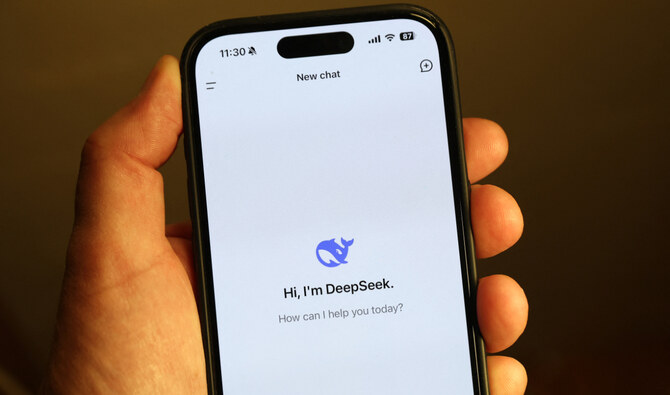
BEIJING: Chinese firm DeepSeek’s artificial intelligence chatbot has soared to the top of the Apple Store’s download charts, stunning industry insiders and analysts with its ability to match its US competitors.
The program has shaken up the tech industry and hit US titans including Nvidia, the AI chip juggernaut that saw nearly $600 billion of its market value erased, the most ever for one day on Wall Street.
Here’s what you need to know about DeepSeek:
DeepSeek was developed by a start-up based in the eastern Chinese city of Hangzhou, known for its high density of tech firms.
Available as an app or on desktop, DeepSeek can do many of the things that its Western competitors can do — write song lyrics, help work on a personal development plan, or even write a recipe for dinner based on what’s in the fridge.
It can communicate in multiple languages, though it told AFP that it was strongest in English and Chinese.
It is subject to many of the limitations seen in other Chinese-made chatbots like Baidu’s Ernie Bot — asked about leader Xi Jinping or Beijing’s policies in the western region of Xinjiang, it implored AFP to “talk about something else.”
But from writing complex code to solving difficult sums, industry insiders have been astonished by just how well DeepSeek’s abilities match the competition.
“What we’ve found is that DeepSeek... is the top performing, or roughly on par with the best American models,” Alexandr Wang, CEO of Scale AI, told CNBC.
That’s all the more surprising given what is known about how it was made.
In a paper detailing its development, the firm said the model was trained using only a fraction of the chips used by its Western competitors.
Analysts had long thought that the United States’ critical advantage over China when it comes to producing high-powered chips — and its ability to prevent the Asian power from accessing the technology — would give it the edge in the AI race.
But DeepSeek researchers said they spent only $5.6 million developing the latest iteration of their model — peanuts when compared with the billions US tech giants have poured into AI.
Shares in major tech firms in the United States and Japan have tumbled as the industry takes stock of the challenge from DeepSeek.
Chip making giant Nvidia — the world’s dominant supplier of AI hardware and software — closed down seventeen percent on Wall Street on Monday.
And Japanese firm SoftBank, a key investor in US President Donald Trump’s announcement of a new $500 billion venture to build infrastructure for artificial intelligence in the United States, lost more than eight percent.
Venture capitalist Marc Andreessen, a close adviser to Trump, described it as “AI’s Sputnik moment” — a reference to the Soviet satellite launch that sparked the Cold War space race.
“DeepSeek R1 is one of the most amazing and impressive breakthroughs I’ve ever seen,” he wrote on X.
Like its Western competitors Chat-GPT, Meta’s Llama and Claude, DeepSeek uses a large-language model — massive quantities of texts to train its everyday language use.
But unlike Silicon Valley rivals, which have developed proprietary LLMs, DeepSeek is open source, meaning anyone can access the app’s code, see how it works and modify it themselves.
“We are living in a timeline where a non-US company is keeping the original mission of OpenAI alive — truly open, frontier research that empowers all,” Jim Fan, a senior research manager at Nvidia, wrote on X.
DeepSeek said it “tops the leaderboard among open-source models” — and “rivals the most advanced closed-source models globally.”
Scale AI’s Wang wrote on X that “DeepSeek is a wake up call for America.”
Beijing’s leadership has vowed to be the world leader in AI technology by 2030 and is projected to spend tens of billions in support for the industry over the next few years.
And the success of DeepSeek suggests that Chinese firms may have begun leaping the hurdles placed in their way.
Last week DeepSeek’s founder, hedge fund manager Liang Wenfeng, sat alongside other entrepreneurs at a symposium with Chinese Premier Li Qiang — highlighting the firm’s rapid rise.
Its viral success also sent it to the top of the trending topics on China’s X-like Weibo website Monday, with related hashtags pulling in tens of millions of views.
“This really is an example of spending a little money to do great things,” one user wrote.


![]()

DeepSeek: Chinese AI firm sending shock waves through US tech
Short Url
https://arab.news/rtzbu
DeepSeek: Chinese AI firm sending shock waves through US tech
- The program has shaken up the tech industry and hit US titans including Nvidia, the AI chip juggernaut that saw nearly $600 billion of its market value erased, the most ever for one day on Wall Street


Latest updates


© 2026 SAUDI RESEARCH & PUBLISHING COMPANY, All Rights Reserved And subject to Terms of Use Agreement.