

Oman, India revise deal to avoid double taxation

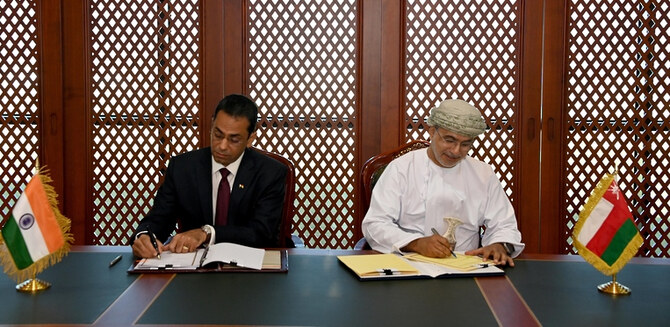
The agreement was signed in Muscat on Jan. 27 by Nasser bin Khamis Al-Jashmi, Chairman of Oman’s Tax Authority, and Indian Ambassador to Oman Amit Narang, as reported by Oman News Agency.
Short Url
Updated 27 January 2025
Follow

Oman, India revise deal to avoid double taxation

JEDDAH: Oman and India have finalized an updated protocol to prevent double taxation and curb financial evasion related to income taxes, further bolstering their economic ties.

The agreement was signed in Muscat on Jan. 27 by Nasser bin Khamis Al-Jashmi, Chairman of Oman’s Tax Authority, and Indian Ambassador to Oman Amit Narang, as reported by Oman News Agency.

Al-Jashmi highlighted the importance of the new protocol in strengthening economic relations between the two countries, noting that the agreement is the result of ongoing efforts to enhance bilateral cooperation in the tax sector.

In December, Oman also signed a similar agreement with Tanzania to deepen their strategic partnership.

That deal aimed to foster an attractive investment climate, protect investors from double taxation, and increase transparency in financial transactions.

In October, Al-Jashmi represented Oman in signing a similar agreement with Estonia. The agreement adhered to the standard framework set by the Organization for Economic Co-operation and Development.

According to a statement from Estonia's Ministry of Foreign Affairs, the agreement was designed to provide a stable tax environment for both foreign entrepreneurs investing in Estonia and Estonian businesses expanding internationally.

The ministry emphasized that the primary goal of double taxation avoidance agreements was to foster investment between the signatory countries.

Additionally, the ministry highlighted that foreign investors value the assurance that they will not face a higher tax burden than local businesses operating in the target country.

As of October 2024, India exported $410 million worth of goods to Oman and imported $743 million, resulting in a trade deficit of $334 million, according to the Observatory of Economic Complexity.

India’s top exports to Oman included petroleum products valued at $146 million, processed minerals at $24.4 million, and basmati rice at $15 million. Iron and steel exports totaled $13.9 million, while ships, boats, and floating structures contributed $9.93 million.

On the import side, India’s purchases from Oman were led by fertilizers, totaling $118 million. Petroleum products accounted for $92.5 million, and ships, boats, and floating structures reached $77.5 million. Other commodities amounted to $45.2 million, while crude petroleum was valued at $43.5 million.


Fiscal discipline critical as high interest rates persist: Saudi finance minister  

Updated 22 sec ago
Follow

Fiscal discipline critical as high interest rates persist: Saudi finance minister  

RIYADH: Saudi Arabia’s finance minister warned that both advanced and emerging economies risk long-term instability if governments rely on borrowing and optimistic assumptions instead of disciplined fiscal management, as global interest rates are likely to remain elevated for years.  

Speaking during a panel at the annual AlUla Conference for Emerging Market Economies, Mohammed Al-Jadaan said countries are unlikely to see meaningful monetary easing in the near term, underscoring the need to preserve fiscal space and prioritize spending that supports sustainable growth.   

“We are unlikely to see an easing in monetary policy in the few years to come,” he said, adding that while interest rates may come down from current levels, they are “not too much lower” than where they are now, reinforcing the need to focus on fiscal policy.  

Al-Jadaan cautioned that some advanced economies are now repeating mistakes long associated with emerging markets. “Some advanced economies are going through the same struggles because they are falling into the same trap that emerging economies fell into, thinking they could live through it, and unfortunately, it is not sustainable,” he said.  

He said that unless governments treat fiscal policy as a serious balance-sheet issue rather than a cash-flow exercise, they risk falling into the trap of spending whenever they can borrow money, noting that countries can become insolvent even while holding cash if liabilities outpace assets.  

Al-Jadaan emphasized the importance of building fiscal buffers during periods of economic strength. “Where you fail is when you are in good times and fail to build the buffers,” he said, adding that inflated revenue assumptions often lead governments into debt when anticipated income does not materialize.  

The importance of buffers was echoed by Pakistan’s Finance Minister Muhammad Aurangzeb, who said the issue is far from academic for Pakistan. “The bane of our country has been the twin structural deficits, so we need to religiously guard the progress we have made over the last two to three years in terms of successive primary surpluses,” Aurangzeb said.  

He pointed to a sharp improvement in Pakistan’s fiscal position. “We hit about 8 percent fiscal deficit, and we are now at about 5.4 percent, and the current trajectory looks good in terms of bringing it even below 5 percent,” he said, citing gains across revenue, expenditure, and debt management.  

Aurangzeb said recent climate shocks had underscored the value of fiscal space. “Three years back we had a catastrophic flood and had to go into international appeal, but with the fiscal space we had available last year, we could muster our own resources to absorb that shock,” he said, adding that buffers allow governments to respond to exogenous events without destabilizing public finances.  

Both ministers warned against using borrowing as a shortcut to growth. “You don’t finance growth by throwing more money and borrowing more money,” Al-Jadaan said, calling for prioritization and efficiency in spending and treating fiscal space as a strategic asset.  

Al-Jadaan also distinguished between productive and unproductive deficits, warning that “bad deficit is a deficit that is not going to yield any growth and instead yields a liability for the future,” particularly when it finances consumption or recurring operating costs. By contrast, he said investment in infrastructure such as airports, ports, and railroads can act as a catalyst for private sector investment.  

Aurangzeb said Pakistan is pursuing reforms to support that approach, including expanding the tax base and reducing governance leakages. “We were below 10 percent tax to GDP and are now close to 12 percent,” he said, adding that technology and AI-led monitoring are helping curb “leakage and theft,” which he described as a euphemism for corruption.  

He also pointed to progress on debt. “Our debt-to-GDP ratio was about 74 percent and is now down to 70 percent,” Aurangzeb said, noting that greater fiscal discipline could free up resources for sectors such as human capital, agriculture, and information technology.  

Al-Jadaan concluded by warning that even well-intentioned borrowing carries risks. “Even on the good deficit side, markets are brutal,” he said, cautioning that excessive borrowing at a rapid pace can push up funding costs across the wider economy.