

Rubio threatens bounties on Taliban leaders over detained Americans

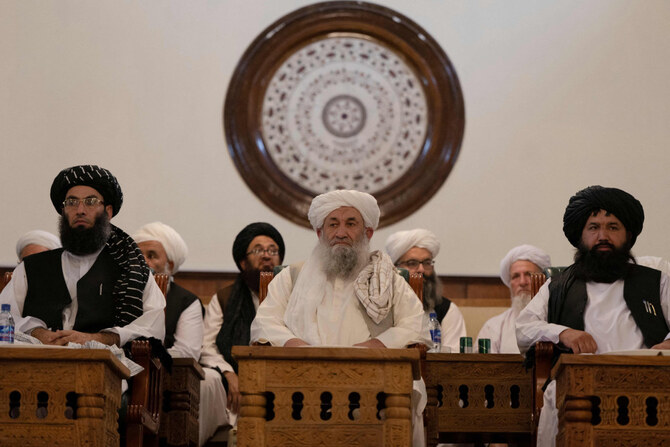
This photo taken on August 13, 2022, shows Afghanistan's Prime Minister Mohammad Hassan Akhund (C) and Minister for Promotion of Virtue and Prevention of Vice Sheikh Mohammad Khalid (L) at a gathering at the former presidential palace in Kabul. (AFP)
Short Url
Updated 26 January 2025
Follow

Rubio threatens bounties on Taliban leaders over detained Americans

  • The new top US diplomat issued the harsh warning via social media, days after the Afghan Taliban government and the US swapped prisoners in one of the final acts of former president Joe Biden

WASHINGTON: US Secretary of State Marco Rubio on Saturday threatened bounties on the heads of Afghanistan’s Taliban leaders, sharply escalating the tone as he said more Americans may be detained in the country than previously thought.
The threat comes days after the Afghan Taliban government and the United States swapped prisoners in one of the final acts of former president Joe Biden.
The new top US diplomat issued the harsh warning via social media, in a rhetorical style strikingly similar to his boss, President Donald Trump.
“Just hearing the Taliban is holding more American hostages than has been reported,” Rubio wrote on X.
“If this is true, we will have to immediately place a VERY BIG bounty on their top leaders, maybe even bigger than the one we had on bin Laden,” he said, referring to the Al-Qaeda leader killed by US forces in 2011.
Rubio did not describe who the other Americans may be, but there have long been accounts of missing Americans whose cases were not formally taken up by the US government as wrongful detentions.
In the deal with the Biden administration, the Taliban freed the best-known American detained in Afghanistan, Ryan Corbett, who had been living with his family in the country and was seized in August 2022.
Also freed was William McKenty, an American about whom little information has been released.
The United States in turn freed Khan Mohammed, who was serving a life sentence in a California prison.
Mohammed was convicted of trafficking heroin and opium into the United States and was accused of seeking rockets to kill US troops in Afghanistan.
The United States offered a bounty of $25 million for information leading to the capture or killing of Osama bin Laden shortly after the September 11, 2001 terror attacks, with Congress later authorizing the secretary of state to offer up to $50 million.
No one is believed to have collected the bounty for bin Laden, who was killed in a US raid in Pakistan.

Trump is known for brandishing threats in his speeches and on social media. But he is also a critic of US military interventions overseas and in his second inaugural address Monday said he aspired to be a “peacemaker.”
In his first term, the Trump administration broke a then-taboo and negotiated directly with the Taliban — with Trump even proposing a summit with the then-insurgents at the Camp David presidential retreat — as he brokered a deal to pull US troops and end America’s longest war.
Biden carried out the agreement, with the Western-backed government swiftly collapsing and the Taliban retaking power in August 2021 just after US troops left.
The scenes of chaos in Kabul brought strong criticism of Biden, especially when 13 American troops and scores of Afghans died in a suicide bombing at the city’s airport.
The Biden administration had low-level contacts with Taliban government representatives but made little headway.
Some members of Trump’s Republican Party criticized even the limited US engagements with the Taliban government and especially the humanitarian assistance authorized by the Biden administration, which insisted the money was for urgent needs in the impoverished country and never routed through the Taliban.
Rubio on Friday froze nearly all US aid around the world.
No country has officially recognized the Taliban government, which has imposed severe restrictions on women and girls under its ultra-conservative interpretation of Islam.
The International Criminal Court’s chief prosecutor on Thursday said he was seeking arrest warrants for senior Taliban leaders over the persecution of women.


Hungary says it will block a key EU loan to Ukraine until Russian oil shipments resume

Updated 9 sec ago
Follow

Hungary says it will block a key EU loan to Ukraine until Russian oil shipments resume

  • Szijjártó said: “As long as Ukraine blocks the resumption of oil supplies to Hungary, Hungary will block European Union decisions that are important and favorable for Ukraine”
  • Hungary’s decision to block the key funding came two days after it suspended diesel shipments

BUDAPEST: Hungary will block a planned 90-billion-euro ($106-billion) European Union loan to Ukraine until the flow of Russian oil through the Druzhba pipeline resumes, Hungary’s foreign minister said.
Russian oil shipments to Hungary and Slovakia have been interrupted since Jan. 27 after what Ukrainian officials said was a Russian drone attack damaged the Druzhba pipeline, which carries Russian crude across Ukrainian territory and into Central Europe.
Hungary and Slovakia, which have both received a temporary exemption from an EU policy prohibiting imports of Russian oil, have accused Ukraine — without providing evidence — of deliberately holding up supplies. Both countries ceased shipping diesel to Ukraine this week over the interruption in oil flows .
In a video posted on social media Friday evening, Foreign Minister Péter Szijjártó accused Ukraine of “blackmailing” Hungary by failing to restart shipments. He said his government would block a massive interest-free loan the EU approved in December to help Kyiv to meet its military and economic needs for the next two years.
“We will not give in to this blackmail. We do not support Ukraine’s war, we will not pay for it,” Szijjártó said. “As long as Ukraine blocks the resumption of oil supplies to Hungary, Hungary will block European Union decisions that are important and favorable for Ukraine.”
Hungary’s decision to block the key funding came two days after it suspended diesel shipments to its embattled neighbor and only days before the fourth anniversary of Russia’s full-scale invasion.
Nearly every country in Europe has significantly reduced or entirely ceased Russian energy imports since Moscow launched its war in Ukraine on Feb. 24, 2022. Yet Hungary and Slovakia — both EU and NATO members — have maintained and even increased supplies of Russian oil and gas.
Hungary’s nationalist Prime Minister Viktor Orbán has long argued Russian fossil fuels are indispensable for its economy and that switching to energy sourced from elsewhere would cause an immediate economic collapse — an argument some experts dispute.
Widely seen as the Kremlin’s biggest advocate in the EU, Orbán has vigorously opposed the bloc’s efforts to sanction Moscow over its invasion, and blasted attempts to hit Russia’s energy revenues that help finance the war. His government has frequently threatened to veto EU efforts to assist Ukraine.
On Saturday, Slovakia’s populist Prime minister Robert Fico said his country will stop providing emergency electricity supplies to Ukraine if oil is not flowing through the Druzhba by Monday. Orbán’s chief of staff, Gergely Gulyás, said earlier this week that Hungary, too, was exploring the possibility of cutting off its electricity supplies to Ukraine.
Not all of the EU’s 27 countries agreed to take part in the 90-billion-euro loan package for Kyiv. Hungary, Slovakia and the Czech Republic opposed the plan, but a deal was reached in which they did not block the loan and were promised protection from any financial fallout.