

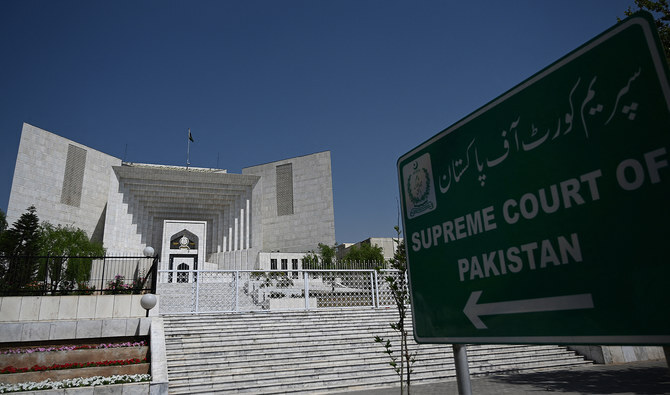

ISLAMABAD: Former prime minister Imran Khan’s Pakistan Tehreek-e-Insaf (PTI) party announced on Saturday it has challenged a contentious constitutional amendment on judicial reforms in the Supreme Court, urging the top court to declare it null and void as the government allegedly harassed opposition lawmakers to have it passed in parliament.
The ruling coalition government passed the contentious 26th constitutional amendment bill from both houses of parliament in October 2024, amid stiff resistance from opposition parties and the legal fraternity. Both argued the government’s move was an attempt to curtail the independence of the judiciary, a charge it denies.
The amendments empower a parliamentary committee to appoint the Supreme Court’s chief justice for a fixed term of three years. It also called for the creation of new group of senior judges to weigh exclusively on constitutional issues.
The government secured 225 votes of the required 224 in the National Assembly, or the lower house of parliament, with the help of a handful of rebel lawmakers from the PTI. The party has claimed that the government harassed and intimidated opposition lawmakers and their families to secure the votes. The government denies the allegations vehemently.
“Legal team representing Pakistan Tehreek e Insaf has challenged the 26th amendment in the Supreme Court of Pakistan, requesting to declare its status null & void along with constitutional benches formation & decisions by the judicial bench,” a statement from the party said.
The PTI alleged that lawmakers were harassed and abducted to ensure the amendments were passed.
“The 26th amendment was opposed by the party at many levels that publicly criticized the process of pushing through the 26th amendment, with individuals being coerced into voting and genuine consent was not involved,” the PTI added.
As per a summary of the petition filed in the Supreme Court, the party has maintained that the 26th amendment introduces “unprecedented and substantial” changes to the fundamental structure and salient features of the constitution.
The development takes place a day after Bilawal Bhutto Zardari, the chairman of the government’s key coalition partner Pakistan Peoples Party, said only parliament has the power to roll back the 26th constitutional amendment.
“As far as rolling back the 26th [constitutional] amendment is concerned, that power only rests with this institution,” Bhutto Zardari told reporters at the National Assembly, referring to the lower house of parliament.
“Neither will we accept nor will the nation nor anyone else if the constitution is rolled back or undermined by another institution.”
TENSIONS WITH THE TOP COURT
The amendment fixing the top justice’s retirement age was passed days before Qazi Faez Isa, the then chief justice, was due to retire.
Khan’s PTI frequently accused Isa of being aligned with the government, its chief rival, an allegation the government has always rejected. Khan’s party repeatedly said the amendments were aimed at granting an extension in tenure to Isa.
Under the previous law, Isa would have been automatically replaced by the most senior judge behind him, currently Justice Mansoor Ali Shah, who consistently issued verdicts deemed favorable to Khan and the PTI.
Sharif’s government has said the bill ensures parliament will not remain “a rubber stamp” one in the wake of its tensions with the judiciary, which were on the rise since the February national election of last year.


