Lebanon army accuses Israel of ‘procrastination’ in ceasefire withdrawal

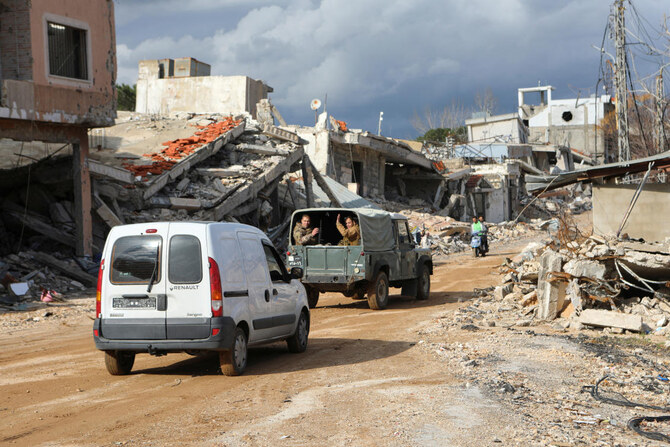
FILE PHOTO: Lebanese army members gesture as they drive through a damaged site at the Lebanese village of Khiam, near the border with Israel, southern Lebanon, January 23, 2025. (Reuters)
Short Url
Updated 25 January 2025
Follow

Lebanon army accuses Israel of ‘procrastination’ in ceasefire withdrawal

BEIRUT: Lebanon’s army accused Israel of procrastinating in withdrawing troops from south Lebanon as required under a ceasefire that ended the war with Hezbollah, a day after Israel said its forces would remain beyond a Sunday deadline for their departure.
The Lebanese army, in a statement issued on Saturday, also urged Lebanese residents to wait before heading into the border region, citing the presence of mines and unexploded Israeli ordnance.
Under the US-brokered agreement, which took effect on Nov. 27, Hezbollah weapons and fighters must be removed from areas south of the Litani River and Israeli troops should withdraw as the Lebanese military deploys into the region, all within a 60-day time frame, meaning by Sunday at 4 a.m. (0200 GMT).
Israeli Prime Minister Benjamin Netanyahu’s office said on Friday the terms had not been fully enforced by the Lebanese state. The White House said a short, temporary ceasefire extension was urgently needed.
The US-backed Lebanese army said it had continued to implement the plan to strengthen its deployment south of the Litani River since the ceasefire came into effect.
“Delays occurred in a number of the phases as a result of procrastination in the withdrawal by the Israeli enemy, which complicated the mission of the army’s deployment,” the statement said. The army “maintains its readiness to complete its deployment as soon as the Israeli enemy withdraws,” it added.
The ceasefire ended more than a year of hostilities which were triggered by the Gaza war and peaked in a major Israeli offensive against the Iran-backed Hezbollah, which uprooted more than a million people in Lebanon.
The Israeli government has not said how much longer its forces might remain in south Lebanon, where the Israeli military says it has been seizing Hezbollah weapons and dismantling infrastructure used by the Shiite armed group.
Hezbollah, which suffered major blows in the war, said on Thursday that any delay of Israel’s withdrawal would be an unacceptable breach of the deal and put the onus on the Lebanese state to act. Hezbollah said the state would have to deal with such a violation “through all means and methods guaranteed by international charters.”
Israel said its campaign against Hezbollah aimed to secure the return home of tens of thousands of people forced by Hezbollah rocket fire to leave their homes in northern Israel.


January settler attacks cause record West Bank displacement since Oct 2023: UN

Updated 8 sec ago
Follow

January settler attacks cause record West Bank displacement since Oct 2023: UN

RAMALLAH: Israeli settler violence and harassment in the occupied West Bank displaced nearly 700 Palestinians in January, the United Nations said Thursday, the highest rate since the Gaza war erupted in October 2023.
At least 694 Palestinians were forcefully driven from their homes last month, according to figures from the UN’s humanitarian agency OCHA, which compiles data from various United Nations agencies.
The UN Human Rights Office (OHCHR) said in late January that settler violence has become a key driver of forced displacement in the West Bank.
January’s displacement numbers were particularly high in part due to the displacement of an entire herding community in the Jordan Valley, Ras Ein Al-Auja, whose 130 families left after months of harassment.
“What is happening today is the complete collapse of the community as a result of the settlers’ continuous and repeated attacks, day and night, for the past two years,” Farhan Jahaleen, a Bedouin resident, told AFP at the time.
Settlers in the West Bank, which Israel has occupied since 1967, use herding to establish a presence on agricultural lands used by Palestinian communities and gradually deny them access to these areas, according to a 2025 report by Israeli NGO Peace Now.
To force Palestinians out, settlers resort to harassment, intimidation and violence, “with the backing of the Israeli government and military,” the settlement watchdog said.
“No one is putting the pressure on Israel or on the Israeli authorities to stop this and so the settlers feel it, they feel the complete impunity that they’re just free to continue to do this,” said Allegra Pacheco, director of the West Bank Protection Consortium, a group of NGOS working to support Palestinian communities against displacement.
She pointed to a lack of attention on the West Bank as another driving factor.
“All eyes are focused on Gaza when it comes to Palestine, while we have an ongoing ethnic cleansing in the West Bank and nobody’s paying attention,” she told AFP.
West Bank Palestinians are also displaced when Israel’s military destroys structures and dwellings it says are built without permits.
In January, 182 more Palestinians were displaced due to home demolitions, according to OCHA.
Excluding Israeli-annexed east Jerusalem, the West Bank is home to more than 500,000 Israelis living in settlements and outposts considered illegal under international law.
Around three million Palestinians live in the West Bank.