

Pakistan minister criticizes opposition for ‘unilaterally’ ending talks with government

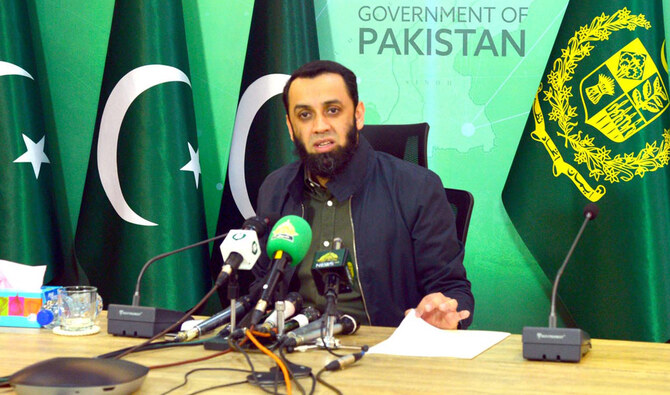
Pakistan’s Information Minister Ataullah Tarar speaks during a press conference in Islamabad on November 23, 2024. (PID/File)
Short Url
Updated 25 January 2025
Follow

Pakistan minister criticizes opposition for ‘unilaterally’ ending talks with government

  • Information Minister Ataullah Tarar says Imran Khan’s party ended talks “in a hurry with ill intention”
  • Khan’s PTI has ruled out further talks unless government forms judicial commissions to probe protests

ISLAMABAD: Pakistan’s Information Minister Ataullah Tarar this week criticized former prime minister Imran Khan’s Pakistan Tehreek-e-Insaf (PTI) party for ending negotiations “unilaterally” with the government, saying it should have waited for the other side’s response. 

PTI leader Omar Ayub Khan announced the party’s decision to end further talks with the government on Thursday, saying that it would only resume negotiations to break political tensions if authorities established judicial commissions to investigate violence at anti-government protests organized by the PTI. 

Negotiations between the two sides kicked off in December 2024 after Khan threatened a civil disobedience movement. Both sides held three rounds of talks, and the government was expected to submit a formal response to the PTI’s demands on Jan. 28. 

“Minister for Information and Broadcasting Attaullah Tarar says Pakistan Tehreek-e-Insaf unilaterally terminated the dialogue process without any reason,” state broadcaster Radio Pakistan reported on Friday. 

The minister said the PTI should have waited for the government’s response to their demands, lamenting that it took the decision to end talks in a “hurry with ill intention.” 

Khan’s ouster in a parliamentary no-trust vote in 2022 has plunged Pakistan into a political crisis, particularly since he was jailed in August 2023 on corruption and other charges. His PTI party has regularly held protests to demand his release, with many of the demonstrations turning violent. 

But despite the government-opposition stalemate, Junaid Akbar Khan, a lawmaker from the PTI, was elected on Friday unopposed as the head of the National Assembly’s Public Accounts Committee (PAC), according to a statement issued by the National Assembly Secretariat. The post of the PAC chairman had been vacant since the general election in February last year.

The PTI’s demands to the government revolve around the release of all political prisoners including Khan, and the formation of two judicial commissions to probe into violent protest rallies, including one on May 9, 2023, when PTI supporters rampaged through military offices and installations, and a second one on Nov. 26, 2024 to demand Khan’s release, in which the government says four troops were killed.

So far, the government has remained tight-lipped on whether or not it would form the judicial commissions as per the PTI’s demands.


Pakistan flags funding strain, host state cooperation gaps in UN peacekeeping

Updated 7 sec ago
Follow

Pakistan flags funding strain, host state cooperation gaps in UN peacekeeping

  • Pakistan says blue helmets remain the most visible symbol of UN commitment to peace
  • The country urges member states to pay contributions on time to sustain UN missions

ISLAMABAD: Pakistan on Friday raised concerns over mounting financial pressures on United Nations peacekeeping operations along with a lack of cooperation from some host countries, warning that the challenges risk undermining the effectiveness and safety of missions worldwide.

Pakistan’s top diplomat at the UN flagged the issues while speaking at a UN Security Council briefing on peacekeeping police components.

Pakistan is one of the world’s top troop-contributing countries and has deployed more than 235,000 peacekeepers to 48 UN missions across four continents over the past eight decades.

A total of 182 of its peacekeepers have also lost their lives while serving under the UN flag.

“We are concerned at the current challenges faced by the United Nations peacekeeping, both financial as well as those arising from lack of host state cooperation,” Ambassador Asim Iftikhar Ahmad told the council. “Pakistan underscores the importance of full cooperation by host States to enable timely deployment of peacekeepers including police components where authorized by the Security Council.”

He noted that UN missions were operating under acute financial stress, leading to capacity reductions that directly affected mandate delivery and the safety of peacekeepers, while UN police units continued to face gaps between authorized strength and actual deployments.

Ahmad urged UN member states to pay their assessed contributions in full and on time to ensure peacekeeping missions remain operationally capable.

“Blue helmets are the most visible symbol of the United Nations commitment to peace and stability,” he said. “Peacekeeping brings relevance and legitimacy to this organization by making a tangible difference in people’s lives.”

Pakistan has contributed both military and police personnel to UN operations, deploying more than 50 formed police units to missions including Haiti, Darfur, Timor-Leste and Côte d’Ivoire, according to Pakistan’s UN mission.