

Pakistan minister criticizes opposition for ‘unilaterally’ ending talks with government

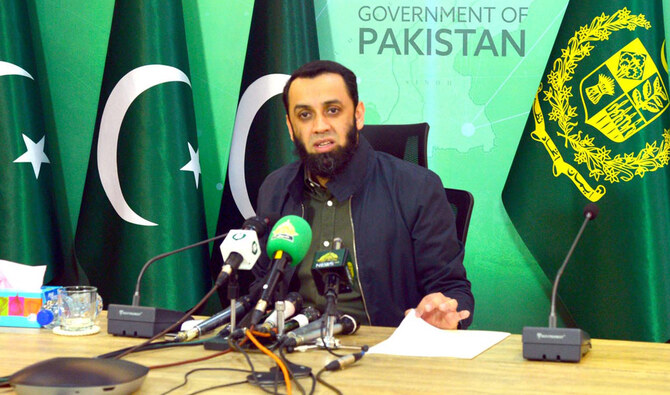
Pakistan’s Information Minister Ataullah Tarar speaks during a press conference in Islamabad on November 23, 2024. (PID/File)
Short Url
Updated 25 January 2025
Follow

Pakistan minister criticizes opposition for ‘unilaterally’ ending talks with government

  • Information Minister Ataullah Tarar says Imran Khan’s party ended talks “in a hurry with ill intention”
  • Khan’s PTI has ruled out further talks unless government forms judicial commissions to probe protests

ISLAMABAD: Pakistan’s Information Minister Ataullah Tarar this week criticized former prime minister Imran Khan’s Pakistan Tehreek-e-Insaf (PTI) party for ending negotiations “unilaterally” with the government, saying it should have waited for the other side’s response. 

PTI leader Omar Ayub Khan announced the party’s decision to end further talks with the government on Thursday, saying that it would only resume negotiations to break political tensions if authorities established judicial commissions to investigate violence at anti-government protests organized by the PTI. 

Negotiations between the two sides kicked off in December 2024 after Khan threatened a civil disobedience movement. Both sides held three rounds of talks, and the government was expected to submit a formal response to the PTI’s demands on Jan. 28. 

“Minister for Information and Broadcasting Attaullah Tarar says Pakistan Tehreek-e-Insaf unilaterally terminated the dialogue process without any reason,” state broadcaster Radio Pakistan reported on Friday. 

The minister said the PTI should have waited for the government’s response to their demands, lamenting that it took the decision to end talks in a “hurry with ill intention.” 

Khan’s ouster in a parliamentary no-trust vote in 2022 has plunged Pakistan into a political crisis, particularly since he was jailed in August 2023 on corruption and other charges. His PTI party has regularly held protests to demand his release, with many of the demonstrations turning violent. 

But despite the government-opposition stalemate, Junaid Akbar Khan, a lawmaker from the PTI, was elected on Friday unopposed as the head of the National Assembly’s Public Accounts Committee (PAC), according to a statement issued by the National Assembly Secretariat. The post of the PAC chairman had been vacant since the general election in February last year.

The PTI’s demands to the government revolve around the release of all political prisoners including Khan, and the formation of two judicial commissions to probe into violent protest rallies, including one on May 9, 2023, when PTI supporters rampaged through military offices and installations, and a second one on Nov. 26, 2024 to demand Khan’s release, in which the government says four troops were killed.

So far, the government has remained tight-lipped on whether or not it would form the judicial commissions as per the PTI’s demands.


Islamic military coalition, Pakistan to deepen cooperation to combat ‘terrorism’ — Pakistani military

Updated 02 February 2026
Follow

Islamic military coalition, Pakistan to deepen cooperation to combat ‘terrorism’ — Pakistani military

  • Islamic Military Counter Terrorism Coalition is a 43-member alliance that includes Pakistan, Saudi Arabia, Egypt, Jordan, UAE and other nations
  • The Pakistani military statement comes after a meeting between IMCTC secretary-general and the chief of Pakistani defense forces in Rawalpindi

ISLAMABAD: Pakistan and the Islamic Military Counter Terrorism Coalition (IMCTC) have reaffirmed their commitment to deepening cooperation, including intelligence sharing and capacity building, to jointly combat “terrorism” and “extremism,” the Pakistani military said on Monday.

The IMCTC is a 43-member military alliance that was formed on Saudi Arabia’s initiative in Dec. 2015 to consolidate Muslim countries’ efforts in countering “terrorism.”

A 17-member IMCTC delegation is visiting Pakistan from Feb. 2-6 to conduct a training at National University of Sciences and Technology on “Re-integration and Rehabilitation of Extremist Elements,” according to the Pakistani military.

On Monday, IMCTC Secretary-General Maj. Gen. Mohammed bin Saeed Al-Moghedi held a meeting with Chief of Pakistani Defense Forces Field Marshal Asim Munir to discuss cooperation among IMCTC member states.

“During the meeting, matters of mutual interest were discussed, with particular emphasis on regional security dynamics and enhanced cooperation in counter-terrorism efforts,” the Inter-Services Public Relations (ISPR), the Pakistani military’s media wing, said in a statement.

“Both sides reaffirmed their shared commitment to combating terrorism and extremism through collaborative strategies, intelligence sharing, and capacity building among member states.”

The IMCTC features Pakistan, Saudi Arabia, Türkiye, Afghanistan, Egypt, Jordan, Qatar, Palestine, UAE, Bangladesh and other nations. In 2017, Pakistan’s former army chief Gen. (retd) Raheel Sharif was appointed as the IMCTC commander-in-chief.

During discussions with Major General Al-Moghedi, Field Marshal Munir appreciated the role of IMCTC in fostering stability and promoting coordinated counterterrorism initiatives across the Islamic world, according to the ISPR.

The IMCTC secretary-general acknowledged Pakistan’s significant contributions and sacrifices in the fight against militancy and lauded the professionalism of Pakistan’s armed forces.

“The meeting underscored the resolve of both sides to further strengthen institutional collaboration for peace, stability, and security in the region,” the ISPR added.

Pakistan enjoys cordial ties with most Muslim countries around the world, particularly Gulf Cooperation Council countries. In Sept. 2025, Pakistan signed a landmark defense pact with Saudi Arabia according to which an act of aggression against one country will be treated as an act of aggression against both.