Pakistan says finalizing agreement with Azerbaijan on arms trade, defense infrastructure, intelligence sharing

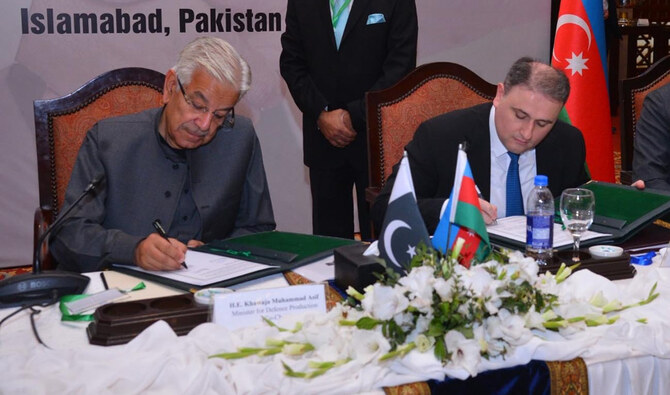
Pakistan’s Minister for Defense Production, Khawaja Asif, and Azerbaijan’s Minister for Defense Industry, Vugar Mustafayev (right), signing protocols in Pakistan-Azerbaijan 8th Joint Commission Meeting on January 24, 2025. (PID)
Short Url
Updated 24 January 2025
Follow

Pakistan says finalizing agreement with Azerbaijan on arms trade, defense infrastructure, intelligence sharing

  • There have been a series of visits by Azerbaijani officials to Pakistan in recent months
  • Islamabad is seeking closer trade and investment ties with former Soviet republics

ISLAMABAD: Pakistani Defense Minister Khawaja Asif said on Friday Islamabad and Baku were in the process of finalizing a memorandum of agreement to enhance security ties through cooperation in arms trade, defense infrastructure and intelligence sharing.

Asif was addressing the eighth session of the Pakistan-Azerbaijan joint commission alongside Azerbaijani Defense Industry Minister Vugar Mustafayev who is visiting Islamabad. 

There have been a series of visits by Azerbaijani officials to Pakistan in recent months, as Islamabad seeks closer ties, especially in trade and investment, with former Soviet republics and Central Asian states. 

Last July, Azerbaijan President Ilham Aliyev visited Pakistan and announced that the two nations were working to increase bilateral trade to $2 billion.

“I’m hopeful that once we finalize our memorandums of understanding on cooperation in the field of the defense industry, we will be able to further our security ties through arms trade, defense infrastructure and sharing of intelligence,” Asif said. 

He invited Azerbaijan to join Pakistan’s Strategic Underground Gas Storage (SUGS), a critical component of energy infrastructure, and the White Oil Pipeline project that transports oil from ports to refineries and other distribution points.

Asif also suggested organizing regular trade exhibitions between the two countries to showcase local products in each other’s markets.

Last December, Pakistan waived customs and regulatory duties on imports from Azerbaijan under the Pakistan-Azerbaijan Preferential Trade Agreement. The agreement aimed to boost economic cooperation by reducing tariffs on goods like Pakistan’s sports equipment, leather, and pharmaceuticals and Azerbaijan’s oil and gas products.


Pakistan deputy PM speaks with Iranian FM as Saudi Arabia intercepts missiles and drones

Updated 4 sec ago
Follow

Pakistan deputy PM speaks with Iranian FM as Saudi Arabia intercepts missiles and drones

  • Ishaq Dar expresses concern over evolving regional situation as both officials agree to remain in contact
  • Pakistan earlier reminded Tehran of its mutual defense pact with Saudi Arabia during diplomatic outreach

ISLAMABAD: Pakistan’s Deputy Prime Minister and Foreign Minister Ishaq Dar spoke with Iranian Foreign Minister Seyyed Abbas Araghchi on Friday amid escalating tensions in the Gulf, including recent missile and drone attacks targeting Saudi Arabia that were intercepted by the Kingdom’s air defenses.

The call comes as Islamabad remains in contact with both Tehran and Gulf states to prevent the widening Iran conflict from spilling further across the region, particularly after attempted strikes on Saudi territory, a sensitive development for Pakistan, which signed a mutual defense pact with the Kingdom last year.

Pakistan’s foreign ministry said Dar raised concerns about the evolving regional situation during the conversation.

“Deputy Prime Minister/Foreign Minister Senator Mohammad Ishaq Dar spoke this evening with the Foreign Minister of Iran, Seyyed Abbas Araghchi,” the ministry said in a statement.

“The DPM/FM expressed concern over the evolving regional situation. The two agreed to remain in touch on the developments,” it added.

The ministry did not share details of the conversation, though it came amid fast-moving developments in the region, with Saudi Arabia saying its air defenses intercepted multiple missiles and drones early on Friday.

Earlier this week, Prime Minister Shehbaz Sharif’s adviser on political affairs Rana Sanaullah said Pakistan was in contact with Iran to discourage attacks on Gulf countries and prevent misunderstandings.

“Such attacks should not be carried out from Iran’s side,” he told Geo TV.

Prior to that, the deputy prime minister told Pakistan’s Senate that Islamabad had engaged both Iran and Saudi Arabia at the outset of Iran’s retaliation in the region, reminding Tehran of its defense agreement with Saudi Arabia and conveying assurances from Riyadh that Saudi territory would not be used against Iran.

Pakistan says its administration is striving to end the conflict, though the United States-Israeli strikes on Iran, which triggered the war and led to its spillover, have only intensified.

Iranian President Masoud Pezeshkian said on Friday some countries had begun mediation efforts but insisted Tehran would defend its sovereignty.

Meanwhile, US President Donald Trump has called for Iran’s “unconditional surrender” on his Truth Social platform as the confrontation shows little sign of easing.