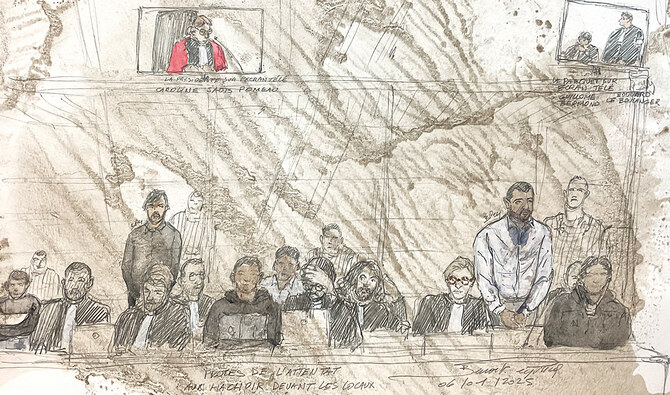
PARIS: A Paris court on Thursday sentenced a Pakistani man to 30 years in jail for attempting to murder two people outside the former offices of Charlie Hebdo in 2020 with a meat cleaver.
When he carried out the attack, 29-year-old Zaheer Mahmood wrongly believed the satirical newspaper was still based in the building, which was targeted by Islamists a decade ago for publishing cartoons of the Prophet Muhammad.
The newspaper had in fact moved in the wake of the attack, which killed 12 people including eight of the paper’s editorial staff.
The killings in 2015 shocked France and triggered a fierce debate about freedom of expression and religion.
Originally from rural Pakistan, Mahmood arrived in France illegally in the summer of 2019.
The court had earlier heard how Mahmood was influenced by radical Pakistani preacher Khadim Hussain Rizvi, who had called for the beheading of blasphemers to “avenge the Prophet.”
Mahmood was convicted of attempted murder and terrorist conspiracy, and handed a ban from ever setting foot on French soil again.


Paris court sentences Pakistani who targeted Charlie Hebdo to 30 years jail
https://arab.news/85tte
Paris court sentences Pakistani who targeted Charlie Hebdo to 30 years jail

- When he carried out attack, 29-year-old Zaheer Mahmood wrongly believed satirical newspaper was still based in the building
- Newspaper had moved in the wake of an earlier attack, which killed 12 people including eight of the paper’s editorial staff

Putin calls Russia’s ties with Pakistan ‘mutually beneficial’
- The Russian President mentions the ties as Pakistan’s new envoy presents his credentials in Moscow
- Pakistan and Russia have strengthened relations in recent years, expanding cooperation in key sectors
ISLAMABAD: Russian President Vladimir Putin has described relations with Pakistan as “mutually beneficial,” according to a social media post by his country’s embassy in Pakistan on Friday, as he met newly appointed Pakistani ambassador Faisal Niaz Tirmizi during a credentials ceremony in Moscow.
Pakistan and Russia have steadily strengthened bilateral ties in recent years while working to further expand cooperation in trade, investment, energy and connectivity.
“We maintain close cooperation with Pakistan, a full member of the Shanghai Cooperation Organization, the largest regional organization in terms of economic, technological, and human potential,” Putin was quoted as saying in a post on X. “Russia
Pakistan relations are genuinely mutually beneficial.”
In recent years, Pakistan and Russia have pledged to deepen economic ties, explore barter trade and energy deals, and boost people-to-people contacts. High-level visits have also taken place between officials of both countries, highlighting interest in expanding cooperation in technology, agriculture and transport.
Last December, Pakistan Finance Minister Muhammad Aurangzeb said Russia and Pakistan were in talks on a potential oil-sector agreement.
Earlier, in May, Pakistan and Russia agreed to establish a steel mill in Karachi, aiming to boost bilateral ties and expand industrial collaboration.
The two countries are also working on the Pakistan Stream Gas Pipeline, a major infrastructure project aimed at transporting imported gas from Karachi to Punjab to help meet Pakistan’s energy needs.
In 2023, Pakistan and Russia also discussed a deal for the delivery of Russian crude to Pakistan, and talks have continued on broader energy partnerships.


