

Imran Khan calls off talks with Pakistan government over deadlock on judicial commissions

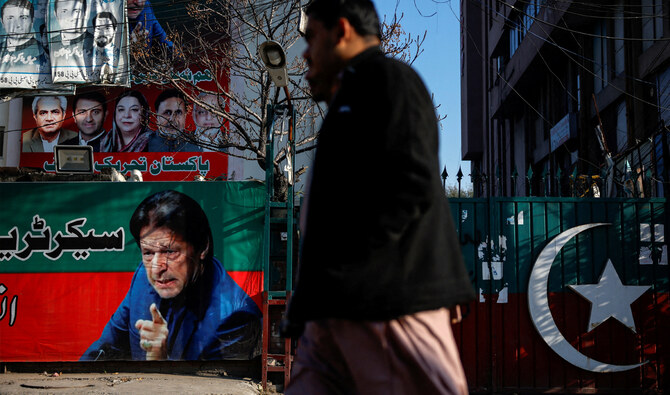
People walk past a banner with a picture of the former Prime Minister Imran Khan outside the party office of Pakistan Tehreek-e-Insaf (PTI), in Lahore, Pakistan on February 9, 2024. (REUTERS/File)
Short Url
Updated 23 January 2025
Follow

Imran Khan calls off talks with Pakistan government over deadlock on judicial commissions

  • First round of talks aimed at cooling political instability took place on Dec. 23 with two follow up sessions on Jan. 2 and 16
  • At last round of talks, PTI gave government seven days to announce judicial commissions into May 2023 and Nov. 2024 protests

ISLAMABAD: Jailed former prime minister Imran Khan has called off negotiations with the government over its failure to establish judicial commissions to investigate violence at anti-government protests organized by his Pakistan Tehreek-e-Insaf (PTI), party chairman Gohar Khan said on Thursday.
Negotiations started last month with the aim of cooling political temperatures in the South Asian nation and three rounds have been held so far. 
The PTI’s demands to the government revolve around the release of all political prisoners including Khan, and the formation of two judicial commissions to probe into violent protest rallies, including one on May 9 , 2023, when PTI supporters rampaged through military offices and installations, and a second one on Nov. 26, 2024 to demand Khan’s release, in which the government says four troops were killed. At the last meeting on Jan. 16, the PTI had given the government seven days to announce the truth commissions, a deadline that expired today, Thursday. 
A Pakistani court last week sentenced Khan to 14 years in prison in a land corruption case, a setback to the nascent talks’ process.
“We [PTI] had given the government time of seven days [to form commissions],” Gohar told reporters outside the Adiala Jail in Rawalpindi where Khan has been incarcerated since 2023. 
“Khan had made it clear that if the formation of the commissions is not announced during this time, then further rounds of talks will not continue … It is sad that the government did not announce anything till today. Hence Khan has called off the negotiations.”

Irfan Siddiqui, the spokesperson for the government’s negotiation committee, said on Wednesday the government would respond to the PTI party’s written demands on Jan. 28.
The talks opened last month as Khan had threatened a civil disobedience movement and amid growing concerns he could face trial by a military court for allegedly inciting attacks on sensitive security installations during the May 9 protests.
Khan’s first arrest in May 2023 in the land graft case in which he was sentenced last week sparked countrywide protests that saw his supporters attack and ransack military installations in an unprecedented backlash against Pakistan’s powerful army generals. Although Khan was released days later, he was rearrested in August that year after being convicted in a corruption case. He remains in prison and says all cases against him are politically motivated.
Protests demanding Khan’s release in November also turned violent, with the PTI saying 12 supporters were killed while the state said four troops had died.


Pakistani, Bangladeshi officials discuss trade, investment and aviation as ties thaw

Updated 28 December 2025
Follow

Pakistani, Bangladeshi officials discuss trade, investment and aviation as ties thaw

  • Pakistan and Bangladesh were once one nation, but they split in 1971 as a result of a bloody civil war
  • Ties between Pakistan, Bangladesh have warmed up since last year and both nations have resumed sea trade

ISLAMABAD: Pakistan's High Commissioner to Bangladesh Imran Haider on Sunday met Chief Adviser Muhammad Yunus in Dhaka, the latter's office said on, with the two figures discussing trade, investment and aviation.

Pakistan and Bangladesh were once one nation, but they split in 1971 as a result of a bloody civil war, which saw the part previously referred to as East Pakistan seceding to form the independent nation of Bangladesh.

Ties between Pakistan and Bangladesh have warmed up since former prime minister Sheikh Hasina’s ouster as a result of a student-led uprising in August 2024. Relations remain frosty between Dhaka and New Delhi over India’s decision to grant asylum to Hasina.

Pakistan has attempted to forge closer ties with Bangladesh in recent months and both South Asian nations last year began sea trade, followed by efforts to expand government-to-government commerce.

"During the meeting, both sides discussed ways to expand cooperation in trade, investment, and aviation as well as scaling up cultural, educational and medical exchanges to further strengthen bilateral relations between the two South Asian nations," Yunus's office said in a statement on X.

In 2023-24 Pakistan exported goods worth $661 million to Bangladesh, while its imports were only $57 million, according to the Trade Development Authority of Pakistan. In Aug. this year, the Pakistani and Bangladeshi commerce ministries signed a memorandum of understanding to establish a Joint Working Group on Trade, aiming to raise their bilateral trade volume to $1 billion in the financial year that began in July.

The Pakistani high commissioner noted that bilateral trade has recorded a 20 percent growth compared to last year, with business communities from both countries actively exploring new investment opportunities, according to the statement.

He highlighted a significant increase in cultural exchanges, adding that Bangladeshi students have shown strong interest in higher education opportunities in Pakistan, particularly in medical sciences, nanotechnology, and artificial intelligence. Haider also said that Dhaka-Karachi direct flights are expected to start in January.

"Chief Adviser Professor Muhammad Yunus welcomed the growing interactions between the two countries and emphasized the importance of increased visits as well as cultural, educational and people-to-people exchanges among SAARC (South Asian Association for Regional Cooperation) member states," the statement read.

"Professor Yunus also underscored the need to further boost Bangladesh–Pakistan trade and expressed hope that during Mr. Haider’s tenure, both countries would explore new avenues for investment and joint venture businesses."