

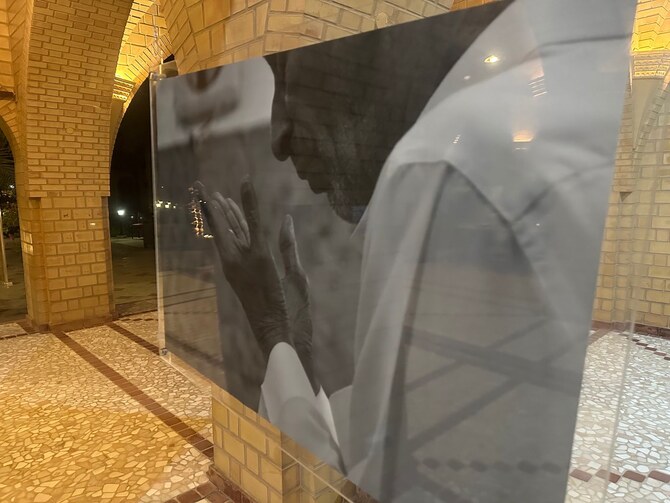
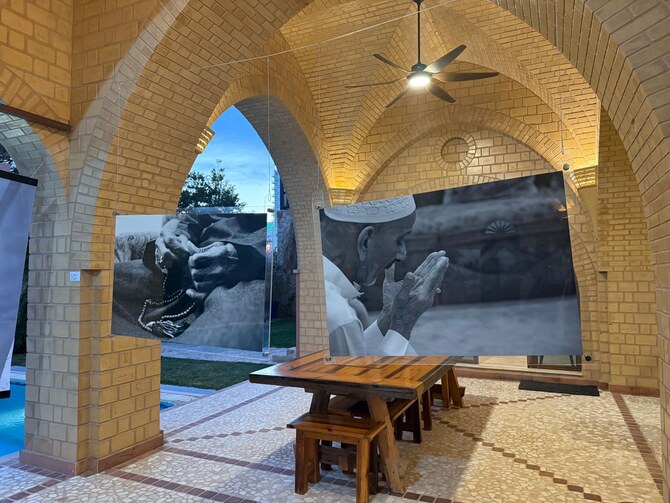

RIYADH: An exhibition in Bahrain by Saudi artist Emtethal Al-Awami’s explored themes of memory, nostalgia, and the intersection of past and present.
“101 Hymns” featured photographs, digital art and videos portraying scenes of prayer, providing a rich and visually engaging experience.
Al-Awami, from Qatif, told Arab News the idea for the exhibition was inspired by her late father, whose actions and movements during prayer and tasbih she had observed throughout her life.
“The movement of his fingers between the beads of the prayer rosary and the sound of his voice reflected moments of serenity and reassurance, embodying feelings of forgiveness and harmony,” she said.
“The scene represents a deep connection with the self, offering a person the time to reflect and return to their true essence.”
The prayer rosary, a symbol of spirituality used across different religions and cultures for over 3,000 years, served as a tool to restore calm amidst the chaos and speed of everyday life, added Al-Awami.
“101 Hymns” sought to show how prayer and tasbih become a sanctuary in a world of pressures and challenges, opening the door to tranquility.
“By observing my father, I realized that these moments provide valuable lessons on patience and serenity, as the soft sound of the prayer beads soothes the soul and offers a deep sense of security,” she said.
After taking time to mourn and reflect following her father’s death around 18 months ago, the Saudi artist said she was determined to complete the project and present it in his honor.
“He was my inspiration and my first supporter, and this idea reflects my love and pride for his spiritual journey, which I aspire to share with others through this exhibit,” she told Arab News.
Al-Awami’s journey as an artist began at an early age with a deep fascination for art and its vast possibilities in various forms of expression. She studied art education at King Saud University in Riyadh, graduating in 1996.
“The initial spark of my artistic journey can be traced back to a specific moment of introspection as I observed the world around me — seeing the beauty in everyday life and realizing the power of visual storytelling,” she said.
She added she was inspired to commit to the pursuit of art as a form of synthesis between individual experiences and broader societal themes.
During her journey to becoming a professional artist, Al-Awami experimented with different styles and mediums which allowed her to progress and refine her voice, establishing her own artistic identity.
“I have learned to weave cultural narratives into my work, and my experiments with different styles and ideas enrich my artistic practice, allowing me to tell diverse stories through my art,” she explained.
As a Saudi artist, Al-Awami often highlights cultural narratives shaped by her own experiences. Arabian art is distinguished by its unique disposition, rooted in a rich history of spiritual, cultural and social chronicles, she said: “It embodies a fusion of traditional techniques with contemporary themes, continually reflecting the dynamic nature of Arab identity, resilience, and creativity across generations.”
Al-Awami emphasized the significant development the artistic community has seen in the Arab world, especially in Saudi Arabia.
Marked by increased recognition of contemporary artists and openness to diverse forms of expression, the Kingdom’s art scene is strongly supported by the government under the Ministry of Culture.
“The emergence of new platforms for showcasing art has revitalized the art scene, fostering collaborations that transcend geographical boundaries,” Al-Awami said.
“As a Saudi woman and artist, I feel a deep sense of responsibility to authentically represent my community. This journey requires overcoming challenges, yet it is rewarding to shed light on the arts and demonstrate that creativity and expression are equally important (as STEM) in enriching society.”


