ISLAMABAD: The Pakistan Business Council Dubai on Wednesday said it aims to strengthen existing relations between Islamabad and Abu Dhabi through collaborative efforts in trade, investment and cultural exchanges, a statement from the Pakistan Consulate General in Dubai said.
The UAE is Pakistan’s third-largest trading partner after China and the United States, and a major source of foreign investment valued at over $10 billion in the last 20 years, according to the UAE foreign ministry.
It is also home to more than a million Pakistani expatriates. Policymakers in Pakistan consider the UAE an optimal export destination due to its geographical proximity, which minimizes transportation and freight costs while facilitating commercial transactions.
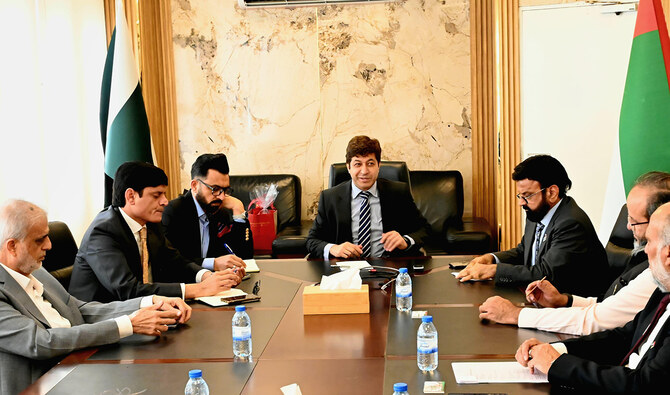
Hussain Muhammad, the consul general of Pakistan in Dubai, met the new board members of the PBC Dubai at the Consulate General of Pakistan. Shabbir Merchant, the PBC Dubai chairman, shared the council’s strategic roadmap for 2025-2026.
“Mr. Merchant stated that PBC aims to strengthen the relationship between Pakistan and UAE through collaborative efforts in trade, investment and cultural exchanges,” the Pakistan Consulate General said. “He added that the Council is committed to avail opportunities for mutual growth and foster a deeper connection between the two nations.”
Muhammad appreciated PBC’s efforts in promoting Pakistan’s economic potential in the UAE, the statement said, adding that the Pakistani consul general also encouraged them to take concrete steps toward enhancing bilateral trade and investment between the two countries.
“The Consul General emphasized the need for business leaders to explore opportunities in Pakistan’s diverse sectors, including IT, manufacturing, agriculture and tourism,” the statement said.
“He said that Pakistan offers immense potential for investment and trade, with Special Investment Facilitation Council (SIFC) established as a single window to facilitate investors.”
The SIFC is a hybrid civil-military body formed in June 2023 to attract international investment, particularly from Gulf countries, in Pakistan’s key economic sectors such as tourism, mining and minerals, agriculture and livestock.
Hussain urged the PBC to act as a bridge for creating new partnerships and expanding existing ones.
Pakistan and UAE have stepped up efforts in recent years to strengthen their business and investment relations. In January 2023, Pakistan and the UAE signed multiple agreements worth more than $3 billion for cooperation in railways, economic zones and infrastructure, a Pakistani official said, amid Pakistani caretaker prime minister Anwaar-ul-Haq Kakar’s visit to Davos for the World Economic Forum’s summit.


![]()

Pakistan Business Council calls for collaborative efforts with UAE in investment, cultural exchanges
Short Url
https://arab.news/j6nfp
Pakistan Business Council calls for collaborative efforts with UAE in investment, cultural exchanges
- UAE is Pakistan’s third-largest trading partner after China and US, and a major source of foreign investment
- Pakistan consul general in Dubai urges business leaders to explore opportunities in IT, agriculture and tourism
Latest updates


© 2026 SAUDI RESEARCH & PUBLISHING COMPANY, All Rights Reserved And subject to Terms of Use Agreement.