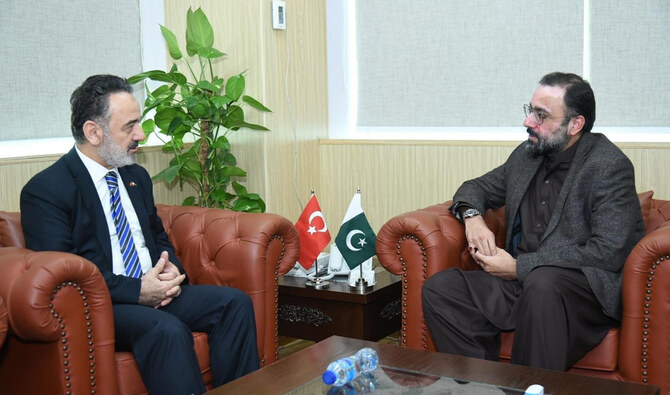
ISLAMABAD: Pakistan’s Religious Affairs Minister Chaudhry Salik Hussain met Turkish Ambassador Irfan Nazir Oglu on Wednesday to discuss provision of modern technical education and enhancing job opportunities for the country’s skilled workers in Turkiye, the religion ministry said in a statement.
Pakistan exports skilled manpower to several countries around the world such as Turkiye and the Gulf countries. Foreign remittances sent by overseas Pakistanis help the cash-strapped country keep its fragile $350 billion economy afloat.
Pakistan enjoys cordial relations and cooperation with Turkiye in various sectors such as trade, defense, media and economy. In May 2024, both countries resolved to enhance the volume of bilateral trade to $5 billion.
“During the meeting, various proposals were discussed regarding religious harmony, respect for humanity and providing more job opportunities for Pakistani workers in Turkiye,” Pakistan’s Ministry of Religious Affairs said.
Hussain pointed out that both countries share similar stances on regional and global issues, and have supported each other on various global issues at the international stage.
“Turkish Ambassador Irfan Nazir Oglu expressed sorrow over the deaths of Pakistanis in the Morocco boat incident and reaffirmed the commitment to providing more job opportunities for skilled Pakistanis in Turkiye,” the religion ministry said.
The ambassador pointed out that Turkiye is working on increasing the supply of machinery to Pakistani industries and expanding technical training and educational projects in the South Asian country.
He said that though several Turkish companies are operating in Pakistan, there remains significant potential to increase joint investment and trade volume between the two countries, the religious affairs ministry said.
Hussain said 600,000 Pakistanis went abroad for employment last year, adding that by December 2024 overseas Pakistanis sent a record remittance of 3.1 billion dollars to Pakistan.
“The establishment of better banking channels between Turkiye and Pakistan is also essential for promoting mutual trade,” the ministry said.
It said the meeting concluded with an agreement to enhance cooperation toward eliminating extremism and “terrorism,” promoting interfaith harmony and providing skilled Pakistanis with modern technical education.


Islamabad, Ankara discuss enhancing training and job opportunities for Pakistanis in Turkiye
https://arab.news/53n6f
Islamabad, Ankara discuss enhancing training and job opportunities for Pakistanis in Turkiye

- Pakistan’s religious affairs minister meets Turkish Ambassador Irfan Nazir Oglu in Islamabad to discuss matters of bilateral interest
- Foreign remittances sent by thousands of overseas Pakistanis help cash-strapped country keeps fragile $350 billion economy afloat

How do Pakistan and Taliban Afghan militaries stack up as tensions flare?
- Pakistan fields 660,000 active troops, 465 combat aircraft and 170 nuclear warheads, dwarfing Taliban forces
- Afghan Taliban command about 172,000 personnel with limited air capability and no nuclear arsenal
Cross-border fighting between Pakistan and Afghanistan intensified overnight, with both sides claiming heavy losses and the Pakistani defense minister saying his country was in an “open war” with its neighbor.
As tensions persist, here is a look at how Pakistan dwarfs Afghanistan’s military forces and arsenals, according to data from the London-based International Institute for Strategic Studies.
OVERVIEW
Pakistan’s armed forces benefit from good recruitment and retention, bolstered by equipment from its main defense partner China. Islamabad continues to invest in its military nuclear programs and is also modernizing its navy and air force.
The capability of the Afghan Taliban’s armed forces, meanwhile, is declining, with a fall in their ability to use foreign equipment that the Islamist group seized when it returned to power in the landlocked country in 2021.
A lack of international recognition for the Taliban administration has also hurt military modernization.
PERSONNEL
Pakistan has 660,000 active personnel in its defense forces, of whom 560,000 are in the army, 70,000 are in the air force, and 30,000 are in the navy.
The strength of the Afghan Taliban’s military is thinner, with only 172,000 active personnel. The group has, however, announced plans to expand its armed forces to 200,000 personnel.
FIGHTING VEHICLES AND ARTILLERY
Pakistan has more than 6,000 armored fighting vehicles, and over 4,600 pieces of artillery.
The Afghan forces also possess armored fighting vehicles, including Soviet-era main battle tanks, armored personnel carriers and autonomous underwater vehicles, but their exact number is unknown.
The precise number of artillery they possess, which is of at least three different types, is similarly not known.
AIR FORCE
Pakistan has a fleet of 465 combat aircraft and more than 260 helicopters that include multi-role, attack and transport choppers.
Afghanistan has no fighter jets and no real air force to speak of. It is known to possess at least six aircraft — some of them dating back again to the Soviet era — and 23 helicopters, although it is not possible to assess how many are in flying condition.
NUCLEAR ARSENAL
While Pakistan is a nuclear-armed country and has 170 warheads, Afghanistan does not have a nuclear arsenal.


