

Holistic approach crucial to sustaining growth in emerging-market economies, say WEF panelists

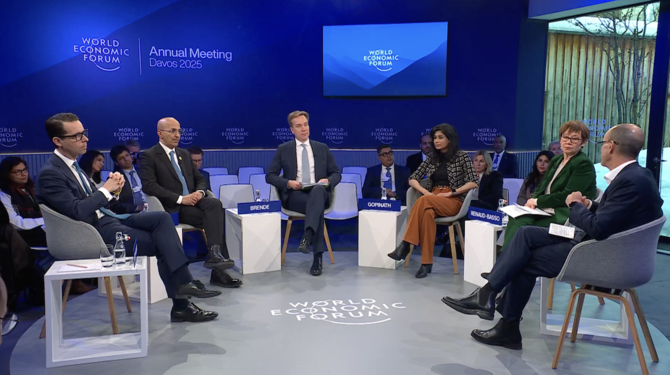
A panel of global leaders at Davos emphasized the importance of a holistic approach to building resilience in emerging markets. (Screen shot)
Short Url
Updated 22 January 2025
Follow

Holistic approach crucial to sustaining growth in emerging-market economies, say WEF panelists

  • Structural reforms, digital infrastructure, private investment vital, says IMF’s Gita Gopinath
  • Saudi Arabia’s Finance Minister Mohammed Al-Jadaan says Vision 2030 is model for resilience

DUBAI: A holistic approach is needed to build resilience and sustainable growth in emerging-market economies, through structural reforms, technological investment, and private sector engagement.

This was the consensus of panelists during a discussion on Wednesday at the World Economic Forum in Davos.

The panelists noted that emerging-market economies have managed recent global shocks such as rising interest rates, the COVID-19 pandemic, and increased energy prices, due to long-term investments in macroeconomic stability.

However, Gita Gopinath, first deputy MD of the International Monetary Fund, warned that per capita gross domestic product growth has slowed since the pandemic.

She emphasized that further structural reforms are needed to boost productivity and private sector investment. “Emerging markets need to reinvest in reforms that deepen capital markets, encourage innovation, and enhance human capital.”

She noted that countries including Saudi Arabia and Mexico are exceptions, having maintained growth despite global slowdowns.

Gopinath also pointed to artificial intelligence as a potential driver of productivity but highlighted a significant digital divide.

While advanced economies face 60 percent job exposure to AI, low-income countries remain far behind, with only 26 percent. She said that emerging markets need to invest in digital infrastructure and education to harness the full potential of AI.

Global debt levels are also of major concern. Public sector debt globally now stands at $100 trillion and is projected to reach 100 percent of global GDP by 2030.

Gopinath warned that debt levels are often underestimated, potentially creating a “serious issue” for countries to address in the coming years.

The solution, she said, lies in attracting private sector investment. For example, climate finance will require 80 to 90 percent of funding from private investors.

Governments must create policies that de-risk investments and encourage private capital to flow into critical areas including climate adaptation and digital transformation, said Gopinath.

Saudi Arabia’s Finance Minister Mohammed Al-Jadaan said the country’s Vision 2030 has laid the foundation for structural reforms.

Through initiatives including the Expenditure and Project Efficiency Authority, the country has significantly improved government spending efficiency and attracted increasing private sector investments, he said.

Al-Jadaan emphasized that resilience-building initiatives may not yield immediate returns but prove their value in times of crisis.

Saudi Arabia’s strong recovery during the COVID-19 pandemic can be attributed to the country’s long-term planning and alignment between government and the private sector, he said.

Odile Francoise Renaud-Basso, president of the European Bank for Reconstruction and Development, said Multilateral Development Banks play a key role in supporting resilience in emerging markets.

She said MDBs help countries develop effective macroeconomic frameworks and create environments that attract private investment.

However, Renaud-Basso said that MDBs cannot substitute for private capital but can help foster investment-friendly policies by improving regulatory frameworks, strengthening the rule of law, and simplifying processes.


Global trade isn’t deglobalizing — it’s reshuffling, Harvard economist says

Updated 09 February 2026
Follow

Global trade isn’t deglobalizing — it’s reshuffling, Harvard economist says

ALULA: Global trade is not retreating into deglobalization despite geopolitical shocks, but is instead undergoing a structural reshuffling led by US-China tensions, according to Harvard University economist Pol Antras. 

Presenting research at the AlUla Emerging Market Economies Conference, Antras said there is no evidence that countries are systematically turning inward. Instead, trade flows are being redirected across markets, creating winners and losers depending on export structure and exposure to Chinese competition. 

This comes as debate intensifies over whether supply-chain disruptions, industrial policy and rising trade barriers signal the end of globalization after decades of expansion. 

Speaking to Arab News on the sidelines of the event, Antras said: “I think the right way to view it is more a reorganization, where things are moving from some countries to others rather than a general trend where countries are becoming more inward looking, in a sense of producers selling more of their stuff domestically than internationally, or consumers buying more domestic products than foreign products.”  

He said a change of that scale has not yet happened, which is important to recognize when navigating the reshuffling — a shift his research shows is driven by Chinese producers redirecting sales away from the US toward other economies. 

He added that countries are affected differently, but highlighted that the Kingdom’s position is relatively positive, stating: “In the case of Saudi Arabia, for instance, its export structure, what it exports, is very different than what China exports, so in that sense it’s better positioned so suffer less negative consequences of recent events.” 

He went on to say that economies likely to be more negatively impacted than the Kingdom would be those with more producers in sectors exposed to Chinese competition. He added that while many countries may feel inclined to follow the United States’ footsteps by implementing their own tariffs, he would advise against such a move.  

Instead, he pointed to supporting producers facing the shock as a better way to protect and prepare economies, describing it as a key step toward building resilience — a view Professor Antras underscored as fundamental. 

Elaborating on the Kingdom’s position amid rising tensions and structural reorganization, he said Saudi Arabia holds a relative advantage in its economic framework. 

“Saudi Arabia should not be too worried about facing increased competitive pressures in selling its exports to other markets, by its nature. On the other hand, there is a benefit of the current situation, which is when Chinese producers find it hard to sell in US market, they naturally pivot to other markets.” 

He said that pivot could benefit importing economies, including Saudi Arabia, by lowering Chinese export prices. The shift could increase the Kingdom’s import volumes from China while easing cost pressures for domestic producers.