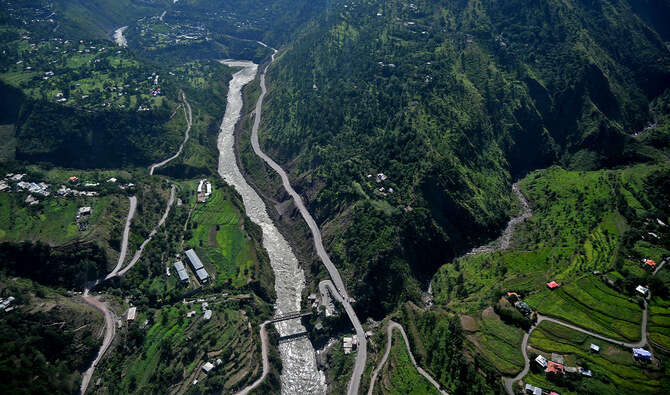

ISLAMABAD: Azad Jammu and Kashmir (AJK) President Sultan Mahmood Chaudhry has invited Chinese businesses and companies to invest in different sectors of the Pakistan-controlled disputed region, state media reported on Wednesday, in a move that is likely to draw the ire of archrival India.
The Muslim-majority Kashmir region has long been a source of tensions between nuclear-armed neighbors India and Pakistan, leading them to fight three wars since winning independence from the British Empire in 1947. The scenic mountain region is divided between India, which rules the populous Kashmir Valley and the Hindu-dominated region around Jammu city, Pakistan, which controls a wedge of territory in the west called AJK, and China, which holds a thinly populated high-altitude area in the north. Besides Pakistan, India also has an ongoing conflict with China over their disputed frontier.
Since both India and Pakistan tested nuclear weapons in 1998, Kashmir has become one of the world’s most dangerous flashpoints. Islamabad says a UN-mandated referendum should take place to settle the dispute over the region, expecting that the majority of Kashmiris would opt to join Pakistan.
On Tuesday, the president of AJK, which is administered by Pakistan as a nominally self-governing entity, met Li Ping, the director of China’s Yunnan Sunny Road and Bridge Company, and briefed him about “massive investment opportunities” in the region, APP reported.
“Seeking Chinese companies investment in different economic sectors of the State including mining and tourism, he said that the AJK government was ready to offer all kinds of facilities and support to investors,” state media said, as Sultan briefed the visiting Chinese business leader about the tourism potential of the region as well as its abundance of natural resources and precious stones, especially rubies and other minerals.
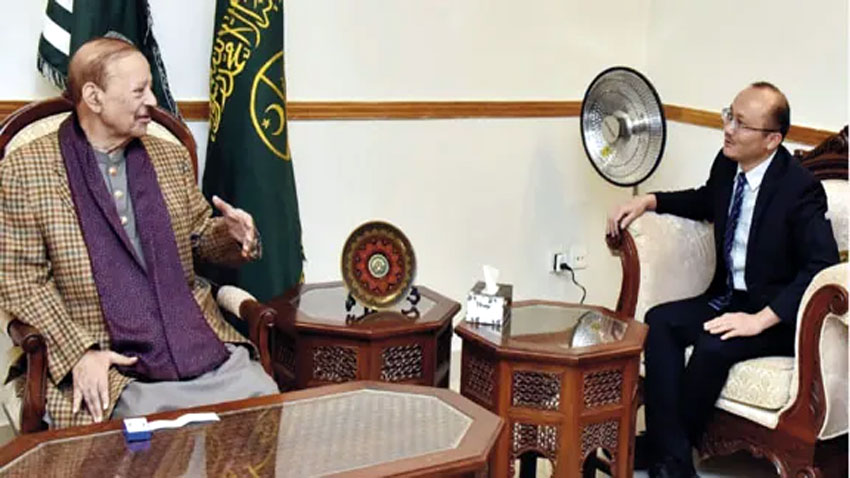
Director of China’s Yunnan Sunny Road and Bridge Company, Li Ping (right) calls on Azad Jammu and Kashmir (AJK) President Sultan Mahmood Chaudhry in Muzaffarabad on January 21, 2025. (Radio Pakistan)
Li gave a detailed briefing to Sultan about the aims, objectives and business activities of his company, which specializes in tunnels, highways and other construction sectors.
“He also expressed his company’s desire to start its projects in Azad Kashmir,” APP said. “The President expressed satisfaction over Yunnan Sunny Company’s desire and said that the AJK government would welcome foreign investment.”
Beijing has already pledged investments in AJK under the China Pakistan Economic Corridor scheme, including the Karot and Kohala hydropower projects, the construction of M-4 motorway, and a Special Economic Zone at Mirpur.
After the partition of the subcontinent in 1947, Kashmir was expected to go to Pakistan, as other Muslim majority regions did. Its Hindu ruler wanted to stay independent but, faced with an invasion by Muslim tribesmen from Pakistan, hastily acceded to India in October 1947 in return for help against the invaders.
The dispute over the former princely state sparked the first two of three wars between India and Pakistan after independence. They fought a second in 1965, and a third, largely over what became Bangladesh, in 1971.
A UN-monitored ceasefire line agreed in 1972, called the Line of Control (LOC), splits Kashmir into two areas — one administered by India, one by Pakistan. Their armies have for decades faced off over the LOC. In 1999, the two were involved in a battle along the LOC that some analysts called an undeclared war. Their forces exchanged regular gunfire over the LOC until a truce in late 2003, which has largely held since.
India accuses Pakistan of backing a separatist insurgency in its portion of Kashmir that began in 1989, in particular by arming and training fighters. Pakistan denies this, saying it only offers political support to the Kashmiri people.