

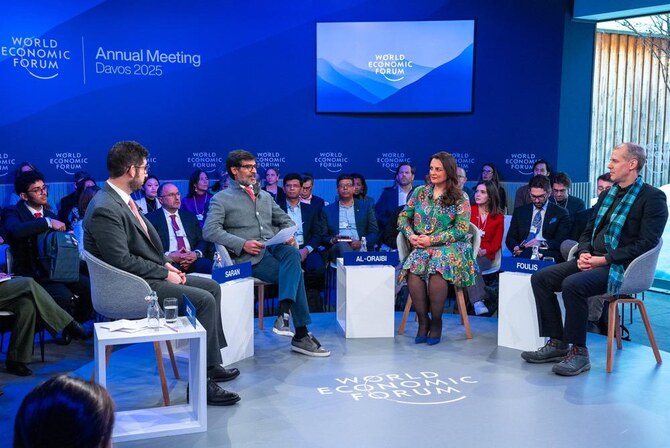

LONDON: While world leaders, business titans, and policymakers gathered in Davos, Switzerland, for the opening of the World Economic Forum’s 55th annual meeting on Monday, all eyes were on Washington, where Donald Trump was being inaugurated for his second term.
This dual spectacle underscored the contrast between two seemingly opposing worldviews: Trump’s “America First” doctrine and the WEF’s globalist vision of “Collaboration for the Intelligent Age.”
The timing of Trump’s inauguration on the forum’s opening day seemed almost poetic. Experts noted the symbolic clash between the Davos elite, often described as the architects of a “new world order,” and Trump’s unapologetic brand of populism.
“Thank you to the World Economic Forum for having us, but most of all for having an exquisite sense of humor by asking us to say what’s going to happen in the Trump administration,” Sam Jacobs, editor-in-chief of Time magazine, quipped during the forum’s first panel, titled “First Impressions: Inauguration Day.”
This year’s conference invites participants to explore ways to tackle shared challenges like climate change, technology, and economic inequality through global collaboration. Yet, as economics writer Kate Andrews observes, it is “an idea that means little to nothing if the world’s largest economy — and leader in AI development — is not on board.”
Indeed, Trump’s policies are expected to pivot sharply from the multilateralism championed by the WEF. He has already signaled a return to “America First” economics, emphasizing trade protectionism and other barriers, which are likely to reverberate across the global economy.
Adding to this is his close alignment with US tech leaders, including Meta CEO Mark Zuckerberg, Tesla and X owner Elon Musk, and OpenAI CEO Sam Altman. Their collective support suggests that Trump’s new administration will embrace a less regulated approach to tech innovation, particularly in artificial intelligence, diverging from the more cautious frameworks championed by both former president Joe Biden and the WEF.
“I think the technology race is one that is going to be instrumental in that economic conversation,” Mina Al-Oraibi, editor-in-chief of UAE’s The National, told the panel, highlighting Trump’s likely focus on countering China’s influence in tech and trade.
Still, not all experts see Trump’s policies as a stark departure from those of his predecessor. Patrick Foulis, foreign editor of The Economist, noted that Trump’s strategies could echo some elements of Biden’s economic doctrine.
“Trump, in one sense, represents continuity, and in some sense, he’s actually the intellectual author of the Biden policy. But I think we have very, very solid grounds to doubt his ability to apply over a sustained period of time that kind of strategy,” he said during the panel.
The goal, Foulis argues, is for Trump to “exert more influence over the world economy,” relying less on incentives and more on coercive measures like debt manipulation, tariffs, and tech controls.
In what some view as an olive branch, WEF President and CEO Borge Brende said Donald Trump planned to deliver a 45-minute video address to the forum on Thursday.
The complex relationship between Trump and the WEF remains a study in contrasts. While Trump’s “America First” doctrine appears to run counter to the WEF’s globalist ethos, his presence — or lack thereof — consistently draws attention.
Despite ideological differences, Trump’s influence remains too significant for the forum to overlook. His pivotal role in brokering the recent Gaza ceasefire underscores his relevance on the global stage.
“We’re meeting here in Davos with a ceasefire finally in place in Gaza and after a terrible, devastating war over 15 months. It has changed the region, and in some ways, it changed the world. And Trump 2.0 actually facilitated the ceasefire,” Al-Oraibi said, adding that the “Trump factor” was instrumental in bringing a deal that the Biden administration failed to pull off.

Newly sworn-in President Donald Trump takes part in a signing ceremony at the White House. (Reuters)
“Trump clearly said there had to be a ceasefire before inauguration. And that moment crystallizes what people are expecting under a Trump administration. That comes with many lessons from its first stint at the White House, but also lessons learned about what can be possible in the Middle East.”
Over the past year, the Middle East has experienced seismic changes, including Hezbollah’s diminished influence in Lebanon and the fall of the Bashar Assad regime in Syria. Experts predict that while Trump’s foreign policy will in some ways build on Biden’s, the focus will be more on targeted economic strategies rather than broad hegemonic goals.
“I see the Trumpian agenda essentially as a more comprehensive and forceful expression of American power on a much more limited geographic scope,” said Foulis.
While Trump’s foreign policy appears increasingly selective and driven by economic interests rather than purely hegemonic ambitions, Al-Oraibi believes the Middle East will remain central to US priorities, particularly as attention on Gaza and Palestine shows little sign of waning.
“The fact that the ceasefire was put in place just before the inauguration of Donald Trump shows that they realize this is not something that they want hanging over their heads from day one, but it is a long road ahead,” she said, adding that the administration may want to take advantage of the momentum to bring about a solution to the Palestinian question and possibly promote a two-state solution.
“The one thing that is clear is the US remains the most important superpower,” she said. “Yet there’s still so much that can go wrong.”
Besides foreign and economic policy, the panel also explored how Trump’s new administration might handle energy and climate issues — both pillars of forum discussions. While a rollback of Biden’s green policies is expected, experts believe the energy transition has become too entrenched to reverse completely.
“If for Trump, that energy transition can be reframed as a nationalist cause, so something that benefits the American economy, I don’t think he’s going to oppose it,” said Jacobs.
As speculation builds around the consequences of Trump’s return to the Oval Office, many experts caution that lessons from his first term may only partially apply this time around.
What is certain, according to Jacobs, is that a Trump 2.0 presidency promises to be “200 times more unpredictable, and more volatile than the first term,” emphasizing that the real focus should be on “where points of tension emerge” rather than specific policies.
For the WEF, Trump’s presence offers both challenges and opportunities. As the world grapples with interconnected crises, Davos prides itself on providing a platform for critical dialogue. The stakes are high, however, and Trump’s return to power adds another layer of complexity to an already transformative moment in world history.


