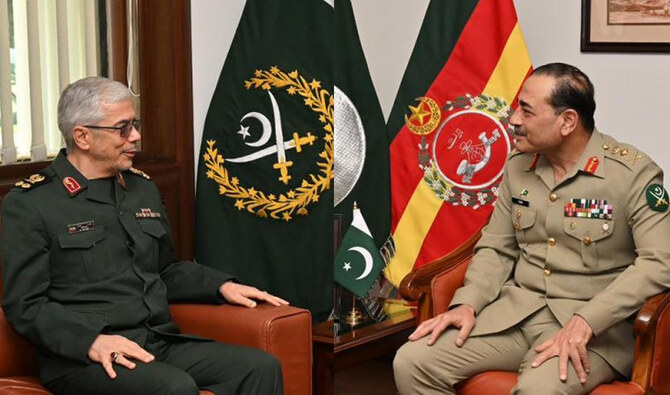
ISLAMABAD: Maj. Gen. Mohammad Bagheri, chief of general staff of Iranian armed forces, on Monday held talks with Pakistani civilian and military leaders with regard to regional security, counter-terrorism measures and joint border management, Pakistani authorities said.
Pakistan and Iran have often been at odds over instability along their shared, porous border and routinely trade blame for not rooting out militancy. Tensions surged in January last year when Pakistan and Iran exchanged airstrikes, with both claiming to target alleged militant hideouts in each other’s territory.
The two-day trip of the Iranian general is aimed at resolving security issues between Pakistan and Iran, while expanding friendship and economic ties along their shared border, Iranian media reported ahead of Major General Bagheri’s arrival in Pakistan on Sunday night.
On Monday, the general held separate meetings with Pakistan’s President Asif Ali Zardari, Defense Minister Khawaja Asif and Army Chief Asim Munir. In his meeting with President Zardari, the two figures exchanged views on matters of bilateral importance and stressed the need to promote bilateral trade and economic relations.
“It was also highlighted that terrorism was a shared challenge, and both countries needed to take effective and coordinated measures to address this challenge,” the Press Information Department (PID) of the Pakistani government said in a statement.
In his conversation with the visiting dignitary, Defense Minister Asif expressed satisfaction over positive progression of bilateral relations between the two countries in all fields.
“Both sides showed satisfaction on progress in various areas of mutual interest, including joint border management and counter-terrorism measures, aimed at enhanced cooperation in areas of common interest in future,” the PID said.
Separately, Major General Bagheri met Pakistan’s army chief at the General Headquarters in Rawalpindi, where he was presented a guard of honor.
“During the meeting, both sides discussed matters related to the prevailing regional security environment and bilateral defense cooperation,” said the Inter-Services Public Relations (ISPR), the Pakistani military’s media wing.
In a bid to ease tensions, late Iranian president Ebrahim Raisi had also traveled to Pakistan on a three-day visit in April 2024. During the visit, the two sides had signed memorandums of understanding in the fields of trade, science technology, agriculture, health, culture, and judicial matters.
Raisi’s visit was followed by a two-day visit to Islamabad by Iranian Foreign Minister Seyed Abbas Araghchi in Nov. to hold consultations with the Pakistani leadership on the Middle East situation, following Israel’s invasion of Gaza and Lebanon, and to discuss bilateral ties with Pakistan.


![]()

Iran’s top general meets Pakistani leaders, discusses security and border management
Short Url
https://arab.news/m7bhp
Iran’s top general meets Pakistani leaders, discusses security and border management
- Pakistan, Iran have often been at odds over instability along their shared, porous border and routinely trade blame for not rooting out militancy
- Tensions surged in January last year when Pakistan and Iran exchanged airstrikes, with both countries claiming to target alleged militant hideouts
Latest updates


© 2026 SAUDI RESEARCH & PUBLISHING COMPANY, All Rights Reserved And subject to Terms of Use Agreement.