RAMALLAH, West Bank: The first three hostages were released from Gaza and the first Palestinian prisoners were freed from Israeli custody as the fragile ceasefire between Israel and Hamas took hold following 15 months of war, with mixed emotions and more difficult steps ahead over the next six weeks.
Palestinians across Gaza began making their way home, and the first trucks with a surge of humanitarian aid began to enter the devastated territory.
The ceasefire that began on Sunday morning raises hopes for ending the devastating conflict and returning the nearly 100 remaining hostages abducted in Hamas’ Oct. 7, 2023, attack. But major questions remain about whether fighting will resume after the six-week first phase.
First came the release of Emily Damari, 28; Romi Gonen, 24, and Doron Steinbrecher, 31, in a tense handover to the Red Cross on a Gaza City street. Footage showed them surrounded by a crowd of thousands, accompanied by masked, armed men wearing green Hamas headbands.
The women were taken to Israeli forces and then into Israel, where they hugged family members fiercely and wept. Damari was shown raising her bandaged hand in triumph. The military said she lost two fingers in the Oct. 7 attack.
In Tel Aviv, thousands of people who gathered to watch the news on large screens erupted in applause. For months, many had gathered in the square weekly to demand a ceasefire deal.
“An entire nation embraces you,” Israeli Prime Minister Benjamin Netanyahu said.
Over seven hours later, the first Palestinian prisoners were released. They had been detained for what Israel called offenses related to its security, from throwing stones to more serious accusations such as attempted murder.
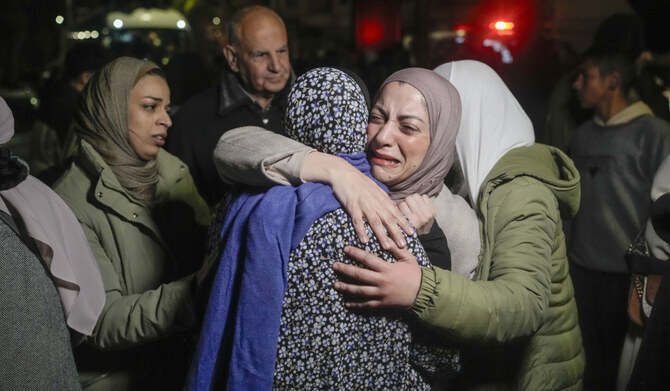
Israel’s military, which occupies the West Bank, warned Palestinians against public celebration — the release took place after 1 a.m. — but crowds thronged the buses after they left the prison, some people climbing on top or waving flags, including those of Hamas.
There were fireworks and whistles, and shouts of “God is great.” Those released were hoisted onto others’ shoulders or embraced.
The most prominent detainee freed was Khalida Jarrar, 62, a member of a secular leftist faction that was involved in attacks against Israel in the 1970s but later scaled back militant activities. Since her arrest in late 2023, she was held under indefinitely renewable administrative detention orders that were criticized by human rights groups.
The next release of hostages and prisoners is due on Saturday, with 33 hostages and nearly 2,000 Palestinian prisoners and detainees to be freed over the ceasefire’s 42-day first phase. In just over two weeks, talks are to begin on the far more challenging second phase.
This is just the second ceasefire in the war, longer and more consequential than a weeklong pause in November 2023, with the potential to end the fighting for good.
But Netanyahu, who had been under pressure from both the Biden administration and President-elect Donald Trump to achieve a deal before Monday’s US inauguration, has said he has Trump’s backing to continue fighting if necessary.
Meanwhile, Israel’s hard-line national security minister said his Jewish Power faction was quitting the government in protest over the ceasefire, reflecting the political friction that some Israelis said delayed a deal. Itamar Ben-Gvir’s departure weakens Netanyahu’s coalition but will not affect the truce.
‘Joy mixed with pain’
Across Gaza, there was relief and grief. The fighting has killed tens of thousands, destroyed large areas and displaced most of the population.
“This ceasefire was a joy mixed with pain, because my son was martyred in this war,” said Rami Nofal, a displaced man from Gaza City.
Masked militants appeared at some celebrations, where crowds chanted slogans in support of them, according to Associated Press reporters in Gaza. The Hamas-run police began deploying in public after mostly lying low due to Israeli airstrikes.
Some families set off for home on foot, their belongings loaded on donkey carts.
In the southern city of Rafah, residents returned to find massive destruction. Some found human remains in the rubble, including skulls.
“It’s like you see in a Hollywood horror movie,” resident Mohamed Abu Taha said as he inspected the ruins of his family’s home.
Already, Israeli forces were pulling back from areas. Residents of Beit Lahiya and Jabaliya in northern Gaza told the AP they didn’t see Israeli troops there.
One resident said they saw bodies in the streets that appeared to have been there for weeks.
Israelis divided over deal
In Israel, people remained divided over the agreement.
Asher Pizem, 35, from the city of Sderot, said the deal had merely postponed the next confrontation with Hamas. He also criticized Israel for allowing aid into Gaza, saying it would contribute to the militant group’s revival.
“They will take the time and attack again,” he said while viewing Gaza’s smoldering ruins from a small hill in southern Israel with other Israelis gathered there.
When President Joe Biden was asked Sunday whether he has any concerns about Hamas regrouping, he said no.
Immense toll
The toll of the war has been immense, and new details will now emerge. The head of the Rafah municipality in Gaza, Ahmed Al-Sufi, said a large part of the infrastructure, including water, electricity and road networks, was destroyed, in addition to thousands of homes.
There should be a surge of humanitarian aid, with hundreds of trucks entering Gaza daily, far more than Israel allowed before. The UN humanitarian agency said more than 630 trucks with aid entered on Sunday, with at least 300 going to hard-hit northern Gaza.
“This is a moment of tremendous hope,” humanitarian chief Tom Fletcher said.
Over 46,000 Palestinians have been killed, according to Gaza’s Health Ministry, which says women and children make up more than half the fatalities but does not distinguish between civilians and fighters.
The Hamas-led attack on southern Israel that sparked the war killed over 1,200 people, mostly civilians, and militants abducted around 250 others. More than 100 hostages were freed during the weeklong ceasefire in November 2023.
Some 90 percent of Gaza’s population has been displaced. Rebuilding — if the ceasefire reaches its final phase — will take several years at least. Major questions about Gaza’s future, political and otherwise, remain unresolved.


![]()

Israel frees 90 Palestinian prisoners as ceasefire takes hold after Hamas returns 3 Israeli hostages
Short Url
https://arab.news/5snkw
Israel frees 90 Palestinian prisoners as ceasefire takes hold after Hamas returns 3 Israeli hostages
- Palestinians across Gaza return home as first trucks with humanitarian aid enter devastated territory
- Israel’s military, which occupies the West Bank, had warned Palestinians against public celebration
Latest updates


© 2026 SAUDI RESEARCH & PUBLISHING COMPANY, All Rights Reserved And subject to Terms of Use Agreement.