

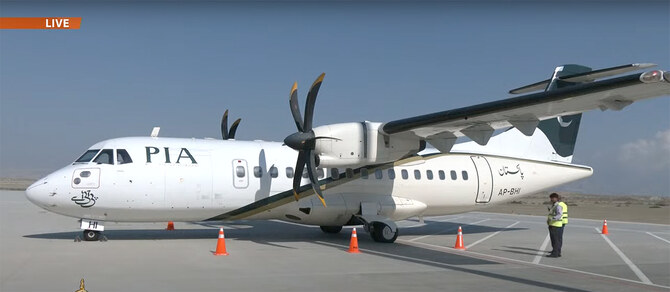

KARACHI: Pakistan’s new Gwadar International Airport began commercial operations on Monday after a Pakistan International Airlines (PIA) flight arrived from the southern port city of Karachi, the Pakistan Airports Authority (PAA) said, following a months-long delay in the opening of the China-funded facility.
A security review, prompted by a string of deadly attacks by separatist militants in the southwestern Balochistan province in August last year, had delayed the airport’s opening to the end of 2024 from Aug. 14. The airport was then due to begin operations on Jan. 10, which was once again postponed.
Pakistan hopes the $246-million Chinese-backed project, which will handle both domestic and international flights, will become one of Pakistan’s largest airports.
“Pakistan achieved a landmark moment in its aviation history on Monday as the first commercial flight successfully landed at the New Gwadar International Airport,” the PAA said in a statement.
PIA flight PK-503 departed from Karachi at 9:50 am and touched down at the airport at 11:15am, carrying 46 passengers. In a video shared by the PAA, the PIA flight was seen being greeted by a traditional water salute by water bowsers as it landed.
Defense and Aviation Minister Khawaja Muhammad Asif, who was the chief guest at the event, said he hoped the new airport would drive economic growth and regional tourism, and strengthen international connectivity, the PAA said.
Last month, Prime Minister Shehbaz Sharif’s office said the Gwadar airport would be able to handle A-380 aircraft and be capable of accommodating 4 million passengers annually.
The airport will eventually feature various facilities, including a cold storage, cargo sheds, hotels and shopping malls, with banking services arranged through the State Bank of Pakistan, according to the PM’s office. PIA has also planned to increase flights between Karachi and Gwadar to three times a week, while discussions are ongoing with private airlines and carriers from China, Oman and the United Arab Emirates (UAE) to launch both domestic and international services.
“The New Gwadar International Airport is poised to play a pivotal role in connecting Pakistan to global markets and facilitating trade, tourism, and economic development,” the PAA said.
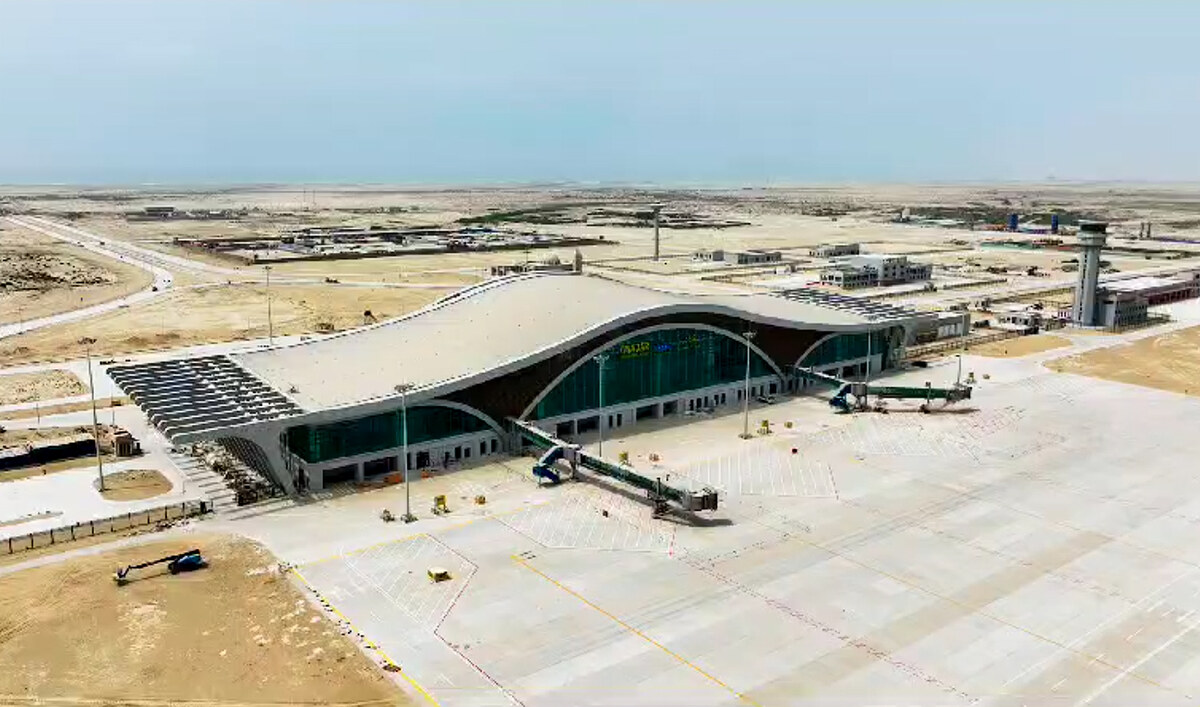
This screengrab, taken from a handout video released by Pakistan Civil Aviation Authority in December 2024, shows generic view of the Gwadar International Airport in southwestern Balochistan. (Screengrab/CAA)
China has pledged over $65 billion in infrastructure, energy and other projects in Pakistan under the China Pakistan Economic Corridor (CPEC). Part of President Xi Jinping’s Belt and Road Initiative, the program in Pakistan is also developing a deep-water port close to the new Gwadar airport, a joint venture between Pakistan, Oman and China that is close to completion.
Although no Chinese projects were targeted in the militant attacks in August that delayed the airport’s launch, they have been frequently attacked in the past by separatists who view China as a foreign invader trying to gain control of impoverished but mineral-rich Balochistan, the site of a decades-long insurgency.
Recent attacks, including one in October 2024 in which two Chinese workers were killed in a suicide bombing in Karachi, have forced Beijing to publicly criticize Pakistan over security lapses and media has widely reported in recent months that China wants its own security forces on the ground to protect its nationals and projects, a demand Islamabad has long resisted.


