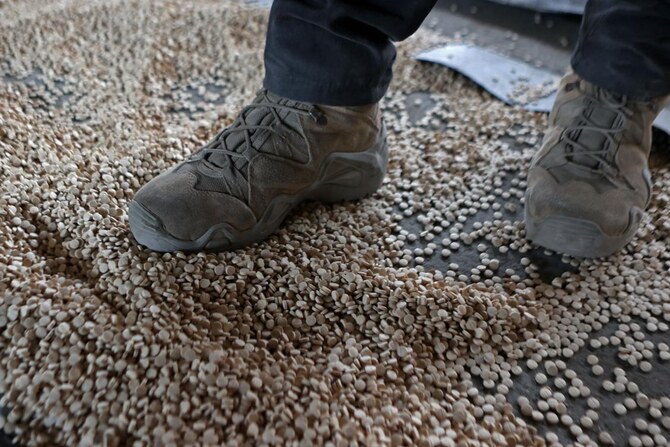
DAMASCUS: Syrian security forces destroyed seized drugs Sunday including around 100 million pills of the amphetamine-like stimulant captagon — whose production and trafficking flourished under ousted president Bashar Assad, an official said.
A 2022 AFP investigation found that Syria under Assad had become a narco state, with the $10-billion captagon industry dwarfing all other exports and funding both his regime and many of his enemies.
“We destroyed large quantities of narcotic pills,” said official Badr Youssef, including “about 100 million captagon pills and 10 to 15 tons of hashish” as well as raw materials used to produce captagon.
He spoke from the Damascus headquarters of the defunct Fourth Division where the drugs were seized. The Fourth Division, a notorious branch of the Syrian army, was controlled by Assad’s brother Maher.
The official SANA news agency said “the anti-narcotics department of the (interior) ministry is destroying narcotic substances seized at the headquarters of the Fourth Division.”
An AFP photographer saw security personnel in a Fourth Division warehouse load dozens of bags filled with pills and other drugs into trucks, before taking them to a field to be burned.
On December 8, Islamist-led rebels ousted Assad after a lightning offensive that lasted less than two weeks. The army and Assad’s security apparatus collapsed as the new authorities seized control of Damascus.
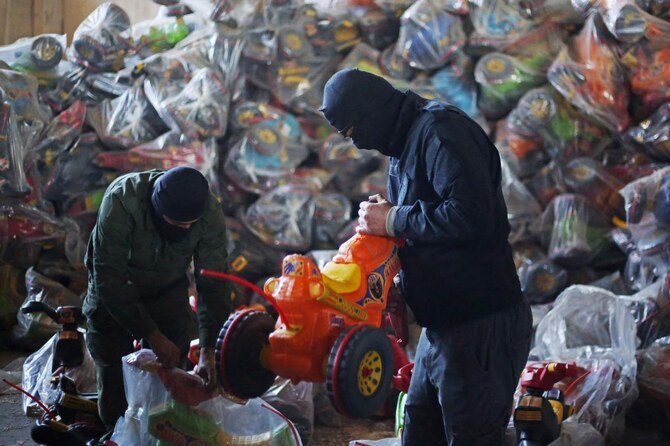
On Saturday, SANA reported that authorities had seized “a huge warehouse belonging to the former regime” in the coastal city of Latakia. It said the factory “specialized in packing captagon pills into children’s toys and furniture.”
On Sunday, an AFP photographer visited the warehouse near the port and saw security personnel dismantling children’s bicycles that contained the small white pills.
Captagon pills had also been hidden inside objects such as doors, shisha water pipes and car parts, he reported.
Abu Rayyan, a security official in Latakia, said that “about 50 to 60 million captagon pills” had been seized that “belonged to the Fourth Division.”
“This is the largest such warehouse in the area,” he said.
Abu Rayyan said the drugs had been packed for export from Latakia “to neighboring countries,” and that they would be destroyed.

Syria destroys millions of captagon pills, other drugs
Short Url
https://arab.news/m4t75
Syria destroys millions of captagon pills, other drugs
- Officials find100 million pills of the amphetamine-like stimulant captagon
- Production and trafficking of the drug flourished under ousted President Bashar Assad
Iran says missile attacks to continue, US talks ‘not on agenda’
- Abbas Araghchi: ‘I don’t think talking with the Americans would be on our agenda anymore’
- Top envoy says Tehran had a “very bitter experience” during previous negotiations with the US
TEHRAN: Iran’s foreign minister said Tuesday that talks with the United States were not on the agenda as their war entered its 11th day.
“I don’t think talking with the Americans would be on our agenda anymore,” Abbas Araghchi told PBS News, saying Tehran had a “very bitter experience” during previous negotiations with the US.
On February 28, the US and Israel launched strikes against Iran that killed its supreme leader Ayatollah Ali Khamenei and triggered a war that has spread across the Middle East.
The Israeli and US attacks took place two days before Washington and Tehran were scheduled to hold talks following three prior rounds of negotiations. Omani mediators in those discussions had said there was “significant progress” in the talks.
Iran has responded to the US-Israeli attacks with drone and missile strikes targeting Israel and US interests across the region.
Shipping traffic through the strategic Strait of Hormuz, through which nearly 20 percent of the world’s crude oil usually transits, has been severely disrupted.
Iranian forces have repeatedly targeted oil tankers passing through the strategic waterway since the war began.
In the interview with PBS News, Araghchi insisted that Iran was acting in “self-defense.”
“We are prepared, we have been prepared to continue attacking them with our missiles as long as needed and as long as it takes,” he said.
Late Monday, Iranian deputy foreign minister Kazem Gharibabadi said some countries in the region and elsewhere had reached out to Iran to push for a ceasefire.
“China, Russia and France, and even some countries in the region, are in contact with us,” he told state TV.
“Some of them are willing to do something to stop this war or establish a ceasefire.”
French President Emmanuel Macron said France and its allies are preparing a “defensive” mission to reopen the Strait of Hormuz.
Gharibabadi said Iran “did not start the aggression and the war … we are defending ourselves.”
“I don’t think talking with the Americans would be on our agenda anymore,” Abbas Araghchi told PBS News, saying Tehran had a “very bitter experience” during previous negotiations with the US.
On February 28, the US and Israel launched strikes against Iran that killed its supreme leader Ayatollah Ali Khamenei and triggered a war that has spread across the Middle East.
The Israeli and US attacks took place two days before Washington and Tehran were scheduled to hold talks following three prior rounds of negotiations. Omani mediators in those discussions had said there was “significant progress” in the talks.
Iran has responded to the US-Israeli attacks with drone and missile strikes targeting Israel and US interests across the region.
Shipping traffic through the strategic Strait of Hormuz, through which nearly 20 percent of the world’s crude oil usually transits, has been severely disrupted.
Iranian forces have repeatedly targeted oil tankers passing through the strategic waterway since the war began.
In the interview with PBS News, Araghchi insisted that Iran was acting in “self-defense.”
“We are prepared, we have been prepared to continue attacking them with our missiles as long as needed and as long as it takes,” he said.
Late Monday, Iranian deputy foreign minister Kazem Gharibabadi said some countries in the region and elsewhere had reached out to Iran to push for a ceasefire.
“China, Russia and France, and even some countries in the region, are in contact with us,” he told state TV.
“Some of them are willing to do something to stop this war or establish a ceasefire.”
French President Emmanuel Macron said France and its allies are preparing a “defensive” mission to reopen the Strait of Hormuz.
Gharibabadi said Iran “did not start the aggression and the war … we are defending ourselves.”
© 2026 SAUDI RESEARCH & PUBLISHING COMPANY, All Rights Reserved And subject to Terms of Use Agreement.


