

Pakistani neuroscientist accused of ‘terrorism’ calls for pardon before Biden leaves office

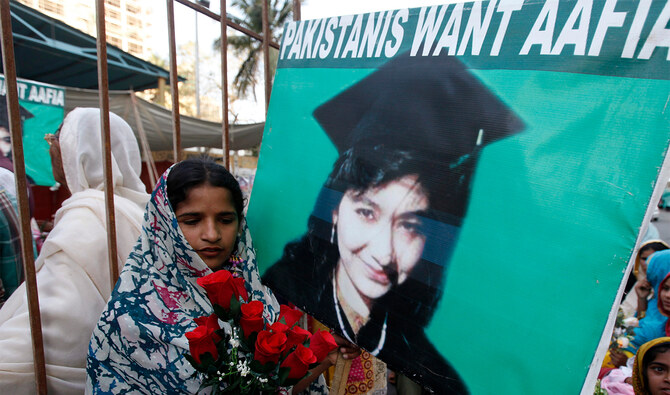
An Aafia Siddiqui supporter carries silk roses next to a poster during a celebration to mark Siddiqui's 41st birthday in Karachi March 2, 2014. (REUTERS/File)
Short Url
Updated 19 January 2025
Follow

Pakistani neuroscientist accused of ‘terrorism’ calls for pardon before Biden leaves office

  • Dr. Aafia Siddiqui was sentenced to 86 years in prison on multiple charges, including attempting to kill US nationals
  • Her lawyer has submitted a dossier to Biden, who has until Monday to grant clemency before Trump's swearing-in

KARACHI: A Pakistani neuroscientist accused of “terrorism” by Washington has appealed to outgoing US President Joe Biden to grant her clemency before he hands over the reins of the country to President-elect Donald Trump, her lawyer said this week.

Dr. Aafia Siddiqui, a US-trained neuroscientist, was convicted in 2010 on multiple charges, including attempting to kill US nationals. She became a suspect after leaving the US and marrying a nephew of Khalid Sheikh Mohammed, a self-proclaimed mastermind of the Sept. 11, 2001, attacks.

Siddiqui was wounded during a confrontation with US officials in Afghanistan in 2008, with some reports suggesting she shot at the Americans. She was sentenced to 86 years in prison in 2010, prompting a huge outcry from Pakistan and human rights voices worldwide.

Her family claims she was visiting Pakistan in 2003 when she was abducted with her three children by Pakistan’s premier intelligence agency and handed to the Central Intelligence Agency (CIA), which took her to Afghanistan. Pakistan’s intelligence agencies have denied the claims. 

Dr. Siddiqui’s lawyer, Clive Stafford Smith, has submitted a 76,500-word dossier to Biden and is calling on the American president to pardon him before Trump’s swearing-in on Monday.

“We just pray and keep our fingers crossed and I hope to goodness our clemency is granted Monday morning,” Smith told Arab News late Saturday night.

“And if not, revert to plan B and plan C and plan D until we get her out of this awful place,” he added.

Smith said Siddiqui was “in good spirits” when he met her on Friday at the detention facility in Fort Worth, Texas, for four hours despite her trauma. He said Dr. Fowzia Siddiqui, her sister, had traveled 10,000 miles to see her sister but was only allowed an hour and 40 minutes to see her sister.

Prime Minister Shehbaz Sharif also wrote a letter to Biden in October 2024, calling for Siddiqui’s release.

In the letter, Sharif stressed that several Pakistani officials had made consular visits to her in prison, raising “serious concerns” about her treatment while incarcerated.

The prime minister said her time in prison had “severely impacted her already fragile mental and frail physical health,” adding: “In fact, they [the officials] even fear that she could take her own life.”

Biden has until Monday to grant Siddiqui clemency. So far, he has issued 39 pardons and commuted 3,989 sentences.

According to Sky News, Smith claims a catalog of intelligence errors led to her initially becoming a suspect, citing witness testimonies that were unavailable at the time of her trial.

Smith said US intelligence “got the wrong end of the stick in the beginning” as agencies thought Siddiqui was a nuclear physicist working on a radioactive bomb “when she really did her PhD in education.”

He said this happened as the US was “terrified of terrorists getting their hands on WMD (weapons of mass destruction),” adding: “She’s no more of a terrorist than I am.”

The US Department of Justice did not respond to Sky News.


Pakistan condemns Netanyahu’s ‘hexagon of alliances’ plan, says alert to growing India-Israel defense ties

Updated 26 February 2026
Follow

Pakistan condemns Netanyahu’s ‘hexagon of alliances’ plan, says alert to growing India-Israel defense ties

  • Israel’s Netanyahu last week proposed an alliance of countries in and around Middle East against its adversaries
  • Pakistan maintains “robust military preparedness” to deter any potential aggression, says foreign office spokesperson

ISLAMABAD: Pakistan’s foreign office spokesperson on Thursday condemned Israeli Prime Minister Benjamin Netanyahu’s recent statement about forming a “hexagon of alliances” within or around the Middle East, saying Islamabad was alert to growing defense ties between New Delhi and Tel Aviv. 

Netanyahu on Sunday outlined plans to form a new regional bloc, describing it as a “hexagon of alliances” that he said could include Israel, India, Greece and Cyprus, along with other unnamed Arab, African and Asian states. He said the grouping would collectively stand against what he described as “radical” adversaries.

His comments came days before Indian Prime Minister Narendra Modi arrived in Israel on Wednesday for a two-day trip to bolster ties. The two are expected to discuss cooperation in science and technology, innovation, agriculture, water management, technology, defense and security during the trip. 

The statement drew a sharp response from Pakistan’s Senate, which unanimously passed a resolution on Tuesday rejecting Netanyahu’s remarks.

“I would also like to draw your attention to the recent resolution adopted by the Senate of Pakistan that strongly condemned such remarks and attempts to undermine Muslim unity,” Foreign Office spokesperson Tahir Andrabi told reporters during a weekly press briefing.

“We continue to condemn these provocative steps and statements by the leadership of the occupying power that threaten regional peace and stability,” he added.

Netanyahu had also said Israel’s goal was to create an axis of nations that see eye to eye against what he described as the “radical Shia” and “radical Sunni” axis of nations. 

Andrabi said attempts to divide the Muslim world along sectarian lines were a “nefarious design” on Netanyahu’s part.

India is Israel’s largest arms buyer and second-largest trading partner in Asia, after China. In response to a question on India’s growing defense ties with Israel, Andrabi said Pakistan remained cognizant of the risks posed by such cooperation.

“Yes, we remain seized of the defense ties between Israel and India,” the spokesperson said, noting that certain “systems and platforms” may have been used by India against Pakistan in the past.

“We are alive to the threats they pose to our security, sovereignty and territorial integrity, as well as to regional peace and stability.”

Andrabi said Pakistan maintained “robust military preparedness” to deter any potential aggression from hostile forces.

‘UTMOST CAUTION EXERCISED’

Andrabi spoke about Pakistan’s recent strikes against alleged militant camps in Afghanistan, saying Islamabad had conducted them in self-defense and with extreme caution to avoid casualties. 

Pakistan said it carried out airstrikes in Afghanistan against militant camps and hideouts in three provinces on Saturday night, killing over 100 militants. Afghanistan accused Pakistan of violating its territorial sovereignty and killing dozens of civilians. Kabul has vowed to retaliate. 

Andrabi said the strikes were carried out to ensure protection for the lives of the people of Pakistan and to prevent “imminent terrorist attacks.”

“These actions were directed solely against identified terrorist camps and hideouts, and utmost caution was exercised to prevent harm to civilians,” he said. 

He warned Pakistan would take necessary measures under its right to self-defense against “terrorist threats” emanating from Afghan territory.

On the safety of Pakistani nationals in Afghanistan following the strikes, Andrabi said Islamabad had raised the issue with Afghan authorities, adding that Islamabad expected “foolproof security” for Pakistani diplomats and civilians.