

Pakistani authorities arrest suspected human smuggler linked to last year’s Greece boat tragedy

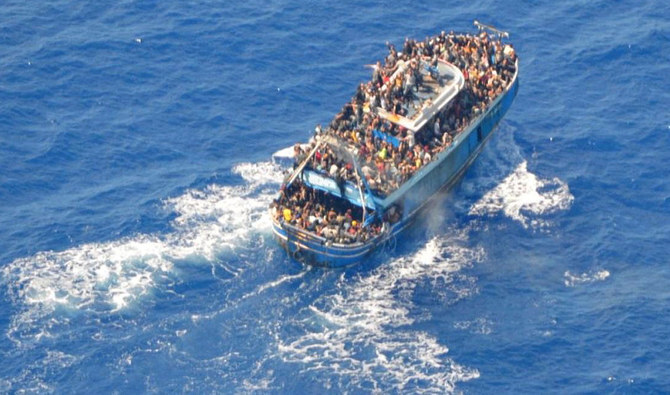
A undated handout photo provided by the Hellenic Coast Guard shows migrants onboard a boat during a rescue operation, before their boat capsized on the open sea, off Greece, June 14, 2023. (Photo courtesy: Hellenic Coast Guard via REUTERS)
Short Url
Updated 19 January 2025
Follow

Pakistani authorities arrest suspected human smuggler linked to last year’s Greece boat tragedy

  • FIA says it found evidence of human smuggling from the suspect's mobile phone after arrest
  • Abdul Salam allegedly extorted Rs4.5 million from a victim who drowned in the boat tragedy

KARACHI: Pakistani authorities on Saturday announced the arrest of a suspected human smuggler from Azad Kashmir, accusing him of involvement in last year’s Greece boat tragedy that killed five nationals and charging him with sending one victim abroad after taking Rs4.5 million ($16,200).

The incident occurred in December when a wooden vessel carrying migrants, which departed from Libya, sank off the southern Greek island of Gavdos. The government has intensified its crackdown on human smugglers in recent months, leading to several arrests.

The latest detention comes just days after another boat capsized off Morocco’s coast, where over 40 Pakistanis are feared to have drowned.

“The smuggler involved in the Greece boat tragedy has been arrested,” the Federal Investigation Agency (FIA) said in a statement. “The accused, Abdul Salam, was apprehended during a raid in Bhimber, Azad Kashmir.”

“He was part of a gang involved in human trafficking and extorted Rs4.5 million from victim Ahsan Ali for facilitating his travel to Europe,” it added.

The FIA said the suspect and his associates had kept the victim in safe houses in Libya before coercing him to board the ill-fated boat to Greece. Ali, who hailed from Jalalpur Jattan, died in the shipwreck.

The FIA informed that evidence related to human smuggling was recovered from the suspect’s mobile phone, and investigations were ongoing to track down his accomplices.

“We are using all resources to ensure the arrest of those involved in these tragic incidents,” said Abdul Qadir Qamar, Director of FIA’s Gujranwala Zone. “Raids are being conducted to apprehend the remaining suspects.”

The FIA reiterated its commitment to bringing human smugglers to justice.

“No one will be allowed to play with the lives of innocent people,” the statement said. “Those responsible will face severe punishments based on solid evidence.”


Pakistani economists flag debt sustainability risks as foreign loans surge in FY26

Updated 5 sec ago
Follow

Pakistani economists flag debt sustainability risks as foreign loans surge in FY26

  • Pakistan received $2.98 billion from bilateral, global lenders from July to November this year, official data shows
  • Economists urge government to take structural reforms to boost exports, cut energy costs, ensure rupee stability

KARACHI: Pakistani economists on Wednesday warned the government against debt sustainability risks as the country’s foreign loan receipts surged to nearly $3 billion in the first five months of the current fiscal year, data from the economic affairs ministry showed. 

Pakistan received 16 percent more financing, which is $2.98 billion, from bilateral and multilateral lenders during the July to November period of the current fiscal year compared to last year, the economic affairs’ ministry data showed. 

Pakistan, as per the data, seeks to raise $19.8 billion in loans this year through June, which include $16.7 billion non-project and $3.11 billion project loans from multilateral lenders such as the Asian Development Bank (ADB), Asian Infrastructure Investment Bank (AIIB), Islamic Development Bank (IsDB), European Union (EU), European Investment Bank (EIB), UNICEF and others. 

Pakistan’s bilateral lenders include the countries of China, Saudi Arabia, Kuwait, Oman, the US, Denmark, France, Germany, Italy, Japan and South Korea

“As long as you are utilizing the loan for economic recovery and growth, it is understood,” Sana Tawfik, head of research at the Karachi-based brokerage firm Arif Habib Limited, told Arab News.

“But in the long term, it is not sustainable to rely only on loans. Foreign reserves should be built on FDI [foreign direct investment] and not on loans,” she added. 

Pakistan’s finance adviser Khurram Schehzad and finance ministry spokesperson Qamar Sarwar Abbasi did not respond to requests for comment.

Cash-strapped Pakistan came close to a sovereign default in 2023 before a last-gasp financial bailout by the International Monetary Fund (IMF) averted the risk. 

While Pakistan has lowered inflation and registered other economic gains, the country’s $15.9 billion foreign reserves mostly come from the IMF in budgetary support and bank deposits from countries such as Saudi Arabia and China.

The cash-strapped country will seek $13.5 billion in budgetary support, $700 million in short-term loans from the IsDB, $1.44 billion as program loans, $1 billion worth of oil on deferred payments and $3.11 billion as project loans by June, the data said. 

Prime Minister Shehbaz Sharif’s government also plans to raise $400 million through issuing international bonds, $3.1 billion in loans from foreign commercial banks, $410 million from the IMF, $609 million through Naya Pakistan Certificates (NPCs) and $5 billion as time deposits from Saudi Arabia, and $4 billion as safe deposit from China.

“Long-term solution is not to take loans and this only adds up to the existing external account,” Tawfik said. 

She, however, appreciated the government’s ability to reduce its current account deficit in recent months. The economist noted that Pakistan, in the short run, could manage its current account deficit if it remains in the $1.5 billion range throughout the year.

She urged the government to focus on increasing exports, noting its debt servicing requirement was $25.8 billion this year.

Tawfik called for long-term reforms such as reducing the cost of doing business, cutting energy costs, clearing Pakistan’s longstanding power sector debt and keeping the rupee stable to attract increased remittances from Pakistanis working abroad.

“In the long run, we must focus on increasing Pakistan’s exports, remittances, and FDI,” the economist said. “FDI is the most important.”

‘OBVIOUSLY A RISK FACTOR’

However, neither are Pakistan’s exports on the rise nor is FDI. Pakistan’s current account deficit widened by 37 percent to $16 billion from July to November this year. This was due to a 6.4 percent decline in exports to $12.8 billion and a 13 percent hike in imports to $28 billion, data from the Pakistan Bureau of Statistics (PBS) showed. 

FDI dropped by more than 25 percent to $927 million during the same period and has never surged beyond $3 billion in nearly 20 years, data from Pakistan’s central bank shows. 

“Our debt sustainability will be questioned at any point if we, going forward, are not able to match these debt flows or counter these debt flows with growth and remittances and exports,” Muhammad Saad Ali, head of research at Lucky Investments Ltd, told Arab News. 

He noted that debt sustainability is “obviously a risk factor” as Pakistan has not increased its FDI nor exports during the period when its foreign debt has increased.

However, he said that there was a positive side to the 16 percent rise in foreign debt receipts as well, adding that recent macroeconomic improvements have enabled Islamabad to borrow more from global lenders. 

But the risks remain. 

“You (government) are increasing your debt and your debt sustainability will come into question again if global factors or global environment turn south,” he warned.