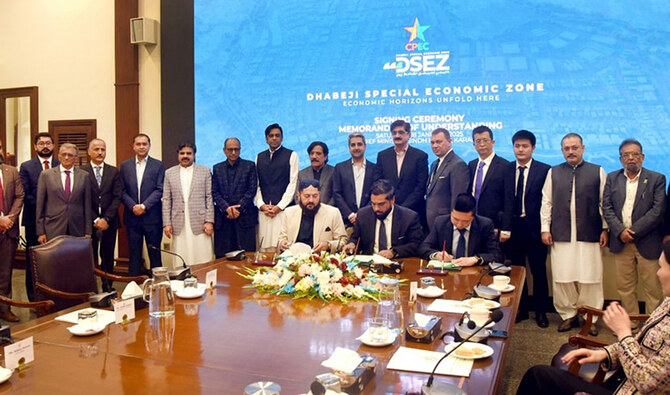
KARACHI: The provincial administration of Sindh on Saturday announced the establishment of a special economic zone after the signing of a memorandum of understanding supported by Chinese authorities, projecting the initiative to transform Pakistan’s economy by attracting $3 billion in investment and creating over 100,000 jobs.
The announcement is part of the second phase of the China-Pakistan Economic Corridor (CPEC), which aims to enhance industrial development by setting up such economic zones. The first CPEC phase focused on infrastructure and energy projects, while the second phase emphasizes industrial collaboration between the two countries.
The Dhabeji Special Economic Zone (SEZ), which is being developed under public-private partnership by the Sindh administration, is strategically located near Karachi’s ports, offering connectivity to regional trade routes to position it as a vital industrial hub.
“The Dhabeji SEZ is set to transform Pakistan’s economic landscape,” Sindh Chief Minister Syed Murad Ali Shah said, according to an official statement released after the MoU signing.
He added the project would stimulate industrial growth, reduce reliance on imports, boost exports and create a self-reliant and sustainable economy.
Special Assistant to the CM on Investment, Syed Qassim Naveed Qamar, also highlighted the SEZ’s transformative potential.
“This SEZ will create over 100,000 direct and indirect jobs, promote value-added industries and empower local communities through skills development.”
The MoU signing ceremony was also attended by members of the Sindh Cabinet, senior officials and other dignitaries.

Pakistan eyes $3 billion investment as Sindh announces China-backed special economic zone
https://arab.news/r8pp7
Pakistan eyes $3 billion investment as Sindh announces China-backed special economic zone
- CM Murad Ali Shah emphasizes its transformative potential amid hopes for over 100,000 jobs
- Dhabeji SEZ will be located near Karachi’s ports, offering connectivity to regional trade routes
Sindh assembly passes resolution rejecting move to separate Karachi
- Chief Minister Shah cites constitutional safeguards against altering provincial boundaries
- Calls to separate Karachi intensified amid governance concerns after a mall fire last month
ISLAMABAD: The provincial assembly of Pakistan’s southern Sindh province on Saturday passed a resolution rejecting any move to separate Karachi, declaring its territorial integrity “non-negotiable” amid political calls to carve the city out as a separate administrative unit.
The resolution comes after fresh demands by the Muttahida Qaumi Movement (MQM) and other voices to grant Karachi provincial or federal status following governance challenges highlighted by the deadly Gul Plaza fire earlier this year that killed 80 people.
Karachi, Pakistan’s largest and most densely populated city, is the country’s main commercial hub and contributes a significant share to the national economy.
Chief Minister Syed Murad Ali Shah tabled the resolution in the assembly, condemning what he described as “divisive statements” about breaking up Sindh or detaching Karachi.
“The province that played a foundational role in the creation of Pakistan cannot allow the fragmentation of its own historic homeland,” Shah told lawmakers, adding that any attempt to divide Sindh or separate Karachi was contrary to the constitution and democratic norms.
Citing Article 239 of Pakistan’s 1973 Constitution, which requires the consent of not less than two-thirds of a provincial assembly to alter provincial boundaries, Shah said any such move could not proceed without the assembly’s approval.
“If any such move is attempted, it is this Assembly — by a two-thirds majority — that will decide,” he said.
The resolution reaffirmed that Karachi would “forever remain” an integral part of Sindh and directed the provincial government to forward the motion to the president, prime minister and parliamentary leadership for record.
Shah said the resolution was not aimed at anyone but referred to the shifting stance of MQM in the debate while warning that opposing the resolution would amount to supporting the division of Sindh.
The party has been a major political force in Karachi with a significant vote bank in the city and has frequently criticized Shah’s provincial administration over its governance of Pakistan’s largest metropolis.
Taha Ahmed Khan, a senior MQM leader, acknowledged that his party had “presented its demand openly on television channels with clear and logical arguments” to separate Karachi from Sindh.
“It is a purely constitutional debate,” he told Arab News by phone. “We are aware that the Pakistan Peoples Party, which rules the province, holds a two-thirds majority and that a new province cannot be created at this stage. But that does not mean new provinces can never be formed.”
Calls to alter Karachi’s status have periodically surfaced amid longstanding complaints over governance, infrastructure and administrative control in the megacity, though no formal proposal to redraw provincial boundaries has been introduced at the federal level.


