

Aid agencies: Will take $80bn and 40 years to rebuild Gaza Strip

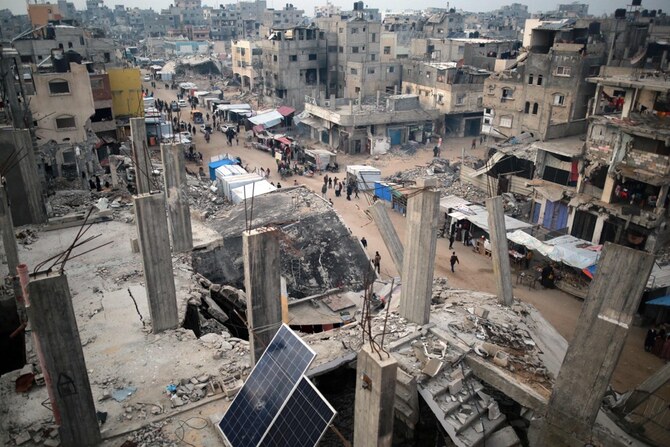
People walk past stalls selling goods amid the rubble of buildings destroyed during previous Israeli strikes, in Khan Yunis in the southern Gaza Strip. (AFP)
Short Url
Updated 18 January 2025
Follow

Aid agencies: Will take $80bn and 40 years to rebuild Gaza Strip

  • Israeli offensive has transformed the enclave into a rubble-strewn wasteland with blackened shells of buildings and mounds of debris

Rebuilding homes and infrastructure after Israel’s 15-month war on Gaza could take 40 years and cost more than $80 billion, aid agencies said on Friday.

The war has transformed the enclave into a rubble-strewn wasteland with blackened shells of buildings and mounds of debris. Major roads have been plowed up. Critical water and electricity infrastructure is in ruins. Most hospitals no longer function.

The full extent of the damage will be known only when the fighting ends on Sunday and inspectors have full access. The most heavily destroyed part of Gaza, in the north, has been sealed off and largely depopulated by Israeli forces in an operation that began last October.

Using satellite data, the UN estimates that 70 percent of structures in Gaza have been damaged or destroyed, including over 245,000 homes.

Before anything can be rebuilt, the rubble must be removed — a staggering task in itself.

The war has littered Gaza with over 50 million tonnes of rubble, about 12 times the size of the Great Pyramid of Giza. With over 100 trucks working full time, it would take 15 years to clear.

“I can’t think of any parallel, in terms of the severity of damage, for an enclave or a country or a people,” said Corey Scher of the Shelter Cluster, an international coalition of aid providers led by the Norwegian Refugee Council.

The first target for aid is the health sector, with more than 80 percent of Gaza’s health facilities damaged or destroyed.

The World Health Organization said on Friday it would start by bringing prefabricated hospitals into the enclave and medically evacuating over 12,000 patients, a third of them children.


UN rights chief Shocked by ‘unbearable’ Darfur atrocities

Updated 18 January 2026
Follow

UN rights chief Shocked by ‘unbearable’ Darfur atrocities

  • Mediation efforts have failed to produce a ceasefire, even after international outrage intensified last year with reports of mass killings, rape, and abductions during the RSF’s takeover of El-Fasher in Darfur

PORT SUDAN: Nearly three years of war have put the Sudanese people through “hell,” the UN’s rights chief said on Sunday, blasting the vast sums spent on advanced weaponry at the expense of humanitarian aid and the recruitment of child soldiers.
Since April 2023, Sudan has been gripped by a conflict between the army and the paramilitary Rapid Support Forces that has left tens of thousands of people dead and around 11 million displaced.
Speaking in Port Sudan during his first wartime visit, UN Human Rights commissioner Volker Turk said the population had endured “horror and hell,” calling it “despicable” that funds that “should be used to alleviate the suffering of the population” are instead spent on advanced weapons, particularly drones.
More than 21 million people are facing acute food insecurity, and two-thirds of Sudan’s population is in urgent need of humanitarian aid, according to the UN.
In addition to the world’s largest hunger and displacement crisis, Sudan is also facing “the increasing militarization of society by all parties to the conflict, including through the arming of civilians and recruitment and use of children,” Turk added.
He said he had heard testimony of “unbearable” atrocities from survivors of attacks in Darfur, and warned of similar crimes unfolding in the Kordofan region — the current epicenter of the fighting.
Testimony of these atrocities must be heard by “the commanders of this conflict and those who are arming, funding and profiting from this war,” he said.
Mediation efforts have failed to produce a ceasefire, even after international outrage intensified last year with reports of mass killings, rape, and abductions during the RSF’s takeover of El-Fasher in Darfur.
“We must ensure that the perpetrators of these horrific violations face justice regardless of the affiliation,” Turk said on Sunday, adding that repeated attacks on civilian infrastructure could constitute “war crimes.”
He called on both sides to “cease intolerable attacks against civilian objects that are indispensable to the civilian population, including markets, health facilities, schools and shelters.”
Turk again warned on Sunday that crimes similar to those seen in El-Fasher could recur in volatile Kordofan, where the RSF has advanced, besieging and attacking several key cities.
Hundreds of thousands face starvation across the region, where more than 65,000 people have been displaced since October, according to the latest UN figures.