



STILFONTEIN, South Africa: The death toll in a monthslong standoff between police and miners trapped while working illegally in an abandoned gold mine in South Africa has risen to at least 87, police said Thursday. Authorities faced growing anger and a possible investigation over their initial refusal to help the miners and instead “smoke them out” by cutting off their food supplies.
National police spokesperson Athlenda Mathe said that 78 bodies were retrieved in a court-ordered rescue operation, with 246 survivors also pulled out from deep underground since the operation began on Monday. Mathe said nine other bodies had been recovered before the rescue operation, without giving details.
Community groups launched their own rescue attempts when authorities said last year they would not help the hundreds of miners because they were “criminals.”
The miners are suspected to have died of starvation and dehydration, although no causes of death have been released.
South African authorities have been fiercely criticized for cutting off food and supplies to the miners in the Buffelsfontein Gold Mine last year. That tactic to “smoke them out,” as described by a prominent Cabinet minister, was condemned by one of South Africa’s biggest trade unions.
Police and the mine owners were also accused of taking away ropes and dismantling a pulley system the miners used to enter the mine and send supplies down from the surface.
A court ordered authorities last year to allow food and water to be sent down to the miners, while another court ruling last week forced them to launch a rescue operation.
Many say the unfolding disaster underground was clear weeks ago, when community members sporadically pulled decomposing bodies out of the mine, some with notes attached pleading for food to be sent down.
“If the police had acted earlier, we would not be in this situation, with bodies piling up,” said Johannes Qankase, a local community leader. “It is a disgrace for a constitutional democracy like ours. Somebody needs to account for what has happened here.”
South Africa’s second biggest political party, which is part of a government coalition, called for President Cyril Ramaphosa to establish an independent inquiry to find out “why the situation was allowed to get so badly out of hand.”
“The scale of the disaster underground at Buffelsfontein is rapidly proving to be as bad as feared,” the Democratic Alliance party said.
Authorities now believe that nearly 2,000 miners were working illegally in the mine near the town of Stilfontein, southwest of Johannesburg, since August last year. Most of them resurfaced on their own over the last few months, police said, and all the survivors have been arrested, even as some emerged this week badly emaciated and barely able to walk to waiting ambulances.
A convoy of mortuary vans arrived at the mine to carry away the bodies.
Mathe said at least 13 children had also come out of the mine before the official rescue operation.

Community members and workers protest during the rescue operation to retrieve illegal miners from an abandoned gold mine in Stilfontein on January 14, 2025. (AFP)
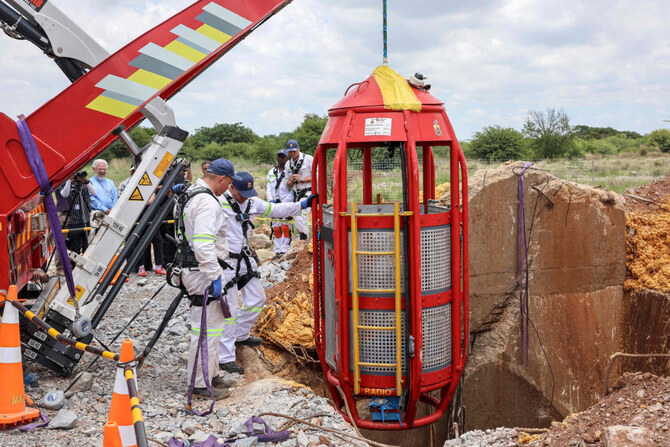
Police announced Wednesday that they were ending the operation after three days and believed no one else was underground. To be sure, a camera was sent down Thursday in a cage that was used to pull out survivors and bodies.
Two volunteer rescuers from the community had gone down in the small cage during the rescue operation to help miners as authorities refused to allow any official rescue personnel to go into the shaft because it was too dangerous.
“It has been a tough few days, there were many people who (we) saved but I still feel bad for those whose family members came out in body bags,” said Mandla Charles, one of the volunteer rescuers. “We did all we could.” The two volunteers were being offered trauma counselling, police said.
The mine is one of the deepest in South Africa and is a maze of tunnels and levels and has several shafts leading into it. The miners were working up to 2.5 kilometers (1.5 miles) underground in different groups.
Police have maintained that the miners were able to come out through several shafts but refused out of fear of being arrested. That’s been disputed by groups representing the miners, who say hundreds were trapped and left starving in dark and damp conditions with decomposing bodies around them.
Police Minister Senzo Mchunu denied in an interview with a national TV station that the police were responsible for any starvation and said they had allowed food to go down.
The initial police operation last year to force the miners to come out and give themselves up for arrest was part of a larger nationwide clampdown on illegal mining called Vala Umgodi, or Close the Hole. Illegal mining is often in the news in South Africa and a major problem for authorities as large groups go into mines that have been shut down to extract leftover deposits.

Mametlwe Sebei (C), president of the General Industries Workers Union of South Africa, joins community members and workers in a protest during the rescue operation to retrieve illegal miners from an abandoned gold mine in Stilfontein on January 14, 2025. (AFP)
Gold-rich South Africa has an estimated 6,000 abandoned or closed mines.
The illicit miners, known as “zama zamas” — “hustlers” or “chancers” in the Zulu language — are usually armed and part of criminal syndicates, the government says, and they rob South Africa of more than $1 billion a year in gold deposits. They are often undocumented foreign nationals and authorities said that the vast majority who came out of the Buffelsfontein mine were from Mozambique, Zimbabwe and Lesotho, and were in South Africa illegally.
Police said they seized gold, explosives, firearms and more than $2 million in cash from the miners and have defended their hard-line approach.
“By providing food, water and necessities to these illegal miners, it would be the police entertaining and allowing criminality to thrive,” Mathe said Wednesday.
But the South African Federation of Trade Unions questioned the government’s humanity and how it could “allow anyone — be they citizens or undocumented immigrants — to starve to death in the depths of the earth.”
While the police operation has been condemned by civic groups, the disaster hasn’t provoked a strong outpouring of anger across South Africa, where the mostly foreign zama zamas have long been considered unwelcome in a country that already struggles with high rates of violent crime.


