

Satellite photos show the Gaza Strip before and after the devastation of the Israel-Hamas war

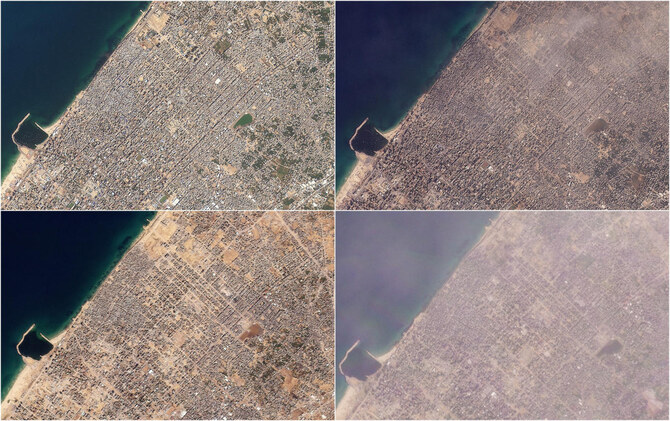
A combination of satellite images shows a general view of Rimal neighborhoods and the surrounding area of Gaza City, from Sept. 30, 2023 (top-left), to Nov. 3, 2023 (top-right), Oct. 8, 2024 (bottom-left), and Jan. 15, 2025 (bottom-right). (Reuters)
Short Url
Updated 17 January 2025
Follow

Satellite photos show the Gaza Strip before and after the devastation of the Israel-Hamas war

  • Some of the images have illustrated a likely buffer zone, wanted by Israel despite international objections
  • Other images tell the story of how Palestinians’ lives have changed during the war

DUBAI: The Israel-Hamas war, now nearing a potential ceasefire, has devastated the Gaza Strip. Satellite photos offer some sense of the destruction in the territory, which has been largely sealed off to journalists and others.
Some of the images have illustrated a likely buffer zone, wanted by Israel despite international objections, which would take some 60 square kilometers (23 square miles) out of the enclave. In all, the strip of land along the Mediterranean Sea is about 360 square kilometers (139 square miles), and Palestinians hope it will be part of a future state, along with the West Bank and east Jerusalem.

Other images tell the story of how Palestinians’ lives have changed during the war. Gaza City, the dense major city in the strip, has been decimated, with buildings destroyed and roads filled with rubble.
As the war progressed, Israel ordered people to move farther south. Today, the result of that movement can be seen in images of Muwasi, just north of the strip’s southern border with Egypt. There, the sandy coast and surrounding farmland have been overtaken by thousands of tents, all visible from space.
The images have also helped relief agencies and experts make estimates regarding the extent of the damage.
Corey Scher of City University of New York and Jamon Van Den Hoek of Oregon State University have been studying Gaza since the start of the war on Oct. 7, 2023, after Hamas entered Israel, killing 1,200 people and taking 250 others hostage. Their latest assessment, published Thursday, estimates 59.8 percent of all buildings in Gaza likely have been damaged in the war.
That’s slightly lower than a December analysis from the United Nations Satellite Center. It estimated 69 percent of all structures in Gaza have been damaged in the fighting, which has killed over 46,000 people, according to local health authorities. They do not distinguish between civilians and militants but say women and children make up more than half of those killed.


UN chief says those behind ‘unacceptable’ Homs attack must face justice

Updated 5 sec ago
Follow

UN chief says those behind ‘unacceptable’ Homs attack must face justice

  • France says the "terror" attack is designed to destabilize the country

UNITED NATIONS/PARIS: United Nations chief Antonio Guterres strongly condemned the deadly attack on Friday prayers at a mosque in the Syrian city of Homs, and said the perpetrators should be brought to justice.
“The Secretary-General reiterates that attacks against civilians and places of worship are unacceptable. He stresses that those responsible must be identified and brought to justice,” spokesman Stephane Dujarric said in a statement.
The explosion killed at least eight worshippers at a mosque in a predominantly Alawite area of Homs, with an Islamist militant group claiming responsibility.

France also condemned the attack, calling it an “act of terrorism” designed to destabilize the country.
The attack “is part of a deliberate strategy aimed at destabilizing Syria and the transition government,” the French foreign ministry said in a statement.
It condemned what it said was an attempt to “compromise ongoing efforts to bring peace and stability.”
The attack, during Friday prayers, was the second blast in a place of worship since Islamist authorities took power a year ago, after a suicide bombing in a Damascus church killed 25 people in June.
In a statement on Telegram, the extremist group Saraya Ansar Al-Sunna said its fighters “detonated a number of explosive devices” in the Imam Ali Bin Abi Talib Mosque in the central Syrian city.