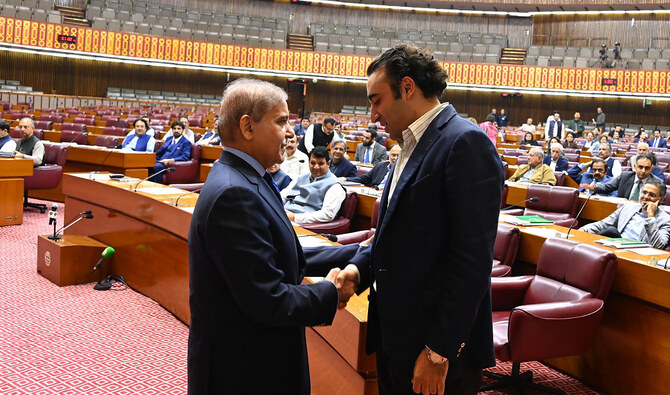
KARACHI: Pakistani political analysts on Thursday said that despite rifts between key ruling coalition members Pakistan Peoples Party (PPP) and the Pakistan Muslim League-Nawaz (PML-N) on policy issues and allocation of resources, there was no threat to Prime Minister Shehbaz Sharif’s government.
The PML-N and the PPP emerged as the two largest political parties in parliament after Pakistan’s contentious February 2024 election. The PPP helped Sharif get elected as Pakistan’s prime minister for a second time and settled for the presidency and the governorship in Punjab and Khyber Pakhtunkhwa (KP) provinces, areas where it performed poorly in the national polls.
The PPP, however, has recently voiced its displeasure with the Sharif-led government on various issues. The party has expressed reservations over government-proposed canals in the Indus River that it believes would reduce water supply to the southern Sindh province, where it remains in power. Sindh Chief Minister Murad Ali Shah this week penned a letter to Sharif, protesting against the National Highway Authority’s (NHA) allocation of inadequate funds for Sindh.
However, political analysts brushed aside concerns the PPP would play a part in toppling the federal government.
“As for leaving the government, that question does not arise as everything happening in the country right now is part of a political arrangement, and this arrangement is intended to move forward,” Salman Ghani, a Lahore-based political analyst, told Arab News.
Ghani said that the PPP initially believed that the PML-N would struggle to manage the country’s economic crisis. However, he said the situation had reversed with visible signs of economic recovery. The PPP’s complaints stem from fears that continued gains by the PML-N could leave the party with no future prospects, he said.
“PPP’s reservations seem more related to political survival than a genuine desire to leave the coalition,” Ghani noted. “In fact, whenever PPP raises issues within the high-level government committees, their demands are met.”
Mazhar Abbas, a Karachi-based political analyst, agreed with Ghani. He said that while differences persist, they are unlikely to cause the coalition to collapse, unless Pakistan’s powerful military decided that the PPP should part ways with the government.
“The PPP will not leave unless the [military] establishment decides that it’s the time for the current regime to go,” he said.
Pakistan’s military, which has directly ruled the country for over 30 years and is believed to wield massive influence indirectly, strongly denies allegations it interferes in political matters.
‘EVERYONE WILL LOSE’
Nadir Nabeel Gabol, a Sindh government spokesperson, warned PPP had the power to oust the federal government if its grievances, especially those related to allocation of resources, were not addressed.
“If this attitude persists, I do not see this federal government surviving much longer,” Gabol told Arab News, noting that PPP had helped topple former prime minister Imran Khan’s coalition government in 2022.
He said the PPP would “consider all options” if the federal government keeps sidelining it.
Senator Dr. Afnan Ullah Khan of the PML-N said the federal government was committed to addressing the PPP’s concerns. He acknowledged that if the PPP withdrew its support, the coalition government would collapse.
“We do not have the numbers without them,” he admitted.
He said tensions between the two allies would not escalate to that point, given the recent economic gains by the coalition government.
“If we maintain stability and the IMF program continues smoothly, the economy can stay on track,” he said. “But if instability sets in, everyone will lose.”
Gabol also expressed hope that the rift would be resolved.
“The Pakistan People’s Party hopes it does not come to that,” he said, referring to the party’s possible withdrawal of support in parliament. “The Sindh government hopes that its grievances will be addressed and that democracy will take its course, as it always does.”


![]()

Analysts say no threat to Pakistan ruling coalition despite rifts between key members PPP, PML-N
Short Url
https://arab.news/by733
Analysts say no threat to Pakistan ruling coalition despite rifts between key members PPP, PML-N
- PPP has reservations over government-proposed canals in Indus River, alleged lack of funds for Sindh
- Ruling party senator admits PPP’s withdrawal of support would trigger coalition government’s collapse
Latest updates


Recommended


© 2026 SAUDI RESEARCH & PUBLISHING COMPANY, All Rights Reserved And subject to Terms of Use Agreement.