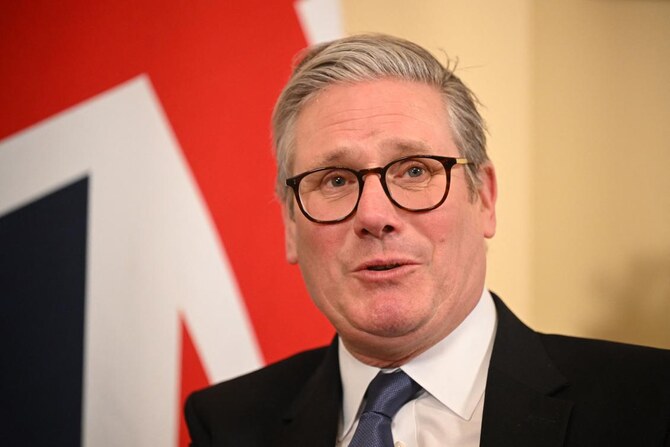
KYIV: British Prime Minister Keir Starmer arrived in Ukraine Thursday with a pledge to help guarantee the country’s security for a century, days before Donald Trump is sworn in as US president.
The British government says Starmer and Ukrainian President Volodymyr Zelensky will sign a “100-Year Partnership” treaty in Kyiv, covering areas including defense, science, energy and trade.
Starmer’s unannounced visit is his first trip to Ukraine since he took office in July. He visited the country in 2023 when he was opposition leader, and has twice held talks with Zelensky in 10 Downing St. since becoming prime minister.
One of Ukraine’s biggest military backers, the UK has pledged 12.8 billion pounds ($16 billion) in military and civilian aid to Ukraine since Russia’s full-scale invasion three years ago, and has trained more than 50,000 Ukrainian troops on British soil. Starmer is due to announce another 40 million pounds ($49 million) for Ukraine’s post-war economic recovery.
But the UK’s role is dwarfed by that of the United States, and there is deep uncertainty over the fate of American support for Ukraine once Trump takes office on Jan. 20. The president-elect has balked at the cost of US aid to Kyiv, says he wants to bring the war to a swift end and is planning to meet Russian President Vladimir Putin, for whom he has long expressed admiration.
Kyiv’s allies have rushed to flood Ukraine with as much support as possible before Trump’s inauguration, with the aim of putting Ukraine in the strongest position possible for any future negotiations to end the war.
Zelensky has said that in any peace negotiation, Ukraine would need assurances about its future protection from its much bigger neighbor.
Britain says its 100-year pledge is part of that assurance, and will help ensure Ukraine is “never again vulnerable to the kind of brutality inflicted on it by Russia,” which seized Crimea from Ukraine in 2014 and attempted a full-scale invasion in February 2022.
The deal commits the two sides to cooperate on defense — especially maritime security against Russian activity in the Batlic Sea, Black Sea and Sea of Azov — and on technology projects including drones, which have become vital weapons for both sides in the war. The treaty also includes a system to help track stolen Ukrainian grain exported by Russia from occupied parts of the country.
“Putin’s ambition to wrench Ukraine away from its closest partners has been a monumental strategic failure. Instead, we are closer than ever, and this partnership will take that friendship to the next level,” Starmer said ahead of the visit.
“This is not just about the here and now, it is also about an investment in our two countries for the next century, bringing together technology development, scientific advances and cultural exchanges, and harnessing the phenomenal innovation shown by Ukraine in recent years for generations to come.”
Zelensky says he and Starmer also will discuss a plan proposed by French President Emmanuel Macron that would see troops from France and other Western countries stationed in Ukraine to oversee a ceasefire agreement.
Zelensky has said any such proposal should go alongside a timeline for Ukraine to join NATO. The alliance’s 32 member countries say that Ukraine will join one day, but not until after the war. Trump has appeared to sympathize with Putin’s position that Ukraine should not be part of NATO.
As the grinding war nears the three-year mark, both Russia and Ukraine are pushing for battlefield gains ahead of possible peace talks. Ukraine has started a second offensive in Russia’s Kursk region, where it is struggling to hang onto a chunk of territory it captured last year, and has stepped up drone and missile attacks on weapons sites and fuel depots inside Russia.
Moscow is slowly taking territory at the cost of high casualties, along the 600-mile (1,000-kilometer) front line in eastern Ukraine and launching intense barrages at Ukraine’s energy system, seeking to deprive Ukrainians of heat and light in the depths of winter. A major Russian ballistic and cruise missile attack on regions across Ukraine on Wednesday, and compelling authorities to shut down the power grid in some areas.


![]()

UK’s Starmer arrives in Ukraine for security talks with Zelensky days before Trump is sworn in
Short Url
https://arab.news/gqdxc
UK’s Starmer arrives in Ukraine for security talks with Zelensky days before Trump is sworn in
- The British government says Starmer and Ukrainian President Volodymyr Zelensky will sign a “100-Year Partnership” treaty in Kyiv
Latest updates


© 2026 SAUDI RESEARCH & PUBLISHING COMPANY, All Rights Reserved And subject to Terms of Use Agreement.