

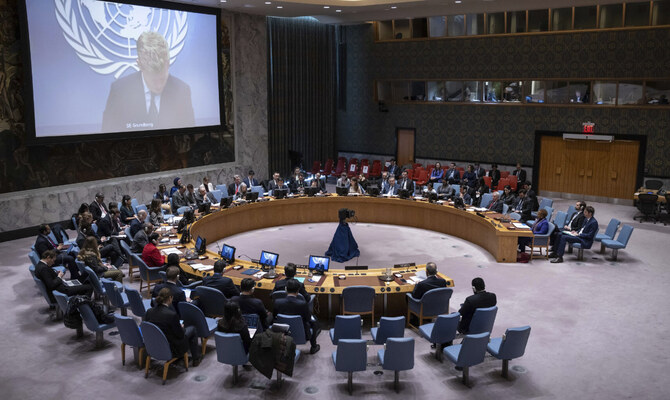

NEW YORK CITY: The UN Security Council on Wednesday adopted a resolution that extends by six months the requirement for the secretary-general to provide monthly reports on attacks by the Houthis in Yemen against ships in the Red Sea.
The reporting obligation was established by the adoption of Resolution 2722 in January 2024, which was introduced in response to the repeated attacks on commercial shipping. The Iran-backed Houthis vowed to continue targeting vessels until Israel ended its war in Gaza.
The attacks prompted retaliatory strikes on Houthi targets in Yemen by the US, UK and Israel. Meanwhile, the EU launched Operation Aspides, a defensive mission based in Greece that aims to safeguard and escort vessels in the Red Sea but does not participate in any offensive action.
The text of the extension resolution was drafted by Greece and the US, the co-penholders on the issue of the Red Sea crisis. Twelve members of the Security Council voted in favor, while Algeria, China and Russia abstained.
A source at the Russian mission in New York told Arab News that although the safety of maritime navigation is of the utmost importance to Moscow, it considered the language of Resolution 2763 to be “highly politicized and unbalanced” because it failed to mention “the attacks on the sovereignty of Yemen” in the form of airstrikes by the US, UK and Israel.
The text of the resolution, which was seen by Arab News, demands that the Houthis immediately cease all attacks against merchant and commercial vessels and release the cargo ship Galaxy Leader and its crew. The Houthis hijacked the vessel in November 2023 and 25 crew members remain detained by the group.
The new resolution also emphasizes the need “to address the root causes of these attacks, including the conflicts contributing to regional tensions and the disruption of maritime security.”
It notes the use of advanced weaponry by the Houthis and demands that UN member states stop supplying the group with arms.
Greece’s permanent representative to the UN, Evangelos Sekeris, told fellow council members that the “Houthis’ constant attacks against vessels are still disrupting international commercial shipping. Maritime security conditions remain degraded and are expected to further deteriorate, while rerouting of shipping companies continues in favor of safer but costlier alternative maritime routes.”
Sekeris lamented that fact that “we are still witnessing the Houthis’ ongoing aggressiveness and escalatory actions through launching unjustified attacks, with the systematic use of advanced weaponry such as anti-ballistic missiles and drones, even against civil infrastructure, including oil terminals under the control of the government of Yemen.”
He added: “The humanitarian repercussions are severe. We need to put an end to this, by looking thoroughly into the origins of the use of advanced weaponry and by preserving the applicability of the targeted arms embargo.”
This year, Greece, which has a keen interest in maritime security, took over from Japan as the co-penholder on the issue of the Red Sea crisis.
Maritime security is also a key concern for Denmark, Pakistan, Panama and Somalia, who took their seats as newly elected nonpermanent members of the Security Council at the start of this year.
Ships owned or operated by companies from Denmark, Greece and Panama have been targeted by the Houthis in the Red Sea, while Pakistan has participated in maritime-security operations in the Western Indian Ocean. Somalia has been dealing with piracy off its coast for several years.


