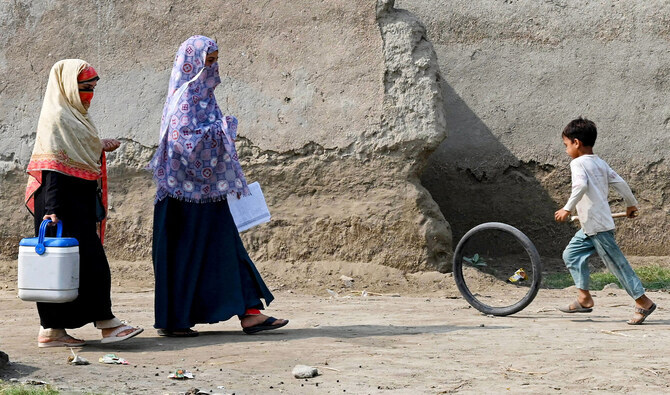
KARACHI: Pakistan’s polio program on Wednesday confirmed another poliovirus infection from last year, taking the tally of total cases reported in 2024 to 72 amid Islamabad’s attempts to stem the spread of the disease.
Polio is a paralyzing disease that has no cure. Multiple doses of the oral polio vaccine and completion of the routine vaccination schedule for all children under the age of five is essential to provide children high immunity against this terrible disease.
The Regional Reference Laboratory for Polio Eradication at the National Institute of Health confirmed the 72nd case in a female child from the northwestern Dera Ismail Khan district.
“The onset of this case was on December 31, 2024,” the program said in a statement. “D.I. Khan has now reported 11 polio cases in 2024.”
Giving a breakdown of the cases reported in 2024, the program said 27 cases were reported from Balochistan, 22 from Khyber Pakhtunkhwa, 21 from Sindh, and one each from Punjab and Islamabad.
Pakistan, along with neighboring Afghanistan, remains the last polio-endemic country in the world. In the early 1990s, Pakistan reported around 20,000 cases annually but in 2018 the number dropped to eight cases. Six cases were reported in 2023 and only one in 2021.
Pakistan’s polio eradication efforts have met several challenges in recent years, including attacks by militants and misinformation by religious hard-liners.
The Pakistan polio program is scheduled to hold the country’s first nationwide vaccination drive of this year from Feb. 3 till Feb. 9.
“It is crucial for parents to ensure vaccination for all their children under the age of five to keep them protected,” it said.


Pakistan polio program says 72 cases reported in 2024
https://arab.news/8638a
Pakistan polio program says 72 cases reported in 2024

- Seventy-second polio case reported in female child from northwestern Dera Ismail Khan district
- Pakistan polio program is scheduled to hold first nationwide vaccination drive of 2025 from Feb. 3

Pakistan industry warns Iran conflict could worsen balance of payments amid trade disruption
- Textile sector expects 10-20 percent drop in March exports if shipping disruptions persist
- Refiner says about 80 percent of Pakistan’s crude imports transit through Strait of Hormuz
KARACHI: Pakistan’s industry leaders warn the escalating conflict between the United States, Israel and Iran could disrupt trade routes, drive up energy costs and worsen the balance of payments after Tehran reportedly blocked the Strait of Hormuz, a strategic sea lane through which much of Pakistan’s oil shipments transit.
Business groups say prolonged disruption to shipping lanes could slow exports and push up freight and fuel costs for the debt-ridden South Asian nation, which relies heavily on imported energy and is trying to stabilize its economy under a $7 billion International Monetary Fund (IMF) program.
“Obviously, Pakistan would face problems like its balance of payment position which is already in a bad shape and may still worsen,” Karachi Chamber of Commerce and Industry (KCCI) President Rehan Hanif told Arab News.
“Pakistan’s daily exports average as much as $85 million. So, if we don’t work for 10 days, we will lose around $1 billion,” he continued while responding to a question about possible disruption to shipments.
The conflict in the Middle East has already rattled global shipping lanes and raised fears of rising energy prices, threatening fragile economies like Pakistan that depend heavily on seaborne trade and imported fuel. An International Monetary Fund (IMF) mission shortened its visit to Pakistan due to escalating tensions in the region and will now continue review talks from Türkiye “virtually.”
Pakistan’s largest oil refiner, Cnergyico Pk Limited, says about 80 percent of the country’s crude oil imports and nearly 25 percent of its gasoil supplies typically transit through the Strait of Hormuz, a critical maritime chokepoint for global energy shipments.
Hanif said crude prices could surge beyond $100 per barrel if the sea route remains blocked for an extended period.
However, Pakistan’s finance adviser Khurram Schehzad said the country’s petroleum stocks remained at comfortable levels but warned prolonged disruption in regional shipping lanes could still affect the economy.
“Our petroleum stocks are at comfortable levels and there is no immediate supply stress,” Schehzad told Arab News. “However, if the situation persists, it may have implications for Pakistan’s energy supply chain and external account.”
Speaking to Arab News, All Pakistan Textile Mills Association (APTMA) Chairman Kamran Arshad said trade data may soon reflect the strain.
“We can see a 10-20 percent drop in March exports from Pakistan and a 10 percent increase in imports due to rising crude oil prices and other materials as such,” he said.
“The textile exports can suffer as freight costs go, he continued, adding that a decline in exports and rise in imports could lead to an even higher than projected trade deficit.
According to official data, Pakistan’s trade deficit widened 25 percent to $25 billion in July–February FY26, with exports declining 7.3 percent to $20.5 billion and imports rising 8.1 percent to $45.5 billion.
“The government’s eight-month trade data show that Pakistan’s exports might not touch $30 billion and the imports will record an all-time high of $68 billion,” Arshad said.
Khurram Mukhtar, patron-in-chief of the Pakistan Textile Exports Association (PTEA), said Pakistan’s main maritime export routes to Europe and the United States remained operational despite disruptions elsewhere.
“Textile exports to core markets are continuing, though some regional exports to the Middle East have faced temporary suspension due to operational issues, including KGTL [Karachi Gateway Terminal Limited],” he said.
AD Ports Group operates KGTL in Karachi, which has suspended export operations for the Gulf region.
“The bigger concern is oil. If tensions persist and oil prices rise sharply, there will be pressure on the import bill and inflation,” Mukhtar said.
Refiner Cnergyico said it had adjusted its sourcing strategy in advance to reduce reliance on the Hormuz route.
“Any prolonged disruption there would have significant implications for the country’s energy supply chain, including higher freight costs and insurance premiums, and could create supply bottlenecks in the domestic market,” the company’s vice chairman Usama Qureshi said.
He added the organization’s immediate crude supply remained secured until May 2026.
“If crude prices sustain levels above $80 per barrel, Pakistan could face renewed pressure on its foreign exchange reserves,” he warned, referring to the roughly $16 billion in reserves held as of Feb. 20.
Shankar Talreja, head of research at Topline Securities Ltd., said the scale of the economic impact remained uncertain.
“The quantum at this point is difficult to ascertain amid evolving conditions in the region,” he said. “A longer conflict could also impact balance of payment as remittances would also get hit.”
Zayan Babar Khan, an investment analyst at Arif Habib Limited, said exporters could face rising freight rates and delays even if shipping routes remain open.
“The European and American buyers may slow orders if global recession fears rise,” he said.
Khan added Pakistan does not currently rely on LNG spot purchases but said “for the fixed contracts, the LNG rates will increase but with a lag,” and cargo disruptions could still affect electricity generation and worsen the country’s circular debt.


